Department of Biology, Stanford University, Stanford, CA 94305, USA.
Department of Neurology and Neurological Sciences, Stanford University School of Medicine, Stanford, CA 94304, USA.
BMB Rep. 2020 Aug;53(8):393-399. doi: 10.5483/BMBRep.2020.53.8.130.
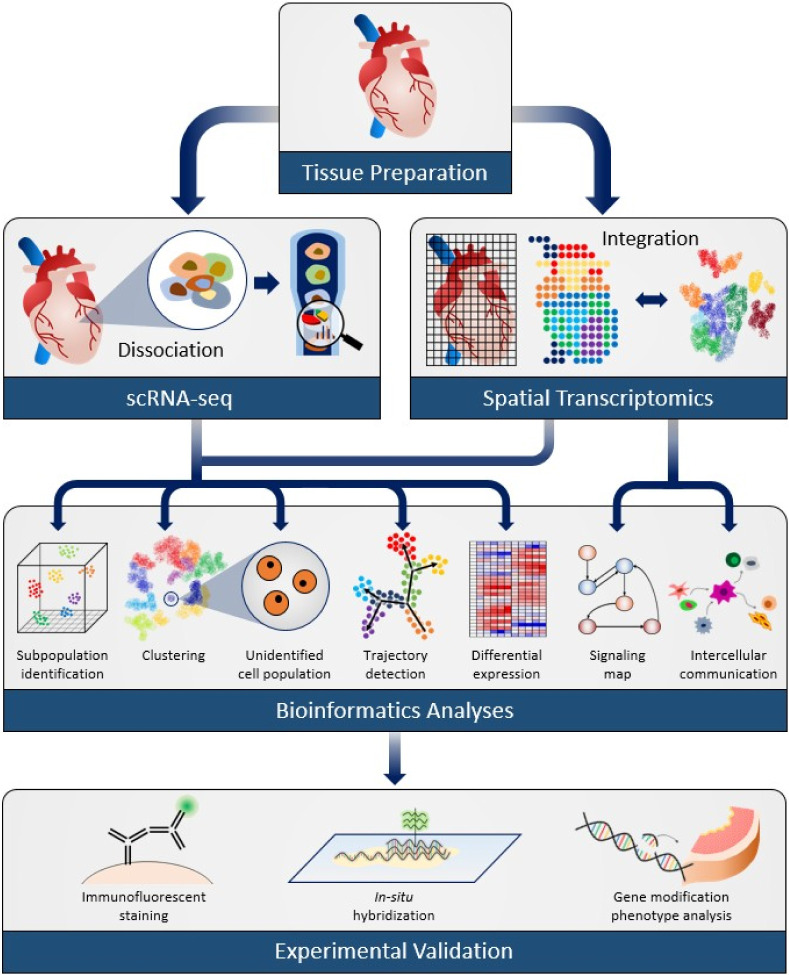
Recent advancements in the resolution and throughput of single-cell analyses, including single-cell RNA sequencing (scRNA-seq), have achieved significant progress in biomedical research in the last decade. These techniques have been used to understand cellular heterogeneity by identifying many rare and novel cell types and characterizing subpopulations of cells that make up organs and tissues. Analysis across various datasets can elucidate temporal patterning in gene expression and developmental cues and is also employed to examine the response of cells to acute injury, damage, or disruption. Specifically, scRNA-seq and spatially resolved transcriptomics have been used to describe the identity of novel or rare cell subpopulations and transcriptional variations that are related to normal and pathological conditions in mammalian models and human tissues. These applications have critically contributed to advance basic cardiovascular research in the past decade by identifying novel cell types implicated in development and disease. In this review, we describe current scRNA-seq technologies and how current scRNA-seq and spatial transcriptomic (ST) techniques have advanced our understanding of cardiovascular development and disease. [BMB Reports 2020; 53(8): 393-399].
近年来,单细胞分析的分辨率和通量取得了重大进展,包括单细胞 RNA 测序 (scRNA-seq),这在过去十年的生物医学研究中取得了重大进展。这些技术已被用于通过鉴定许多罕见和新颖的细胞类型以及表征构成器官和组织的细胞亚群来理解细胞异质性。对各种数据集的分析可以阐明基因表达和发育线索的时间模式,也被用于研究细胞对急性损伤、损伤或破坏的反应。具体来说,scRNA-seq 和空间解析转录组学已被用于描述与哺乳动物模型和人类组织中的正常和病理状况相关的新型或罕见细胞亚群和转录变化的特征。这些应用通过鉴定在发育和疾病中起作用的新型细胞类型,极大地推动了过去十年的基础心血管研究。在这篇综述中,我们描述了当前的 scRNA-seq 技术,以及当前的 scRNA-seq 和空间转录组学 (ST) 技术如何增进我们对心血管发育和疾病的理解。[BMB 报告 2020;53(8):393-399]。