International Institute of Molecular and Cell Biology in Warsaw, Trojdena 4, 02-109 Warsaw Poland.
Postgraduate School of Molecular Medicine, Warsaw Medical University, 61 Żwirki i Wigury St., 02-091 Warsaw, Poland.
Cells. 2020 Jul 22;9(8):1751. doi: 10.3390/cells9081751.
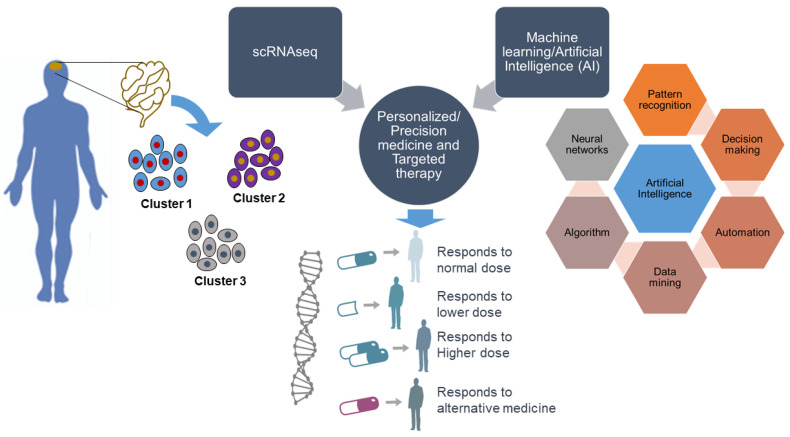
The present review discusses recent progress in single-cell RNA sequencing (scRNA-seq), which can describe cellular heterogeneity in various organs, bodily fluids, and pathologies (e.g., cancer and Alzheimer's disease). We outline scRNA-seq techniques that are suitable for investigating cellular heterogeneity that is present in cell populations with very high resolution of the transcriptomic landscape. We summarize scRNA-seq findings and applications of this technology to identify cell types, activity, and other features that are important for the function of different bodily organs. We discuss future directions for scRNA-seq techniques that can link gene expression, protein expression, cellular function, and their roles in pathology. We speculate on how the field could develop beyond its present limitations (e.g., performing scRNA-seq in situ and in vivo). Finally, we discuss the integration of machine learning and artificial intelligence with cutting-edge scRNA-seq technology, which could provide a strong basis for designing precision medicine and targeted therapy in the future.
本综述讨论了单细胞 RNA 测序(scRNA-seq)的最新进展,该技术可描述各种器官、体液和病变(例如癌症和阿尔茨海默病)中的细胞异质性。我们概述了适用于以非常高的转录组景观分辨率研究细胞群体中存在的细胞异质性的 scRNA-seq 技术。我们总结了 scRNA-seq 的发现和该技术在鉴定细胞类型、活性和其他对不同身体器官功能重要的特征方面的应用。我们讨论了 scRNA-seq 技术的未来发展方向,该技术可以将基因表达、蛋白质表达、细胞功能及其在病理学中的作用联系起来。我们推测该领域将如何超越其当前的局限性(例如,在原位和体内进行 scRNA-seq)。最后,我们讨论了机器学习和人工智能与前沿 scRNA-seq 技术的集成,这可为未来设计精准医学和靶向治疗提供坚实的基础。