Health Services Research Unit, Health Sciences Building, University of Aberdeen, Aberdeen, Scotland, AB25 2ZD, UK.
Institute for Evidence-Based Healthcare, Faculty of Health Sciences and Medicine, Bond University, Gold Coast, Queensland, Australia.
F1000Res. 2020 Feb 5;9:86. doi: 10.12688/f1000research.22182.1. eCollection 2020.
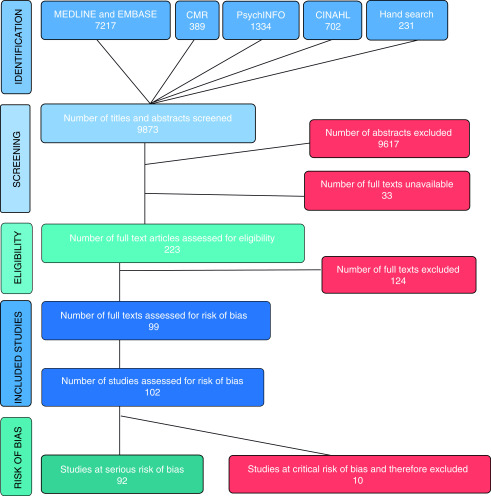
: Recruitment to trials can be challenging. Currently, non-randomised evaluations of trial recruitment interventions are rejected due to poor methodological quality, but systematic assessment of this substantial body of work may inform trialists' decision-making about recruitment methods. Our objective was to quantify the effects of strategies to improve participant recruitment to randomised trials evaluated using non-randomised study designs. : We searched relevant databases for non-randomised studies that included two or more interventions evaluating recruitment to trials. Two reviewers screened abstracts and full texts for eligible studies, then extracted data on: recruitment intervention, setting, participant characteristics, number of participants in intervention and comparator groups. The ROBINS-I tool was used to assess risk of bias. The primary outcome was the number of recruits to a trial. : We identified 92 studies for inclusion; 90 studies aimed to improve the recruitment of participants, one aimed to improve the recruitment of GP practices, and one aimed to improve recruitment of GPs. Of the 92 included studies, 20 were at high risk of bias due to confounding; the remaining 72 were at high risk of bias due to confounding and at least one other category of the ROBINS-I tool. The 20 studies at least risk of bias were synthesised narratively based on seven broad categories; Face to face recruitment initiatives, postal invitations and responses, language adaptations, randomisation methods, trial awareness strategies aimed at the recruitee, trial awareness strategies aimed at the recruiter, and use of networks and databases. The utility of included studies is substantially limited due to small sample sizes, inadequate reporting, and a lack of coordination around deciding what to evaluate and how. : Careful thought around planning, conduct, and reporting of non-randomised evaluations of recruitment interventions is required to prevent future non-randomised studies contributing to research waste. : PROSPERO CRD42016037718.
招募参与者到临床试验中可能具有挑战性。目前,由于方法学质量较差,非随机评估试验招募干预措施的研究被拒绝,但对这大量工作的系统评估可能会为试验人员关于招募方法的决策提供信息。我们的目标是量化使用非随机研究设计评估的提高随机试验参与者招募的策略的效果。
我们在相关数据库中搜索了包含两项或多项评估试验招募干预措施的非随机研究。两名审查员筛选了摘要和全文以确定符合条件的研究,然后提取了关于以下内容的数据:招募干预措施、设置、参与者特征、干预组和对照组的参与者人数。使用 ROBINS-I 工具评估偏倚风险。主要结果是试验的招募人数。
我们确定了 92 项符合条件的研究;90 项研究旨在提高参与者的招募率,一项旨在提高全科医生实践的招募率,一项旨在提高全科医生的招募率。在纳入的 92 项研究中,由于混杂因素,有 20 项研究存在高偏倚风险;其余 72 项研究由于混杂因素以及 ROBINS-I 工具的至少一个其他类别而存在高偏倚风险。基于七个广泛的类别,对至少存在低偏倚风险的 20 项研究进行了叙述性综合;面对面的招募举措、邮寄邀请和回复、语言适应、随机化方法、针对招募对象的试验意识策略、针对招募者的试验意识策略以及使用网络和数据库。由于样本量小、报告不充分以及在决定评估什么和如何评估方面缺乏协调,纳入研究的实用性受到了极大限制。
为了防止未来的非随机研究造成研究浪费,需要仔细考虑招募干预措施的非随机评估的规划、进行和报告。
PROSPERO CRD42016037718。