Institut Pasteur de Nouvelle-Calédonie, URE-Entomologie Médicale, Nouméa, 98845, New Caledonia.
Institut Pasteur de Nouvelle-Calédonie, Groupe de Recherche en Bactériologie Expérimentale, Nouméa, 98845, New Caledonia.
Parasit Vectors. 2020 Jul 20;13(1):359. doi: 10.1186/s13071-020-04234-8.
Mosquito vectors cause a significant human public health burden through the transmission of pathogens. Due to the expansion of international travel and trade, the dispersal of these mosquito vectors and the pathogens they carry is on the rise. Entomological surveillance is therefore required which relies on accurate mosquito species identification. This study aimed to optimize the use of matrix-assisted laser desorption/ionization time-of-flight mass spectrometry (MALDI-TOF MS) for mosquito identification.
Aedes aegypti of the Bora-Bora strain and 11 field-sampled mosquito species were used in this study. Analyses were performed to study the impact of the trapping duration on mosquito identification with MALDI-TOF MS. The best preservation methods to use for short, medium and long-term preservation before MALDI-TOF MS analysis were also assessed. In addition, the number of specimens per species required for MALDI-TOF MS database creation was determined. The first MALDI-TOF database of New Caledonian mosquitoes was assembled and the optimal threshold for mosquito species identification according to the sensitivity and specificity of this technique was determined.
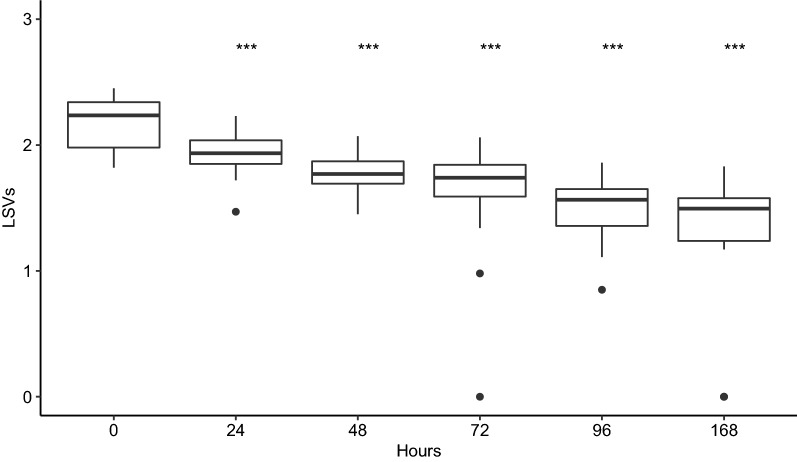
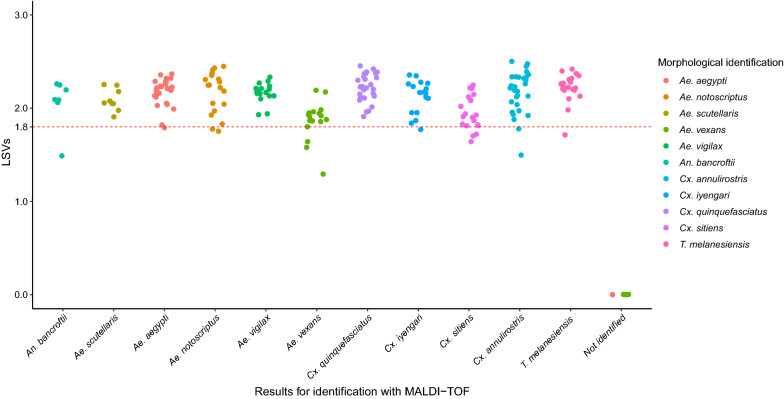
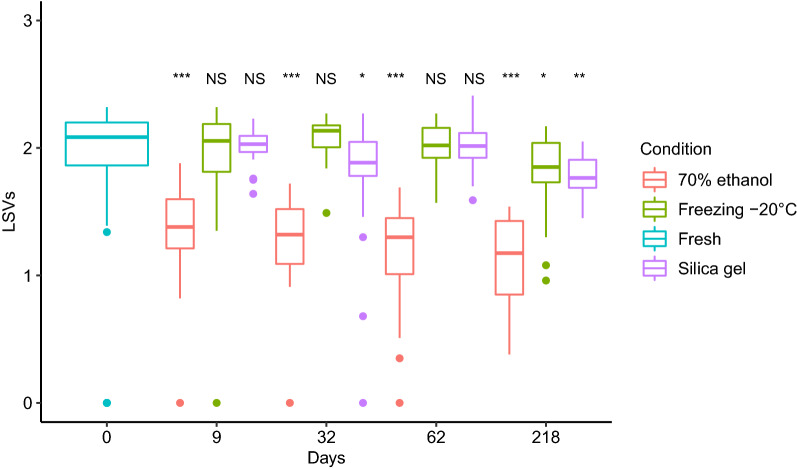
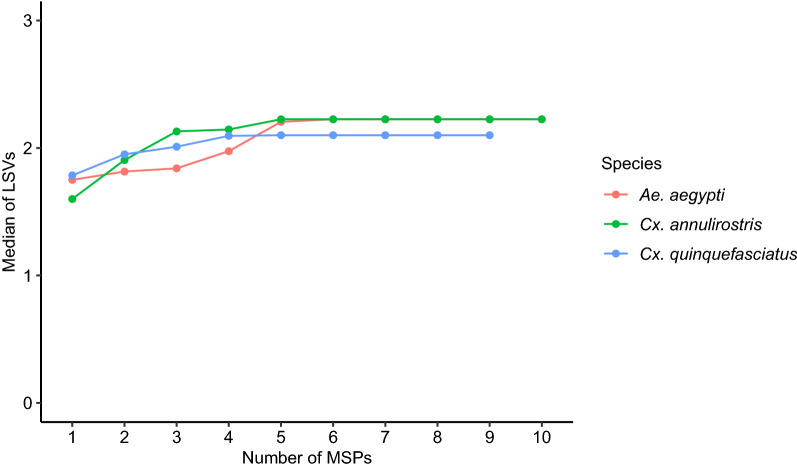
This study showed that the identification scores decreased as the trapping duration increased. High identification scores were obtained for mosquitoes preserved on silica gel and cotton at room temperature and those frozen at - 20 °C, even after two months of preservation. In addition, the results showed that the scores increased according to the number of main spectrum patterns (MSPs) used until they reached a plateau at 5 MSPs for Ae. aegypti. Mosquitoes (n = 67) belonging to 11 species were used to create the MALDI-TOF reference database. During blind test analysis, 96% of mosquitoes tested (n = 224) were correctly identified. Finally, based on MALDI-TOF MS sensitivity and specificity, the threshold value of 1.8 was retained for a secure identification score.
MALDI-TOF MS allows accurate species identification with high sensitivity and specificity and is a promising tool in public health for mosquito vector surveillance.
蚊子作为病媒通过传播病原体给人类公共健康带来了重大负担。由于国际旅行和贸易的扩大,这些蚊子媒介及其携带的病原体的传播呈上升趋势。因此,需要进行昆虫学监测,这依赖于对蚊子种类的准确鉴定。本研究旨在优化基质辅助激光解吸/电离飞行时间质谱(MALDI-TOF MS)在蚊子鉴定中的应用。
本研究使用了博拉博拉株系的埃及伊蚊和 11 种野外采集的蚊子物种。分析了 MALDI-TOF MS 检测中捕蚊时间对蚊子鉴定的影响。还评估了在 MALDI-TOF MS 分析之前进行短期、中期和长期保存的最佳保存方法。此外,还确定了用于创建 MALDI-TOF MS 数据库的每个物种所需的标本数量。组装了新喀里多尼亚蚊子的第一个 MALDI-TOF 数据库,并根据该技术的灵敏度和特异性确定了蚊子种鉴定的最佳阈值。
本研究表明,鉴定评分随捕蚊时间的延长而降低。在室温下用硅胶和棉花保存以及在-20°C 下冷冻保存的蚊子获得了较高的鉴定评分,即使在保存两个月后也是如此。此外,结果表明,评分随着使用的主要图谱模式(MSP)数量的增加而增加,直到达到 Ae. aegypti 的 5 MSP 时达到平台期。使用 11 个物种的 67 只蚊子创建了 MALDI-TOF 参考数据库。在盲测分析中,96%的测试蚊子(n=224)得到正确鉴定。最后,基于 MALDI-TOF MS 的灵敏度和特异性,保留 1.8 的阈值用于确保可靠的鉴定评分。
MALDI-TOF MS 允许进行准确的物种鉴定,具有较高的灵敏度和特异性,是公共卫生中监测蚊子媒介的一种有前途的工具。