Department of Public Health, Erasmus University Medical Center, Rotterdam, The Netherlands.
Department of Work Health Technology, Netherlands Organisation for Applied Scientific Research TNO, Leiden, The Netherlands.
Obes Rev. 2020 Nov;21(11):e13101. doi: 10.1111/obr.13101. Epub 2020 Jul 21.
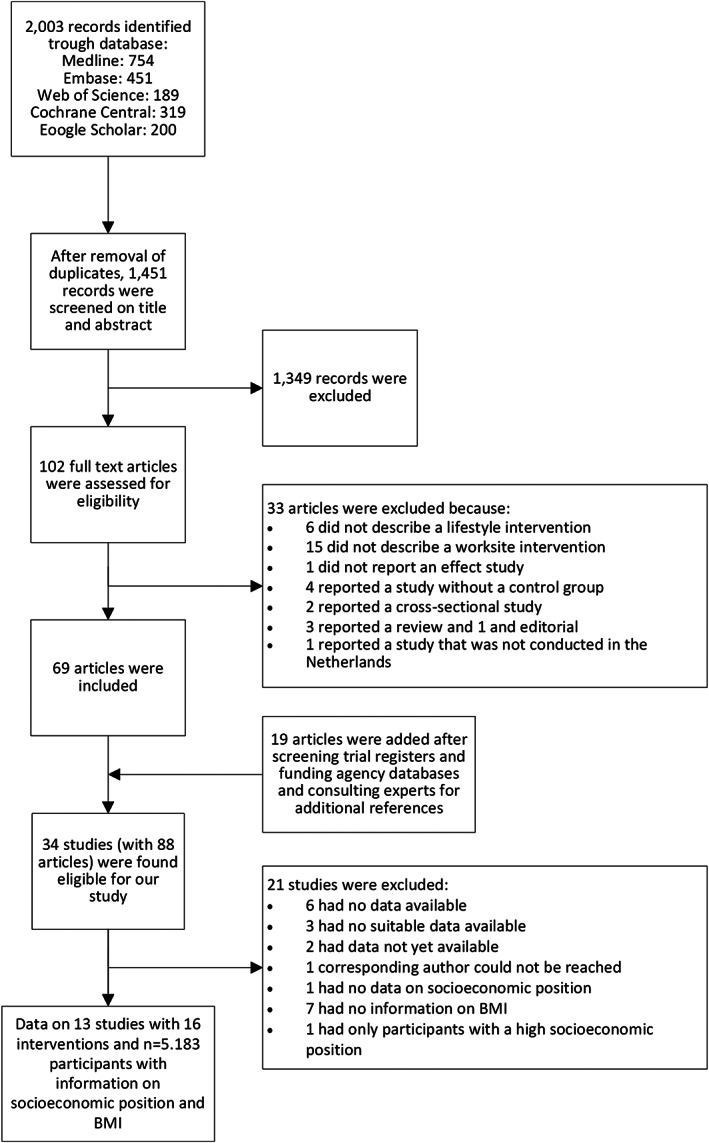
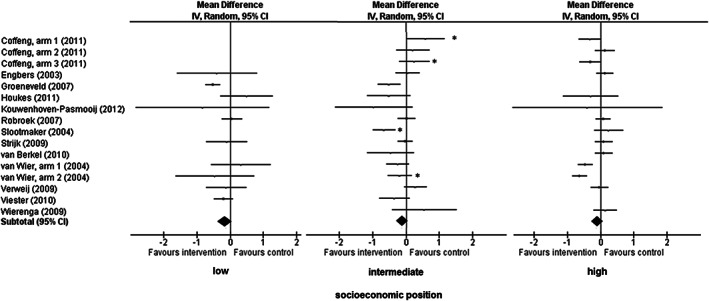
This individual participant data meta-analysis assessed the effectiveness of workplace health promotion programmes on body mass index (BMI) across socio-economic groups and whether study and intervention characteristics explained inequalities in effectiveness. Studies were eligible if they assessed the effect of a workplace health promotion programme on BMI in the Netherlands, included workers of at least two different socio-economic positions (SEPs) and had a study design with premeasurement and postmeasurement and control condition. Data of 13 studies presenting 16 interventions (5183 participants) were harmonized. In a two-stage meta-analysis, the interaction between intervention and SEP on BMI was tested with linear mixed models for each study. Subsequently, the interaction terms were pooled. The influence of study and intervention characteristics on the effectiveness of workplace health promotion programmes was evaluated using meta-regression analyses. Compared with control conditions, workplace health promotion programmes overall showed a statistically non-significant 0.12 kg/m (95% CI: -0.01, 0.25) decrease in BMI, which did not differ across SEP. Interventions evaluated within randomized controlled trials, agentic interventions, those that focused on high-risk groups, included a counselling component, consisted of more than five sessions, or were offered at the individual level did statistically significantly reduce BMI. No evidence was found for intervention-generated SEP inequalities.
这项个体参与者数据荟萃分析评估了工作场所健康促进计划在社会经济群体中的体重指数(BMI)效果,以及研究和干预特征是否解释了效果的不平等。如果研究评估了荷兰工作场所健康促进计划对 BMI 的影响,纳入了至少两个不同社会经济地位(SEP)的工人,并且具有预测量和后测量以及对照条件的研究设计,则研究符合条件。协调了 13 项研究的 16 项干预措施的数据(5183 名参与者)。在两阶段荟萃分析中,使用线性混合模型针对每项研究测试了干预和 SEP 对 BMI 的交互作用。随后,汇总了交互项。使用元回归分析评估了研究和干预特征对工作场所健康促进计划效果的影响。与对照条件相比,工作场所健康促进计划总体上显示 BMI 有统计学上无显著意义的 0.12kg/m(95%CI:-0.01,0.25)下降,这在 SEP 方面没有差异。在随机对照试验中评估的干预措施、代理干预措施、针对高风险群体的干预措施、包括咨询组成部分、包含五个以上疗程或在个体层面提供的干预措施,在统计学上显著降低了 BMI。没有证据表明干预措施产生的 SEP 不平等。