Kim Jooyoung
Phys Act Nutr. 2020 Jun 30;24(2):6-10. doi: 10.20463/pan.2020.0009.
Milk is a commonly ingested post-exercise recovery protein source. Casein protein, found in milk, is characterized by its slow digestion and absorption. Recently, several studies have been conducted with a focus on how pre-sleep casein protein intake could affect post-exercise recovery but our knowledge of the subject remains limited. This review aimed at presenting and discussing how pre-sleep casein protein ingestion affects post-exercise recovery and the details of its potential effector mechanisms.
We systematically reviewed the topics of 1) casein nutritional characteristics, 2) pre-sleep casein protein effects on post-exercise recovery, and 3) potential effector mechanisms of pre-sleep casein protein on post-exercise recovery, based on the currently available published studies on pre-sleep casein protein ingestion.
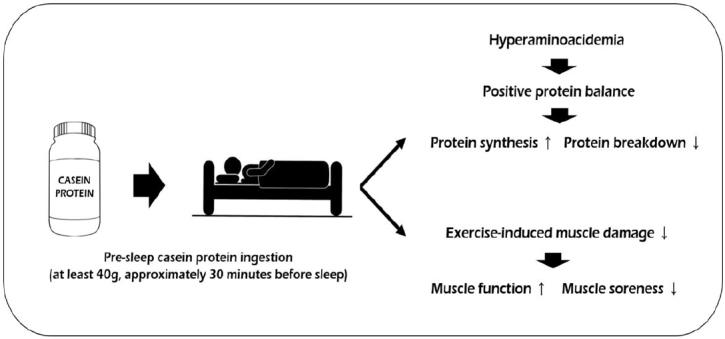
Studies have shown that pre-sleep casein protein ingestion (timing: 30 minutes before sleep, amount of casein protein ingested: 40-48 g) could help post-exercise recovery and positively affect acute protein metabolism and exercise performance. In addition, studies have suggested that repeated pre-sleep casein protein ingestion for post-exercise recovery over a long period might also result in chronic effects that optimize intramuscular physiological adaptation (muscle strength and muscle hypertrophy). The potential mechanisms of pre-sleep casein protein ingestion that contribute to these effects include the following: 1) significantly increasing plasma amino acid availability during sleep, thereby increasing protein synthesis, inhibiting protein breakdown, and achieving a positive protein balance; and 2) weakening exercise-induced muscle damage or inflammatory responses, causing reduced muscle soreness. Future studies should focus on completely elucidating these potential mechanisms.
In conclusion, post-exercise ingestion of at least 40 g of casein protein, approximately 30 minutes before sleep and after a bout of resistance exercise in the evening, might be an effective nutritional intervention to facilitate muscle recovery.
牛奶是运动后常用的恢复性蛋白质来源。牛奶中的酪蛋白具有消化吸收缓慢的特点。最近,已有多项研究聚焦于睡前摄入酪蛋白如何影响运动后的恢复,但我们对该主题的了解仍然有限。本综述旨在介绍和讨论睡前摄入酪蛋白如何影响运动后的恢复及其潜在效应机制的细节。
基于目前已发表的关于睡前摄入酪蛋白的研究,我们系统回顾了以下主题:1)酪蛋白的营养特性;2)睡前摄入酪蛋白对运动后恢复的影响;3)睡前摄入酪蛋白对运动后恢复的潜在效应机制。
研究表明,睡前摄入酪蛋白(时间:睡前30分钟,摄入的酪蛋白量:40 - 48克)有助于运动后的恢复,并对急性蛋白质代谢和运动表现产生积极影响。此外,研究表明,长期重复睡前摄入酪蛋白以促进运动后的恢复,可能还会产生慢性效应,优化肌肉内的生理适应(肌肉力量和肌肉肥大)。睡前摄入酪蛋白产生这些效应的潜在机制包括:1)显著提高睡眠期间血浆氨基酸的可用性,从而增加蛋白质合成、抑制蛋白质分解并实现正氮平衡;2)减轻运动引起的肌肉损伤或炎症反应,减少肌肉酸痛。未来的研究应专注于全面阐明这些潜在机制。
总之,在晚上进行一轮抗阻运动后,睡前约30分钟摄入至少40克酪蛋白可能是促进肌肉恢复的有效营养干预措施。