Javed Zeeshan, Khan Khushbukhat, Sadia Haleema, Raza Shahid, Salehi Bahare, Sharifi-Rad Javad, Cho William C
Office for Research Innovation and Commercialization, Lahore Garrison University, Sector-C, Phase VI, DHA, Lahore, Pakistan.
Atta-ur-Rahman School of Applied Biosciences (ASAB), National University of Sciences and Technology (NUST), Islamabad, 44000 Pakistan.
Cancer Cell Int. 2020 Jul 20;20:326. doi: 10.1186/s12935-020-01412-7. eCollection 2020.
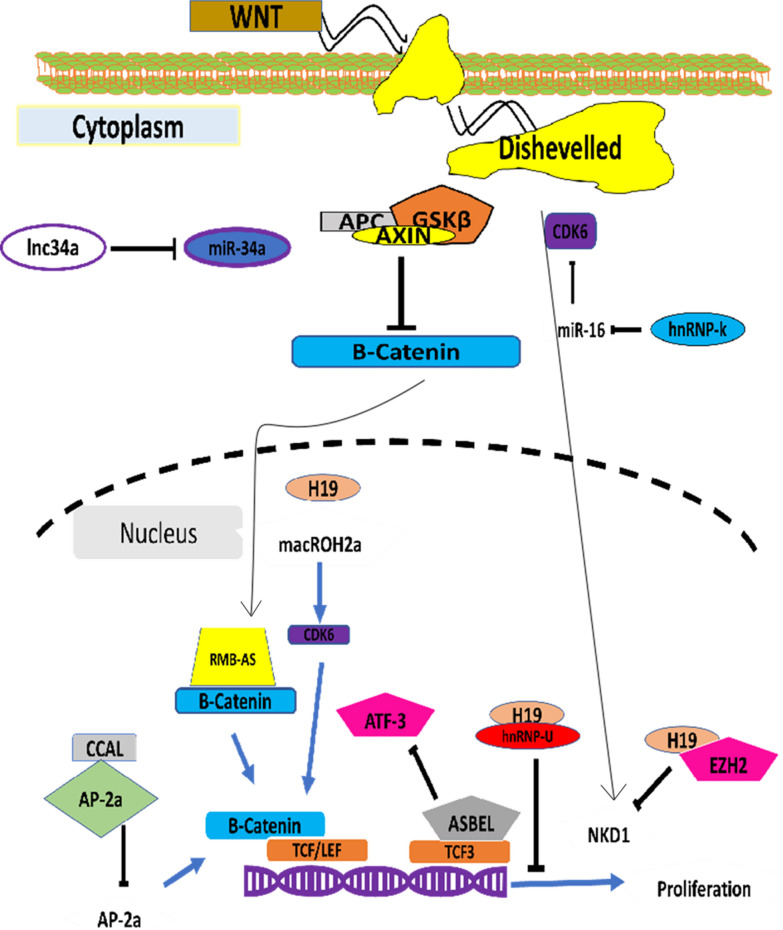
The outlook for new therapeutic approaches is pivotal to ameliorate the deterioration caused by the abrogated signaling. Long non-coding RNAs () are tiny molecules that have begun emerging as vital molecular manager for the regulation of various cellular processes at transcription and translation levels in the colorectal cancer (CRC). Targeting pathway with lncRNA seems a promising approach to eradicate CRC. However, little is known of their active role in commencing both apoptosis and proliferation in CRC. This article reviews the importance of these molecules in the pathogenesis of CRC and also emphasizes on the development of new therapeutic strategies to cope with the mediated CRC.
新治疗方法的前景对于改善因信号转导缺失引起的恶化至关重要。长链非编码RNA(lncRNA)是微小的分子,已开始成为在转录和翻译水平调节结直肠癌(CRC)各种细胞过程的重要分子调控因子。用lncRNA靶向该信号通路似乎是根除CRC的一种有前景的方法。然而,它们在CRC启动凋亡和增殖中的积极作用却鲜为人知。本文综述了这些分子在CRC发病机制中的重要性,并强调了应对该信号介导的CRC的新治疗策略的开发。