Schulz Martin, Griese-Mammen Nina, Schumacher Pia M, Anker Stefan D, Koehler Friedrich, Ruckes Christian, Rettig-Ewen Volker, Wachter Rolf, Trenk Dietmar, Böhm Michael, Laufs Ulrich
Department of Medicine, ABDA - Federal Union of German Associations of Pharmacists, Berlin, Germany.
Institute of Pharmacy, Freie Universität Berlin, Berlin, Germany.
ESC Heart Fail. 2020 Dec;7(6):3310-3319. doi: 10.1002/ehf2.12904. Epub 2020 Jul 23.
Patients with heart failure (HF) have impaired quality of life (QoL). The randomized controlled trial PHARM-CHF investigated whether an interdisciplinary intervention consisting of regular contacts with the community pharmacy and weekly dosing aids improves medication adherence in patients with HF. It is unknown how an intervention involving frequent structured pharmacy visits affects QoL. Our aim was to explore adherence to the intervention and effects on QoL.
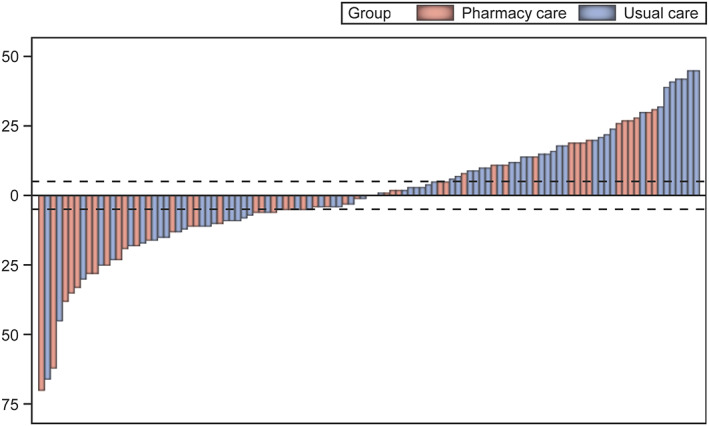
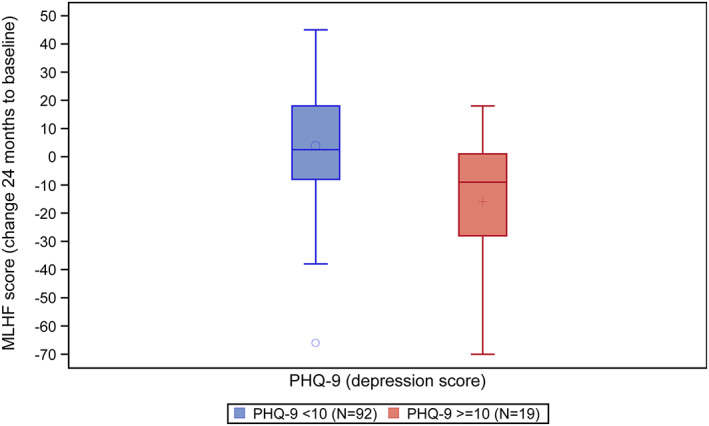
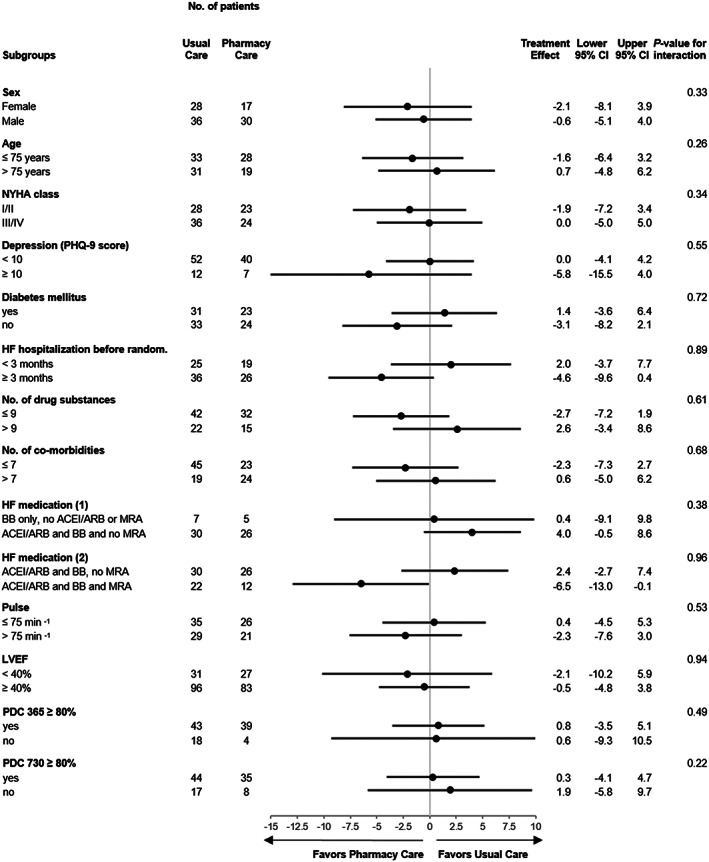
Among 237 patients, n = 110 were randomized to pharmacy care and n = 127 to usual care. The pharmacy care group received a medication review followed by (bi-)weekly dose dispensing and counselling. The median follow-up was 2.0 years [inter-quartile range (IQR) 1.2-2.7]. Median interval between pharmacy visits was 8.4 days (IQR 8.0-10.3) and the visits lasted in median 14 min (IQR 10-15). Median adherence to the intervention was 96% (IQR 84-100). QoL at 365 days was predefined as a main secondary and at 730 days as another secondary endpoint in PHARM-CHF. QoL was measured by the Minnesota Living with Heart Failure Questionnaire; and for 111 patients (n = 47 in the pharmacy care group and n = 64 in the usual care group), data were available at baseline, and after 365 and 730 days (mean age 74 years; 41% female). Improvement in QoL was numerically higher in the pharmacy care group after 365 days and was significantly better after 730 days (difference in total scores -7.7 points [-14.5 to -1.0]; P = 0.026) compared to the usual care group. In all subgroups examined, this treatment effect was preserved. Improvements in the physical and emotional dimensions were numerically higher in the pharmacy care group after 365 days and were significantly better after 730 days: -4.0 points [-6.9 to -1.2]; P = 0.006, and -1.9 points [-3.7 to -0.1]; P = 0.039, respectively.
A pharmacy-based interdisciplinary intervention was well received by the patients and suggests clinically important improvements in QoL.
心力衰竭(HF)患者的生活质量(QoL)受损。随机对照试验PHARM-CHF研究了由社区药房定期联系和每周给药辅助工具组成的多学科干预措施是否能提高HF患者的药物依从性。目前尚不清楚频繁的结构化药房就诊干预如何影响生活质量。我们的目的是探讨对干预措施的依从性及其对生活质量的影响。
在237例患者中,n = 110例被随机分配至药房护理组,n = 127例被分配至常规护理组。药房护理组接受了药物审查,随后每(两)周进行一次剂量配药和咨询。中位随访时间为2.0年[四分位间距(IQR)1.2 - 2.7]。药房就诊的中位间隔时间为8.4天(IQR 8.0 - 10.3),就诊中位持续时间为14分钟(IQR 10 - 15)。对干预措施的中位依从率为96%(IQR 84 - 100)。在PHARM-CHF中,365天时的生活质量被预先定义为主要次要终点,730天时为另一个次要终点。生活质量通过明尼苏达心力衰竭生活问卷进行测量;对于111例患者(药房护理组n = 47例,常规护理组n = 64例),在基线、365天和730天后均有数据可用(平均年龄74岁;41%为女性)。与常规护理组相比,药房护理组在365天后生活质量的改善在数值上更高,在730天后显著更好(总分差异为 - 7.7分[-14.5至 - 1.0];P = 0.026)。在所有检查的亚组中,这种治疗效果均得以保持。药房护理组在365天后身体和情感维度的改善在数值上更高,在730天后显著更好:分别为 - 4.0分[-6.9至 - 1.2];P = 0.006和 - 1.9分[-3.7至 - 0.1];P = 0.039。
基于药房的多学科干预措施受到患者的好评,并表明在生活质量方面有临床重要改善。