National Institute of Public Health, Ljubljana, Slovenia.
Faculty of Medicine, University of Ljubljana, Ljubljana, Slovenia.
ESC Heart Fail. 2021 Jun;8(3):2079-2088. doi: 10.1002/ehf2.13287. Epub 2021 Mar 15.
Self-care strategies in heart failure (HF) are effective for disease management, yet adherence in many patients is inadequate. Reasons are presumably multifactorial but remain insufficiently investigated; thus, we aimed to analyse self-care adherence and associated factors in outpatients with HF.
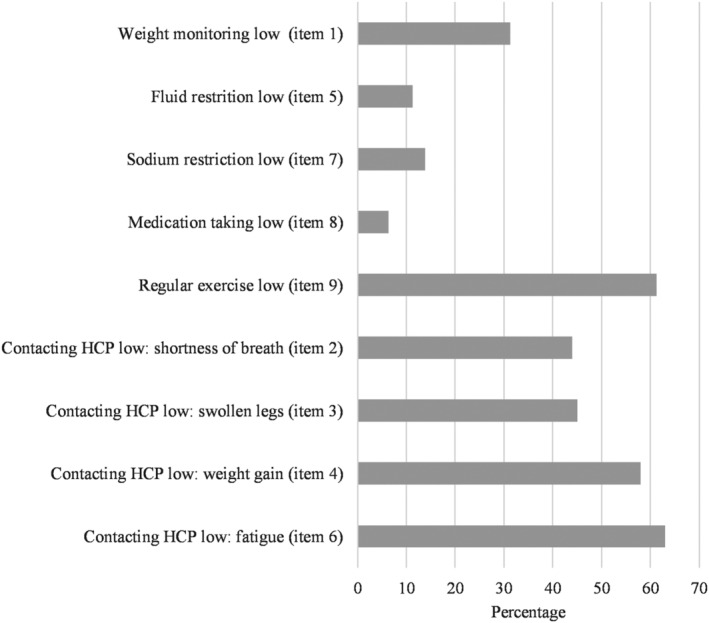
To measure self-care levels and explore barriers and facilitators to self-care adherence in patients with HF, quantitative study using the European Self-Care Behaviour Scale (EHFScBS-9) (n = 80; NYHA II-III, mean age 72 ± 10 years, 58% male) and qualitative study using semi-structured interviews (n = 32; NYHA II-III, mean age 73 ± 11, 63% male) were conducted. We detected lowest adherence to regular exercise (39%) and contacts with healthcare provider in case of worsening symptoms (47%), whereas adherence was highest for regular medication taking (94%). Using the EHFScBS-9 standardized cut-off score ≤ 70, 51% of patients reported inadequate self-care. Binary logistic regression analysis showed significant influence of education (OR = 0.314, 95% CI: 0.103-0.959) and perceived control (OR = 1.236, 95% CI: 1.043-1.465) on self-care adequacy. According to the situation-specific theory of HF self-care, most commonly reported factors affecting the process of self-care were knowledge about HF self-care behaviours (84%), experience with healthcare professionals (84%), beliefs about their expertise (69%) and habits related to medication taking (72%). Among values, working responsibilities (53%) and maintenance of traditions (31%) appeared as the most prevalent socially based values affecting motivation for self-care. Situational characteristics related to the person (self-confidence, 53%; adaptive coping strategies, 88%), problem (burdensome breathing difficulties, 56%; co-morbidities, 81%) and environment (practical support from family/caregivers, 59%; financial difficulties, 50%) were also commonly reported.
Various factors, including health-related beliefs, habits and socially based values, need to be taken into account when planning self-care interventions in patients with HF. A patient tailored approach should be based on adequate patient evaluation, taking into consideration the particular personal and social context.
心力衰竭(HF)的自我护理策略对疾病管理有效,但许多患者的依从性不足。原因可能是多因素的,但仍未得到充分研究;因此,我们旨在分析 HF 门诊患者的自我护理依从性及其相关因素。
为了测量 HF 患者的自我护理水平,并探讨影响自我护理依从性的障碍和促进因素,我们进行了一项定量研究(n=80;NYHA II-III,平均年龄 72±10 岁,58%为男性)和一项半结构性访谈的定性研究(n=32;NYHA II-III,平均年龄 73±11,63%为男性),使用欧洲自我护理行为量表(EHFScBS-9)进行测量。我们发现,患者最不遵守的是定期运动(39%)和在症状恶化时与医疗保健提供者联系(47%),而最遵守的是定期服药(94%)。根据 EHFScBS-9 的标准化截断值≤70,51%的患者报告自我护理不足。二元逻辑回归分析显示,教育(OR=0.314,95%CI:0.103-0.959)和感知控制(OR=1.236,95%CI:1.043-1.465)对自我护理的充分性有显著影响。根据 HF 自我护理的特定情境理论,影响自我护理过程的最常见因素包括对 HF 自我护理行为的知识(84%)、与医疗保健专业人员的经验(84%)、对其专业知识的信念(69%)和与服药相关的习惯(72%)。在价值观方面,工作责任(53%)和维护传统(31%)似乎是影响自我护理动机的最普遍的社会价值观。与个人相关的情境特征(自信心,53%;适应性应对策略,88%)、问题(呼吸困难,56%;合并症,81%)和环境(家人/照顾者的实际支持,59%;经济困难,50%)也经常被报道。
在为 HF 患者规划自我护理干预措施时,需要考虑各种因素,包括与健康相关的信念、习惯和社会价值观。患者量身定制的方法应基于充分的患者评估,并考虑到特定的个人和社会背景。