Department of Family Medicine, Post Graduate Medical Education, Aga Khan University, Dar es Salaam, Tanzania.
Department of Obstetrics and Gynecology, Aga Khan University, P.O BOX 38129, Plot 42, Ufukoni Road, Dar es Salaam, Tanzania.
BMC Pregnancy Childbirth. 2020 Jul 23;20(1):418. doi: 10.1186/s12884-020-03115-3.
Medical screening detects risk factors for disease or presence of disease in otherwise well persons in order to intervene early and reduce morbidity and mortality. During antenatal care (ANC) it is important to detect conditions that complicate pregnancy, like gestational diabetes mellitus (GDM). Despite international and local guidelines recommending screening for GDM during ANC, there is evidence to suggest that the practice was not being carried out adequately. A major challenge may be lack of consensus on uniform GDM screening and diagnostic guidelines internationally and locally. The primary objective was to determine the magnitude of screening for GDM among women receiving ANC at the Aga Khan Hospital, Dar es Salaam and Muhimbili National Hospital, Dar es Salaam. Secondary objectives were: to determine the methods used by health practitioners to screen for GDM, to determine the magnitude of undiagnosed gestational diabetes mellitus among women attending ANC and factors associated with screening for GDM among these women.
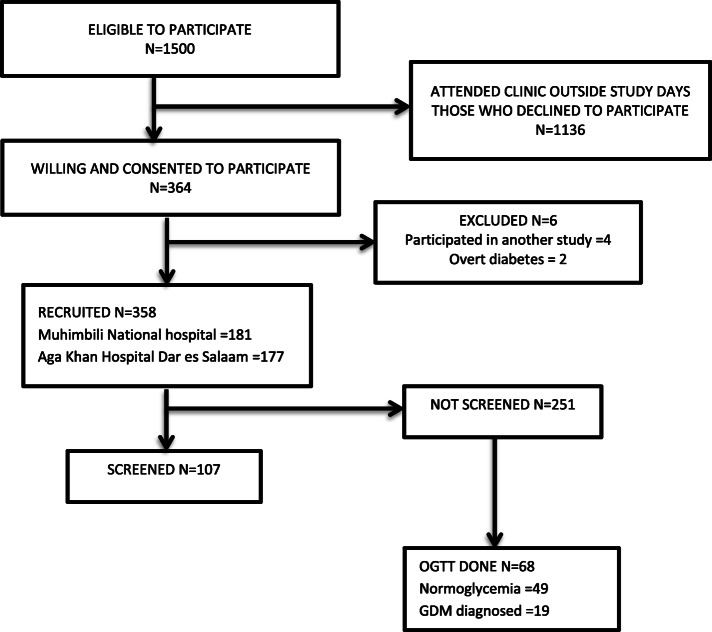
A cross-sectional analytical study was done. Data collection was done using pre-tested questionnaires and reviewing antenatal care records. The proportion of women attending ANC who were screened for GDM was determined. The 75 g Oral Glucose Tolerance Test (OGTT) was offered to women who had not been screened after education and consent.
Only 107 out of 358 (29.9%) had been offered some form of GDM screening. Tests used for GDM screening were random blood sugar (56.8%), fasting blood sugar (32.8%), HbA1C (6%) and 75 g OGTT (3.4%). The uptake of the OGTT was 27%. Of these women the prevalence of GDM was 27.9%. Factors associated with screening for GDM were history of big baby, history of pregnancy induced hypertension and participant awareness of GDM (all p: < 0.05).
Screening for GDM among women attending ANC was lower than the World Health Organization target. Efforts should be directed towards promoting GDM screening, increasing awareness about GDM and developing more effective screening methods.
医学筛查旨在发现健康人群中的疾病风险因素或疾病存在,以便尽早干预,降低发病率和死亡率。在产前保健(ANC)期间,重要的是要发现可能使妊娠复杂化的情况,例如妊娠糖尿病(GDM)。尽管国际和本地指南都建议在 ANC 期间筛查 GDM,但有证据表明该做法并未得到充分实施。一个主要挑战可能是国际和本地缺乏对统一的 GDM 筛查和诊断指南的共识。主要目标是确定在达累斯萨拉姆阿加汗医院和达累斯萨拉姆穆希比利国家医院接受 ANC 的妇女中 GDM 的筛查率。次要目标是:确定卫生保健提供者筛查 GDM 的方法,确定 ANC 就诊妇女中未诊断的妊娠糖尿病的发生率,以及与这些妇女 GDM 筛查相关的因素。
进行了一项横断面分析性研究。使用预先测试的问卷和审查产前保健记录进行数据收集。确定了接受 ANC 的妇女中筛查 GDM 的比例。对未接受筛查的妇女进行教育和同意后,提供 75g 口服葡萄糖耐量试验(OGTT)。
只有 358 名妇女中的 107 名(29.9%)接受了某种形式的 GDM 筛查。用于 GDM 筛查的检查包括随机血糖(56.8%),空腹血糖(32.8%),HbA1C(6%)和 75g OGTT(3.4%)。OGTT 的吸收率为 27%。这些妇女中 GDM 的患病率为 27.9%。与 GDM 筛查相关的因素是巨大儿史,妊娠高血压病史和参与者对 GDM 的认识(均 p<0.05)。
在接受 ANC 的妇女中,GDM 的筛查率低于世界卫生组织的目标。应努力促进 GDM 筛查,提高对 GDM 的认识,并开发更有效的筛查方法。