School of Computer Science and Technology, Xidian University, Xi'an 710071, China.
Institute of Fundamental and Frontier Sciences, University of Electronic Science and Technology, Chengdu 650004, China.
Int J Mol Sci. 2020 Jul 16;21(14):5014. doi: 10.3390/ijms21145014.
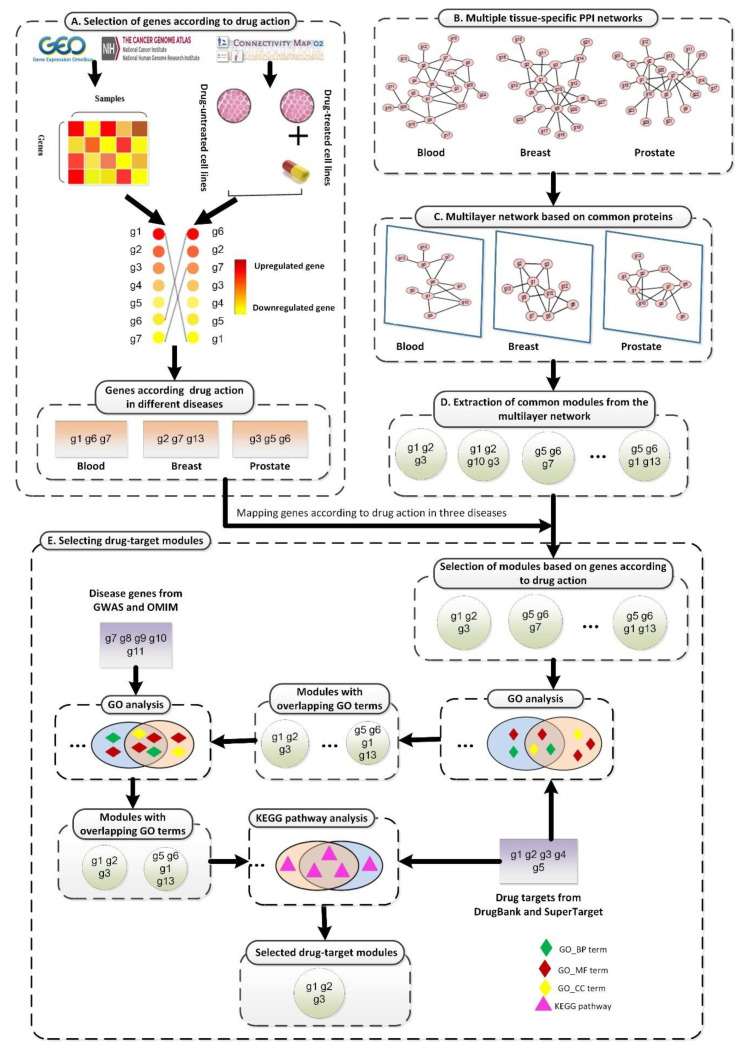
Some drugs can be used to treat multiple diseases, suggesting potential patterns in drug treatment. Determination of drug treatment patterns can improve our understanding of the mechanisms of drug action, enabling drug repurposing. A drug can be associated with a multilayer tissue-specific protein-protein interaction (TSPPI) network for the diseases it is used to treat. Proteins usually interact with other proteins to achieve functions that cause diseases. Hence, studying drug treatment patterns is similar to studying common module structures in multilayer TSPPI networks. Therefore, we propose a network-based model to study the treatment patterns of drugs. The method was designated SDTP (studying drug treatment pattern) and was based on drug effects and a multilayer network model. To demonstrate the application of the SDTP method, we focused on analysis of trichostatin A (TSA) in leukemia, breast cancer, and prostate cancer. We constructed a TSPPI multilayer network and obtained candidate drug-target modules from the network. Gene ontology analysis provided insights into the significance of the drug-target modules and co-expression networks. Finally, two modules were obtained as potential treatment patterns for TSA. Through analysis of the significance, composition, and functions of the selected drug-target modules, we validated the feasibility and rationality of our proposed SDTP method for identifying drug treatment patterns. In summary, our novel approach used a multilayer network model to overcome the shortcomings of single-layer networks and combined the network with information on drug activity. Based on the discovered drug treatment patterns, we can predict the potential diseases that the drug can treat. That is, if a disease-related protein module has a similar structure, then the drug is likely to be a potential drug for the treatment of the disease.
有些药物可用于治疗多种疾病,这表明药物治疗可能存在潜在模式。确定药物治疗模式可以提高我们对药物作用机制的理解,从而实现药物的重新利用。一种药物可以与它所治疗的疾病相关的多层组织特异性蛋白质-蛋白质相互作用(TSPPI)网络相关联。蛋白质通常通过与其他蛋白质相互作用来实现导致疾病的功能。因此,研究药物治疗模式类似于研究多层 TSPPI 网络中的常见模块结构。因此,我们提出了一种基于网络的模型来研究药物的治疗模式。该方法被命名为 SDTP(研究药物治疗模式),基于药物作用和多层网络模型。为了演示 SDTP 方法的应用,我们专注于分析三氮唑乙酸(TSA)在白血病、乳腺癌和前列腺癌中的作用。我们构建了一个 TSPPI 多层网络,并从网络中获得了候选药物-靶标模块。基因本体分析提供了对药物-靶标模块和共表达网络重要性的深入了解。最后,得到了两个作为 TSA 潜在治疗模式的模块。通过对所选药物-靶标模块的重要性、组成和功能进行分析,验证了我们提出的用于识别药物治疗模式的 SDTP 方法的可行性和合理性。总之,我们的新方法使用多层网络模型克服了单层网络的局限性,并将网络与药物活性信息相结合。基于发现的药物治疗模式,我们可以预测药物可能治疗的潜在疾病。也就是说,如果一个与疾病相关的蛋白质模块具有相似的结构,那么该药物很可能是治疗该疾病的潜在药物。