Division of Paediatric Medicine, The Hospital for Sick Children, Toronto, Ontario, Canada.
Department of Paediatrics, University of Toronto, Toronto, Ontario, Canada.
JAMA Netw Open. 2020 Jul 1;3(7):e2010337. doi: 10.1001/jamanetworkopen.2020.10337.
Advance care planning (ACP) is the process of discussing values and preferences for care to help inform medical decision-making. Children with medical complexity (CMC) often have a shortened life span with an unpredictable clinical course and timing of death; however, there is a paucity of literature that describes the experience of ACP from the perspective of bereaved family caregivers of CMC.
To explore the experiences of bereaved family caregivers with ACP for CMC.
DESIGN, SETTING, AND PARTICIPANTS: This qualitative study included 12 interviews with 13 bereaved family caregivers of CMC whose deaths had occurred in the 5 years before study commencement (2013-2018). Participants were recruited at a single tertiary care pediatric center; CMC were treated by the Complex Care or Long-term Ventilation clinic in Toronto, Ontario, Canada. Data were collected from July to October 2018. Thematic analysis with an inductive approach was used.
Qualitative interviews were conducted using purposive sampling of bereaved family caregivers using semistructured interviews that were recorded and transcribed. Interviews were conducted until saturation was reached.
Transcripts were analyzed to create themes that characterized caregiver experiences with ACP.
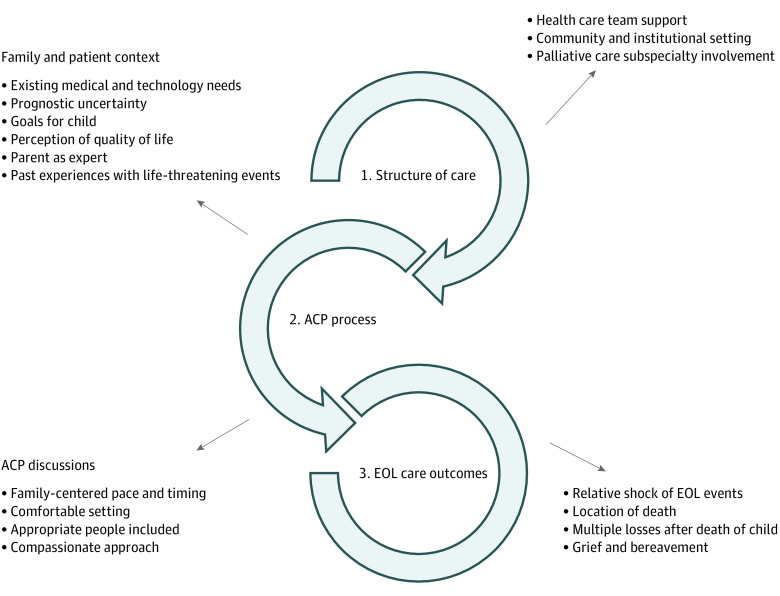
A total of 13 family caregivers were interviewed in 12 interviews, all of whom were parents (12 [92%] women, 1 [8%] man) of a deceased child (aged 7 months to 12 years). Themes were divided in the 3 following categories, which align with the Donabedian model for health service quality: (1) structure of care, (2) ACP process, and (3) end-of-life experience. Notable subthemes for this population included the importance of accounting for parental expertise in the child's care, recurrent experiences with life-threatening events, relative shock of the timing of death, and the multiple losses that caregivers experienced.
In this study, parental experiences revealed that there are key aspects of the structure of the child's care, process around ACP, and end-of-life care experiences that provide important reflections on ACP that warrant future study.
预先医疗指示(ACP)是一个讨论医疗价值和偏好的过程,以帮助提供医疗决策信息。患有复杂疾病的儿童(CMC)的寿命通常较短,且临床过程和死亡时间不可预测;然而,关于从 CMC 丧亲的照顾者的角度描述 ACP 体验的文献却很少。
探讨 CMC 丧亲的照顾者对 ACP 的体验。
设计、地点和参与者: 这是一项定性研究,包括对 13 名 CMC 丧亲的照顾者的 12 次访谈,这些照顾者的孩子在研究开始前 5 年内死亡(2013-2018 年)。参与者是在一家三级儿科中心招募的;CMC 在安大略省多伦多的复杂护理或长期通气诊所接受治疗。数据收集于 2018 年 7 月至 10 月。采用归纳法的主题分析。
采用目的抽样方法,对丧亲的照顾者进行半结构化访谈,记录并转录访谈内容。访谈一直进行到达到饱和状态。
分析转录本以创建描述照顾者 ACP 体验的主题。
在 12 次访谈中对 13 名家庭照顾者进行了采访,他们都是已故孩子的父母(12 名[92%]女性,1 名[8%]男性),年龄从 7 个月到 12 岁。主题分为以下 3 个类别,与健康服务质量的 Donabedian 模型一致:(1)护理结构,(2)ACP 流程,和(3)临终体验。该人群的显著子主题包括在孩子护理中考虑父母专业知识的重要性、危及生命事件的反复发生、死亡时间的相对震惊,以及照顾者经历的多重损失。
在这项研究中,父母的经验表明,儿童护理结构、ACP 流程和临终关怀体验方面存在关键方面,这些方面为 ACP 提供了重要的反思,值得进一步研究。