Department of Biomedical Sciences, University of Padua, 35131 Padua, Italy.
Myology Center (Cir-Myo), University of Padua, 35129 Padua, Italy.
Cells. 2020 Jul 24;9(8):1768. doi: 10.3390/cells9081768.
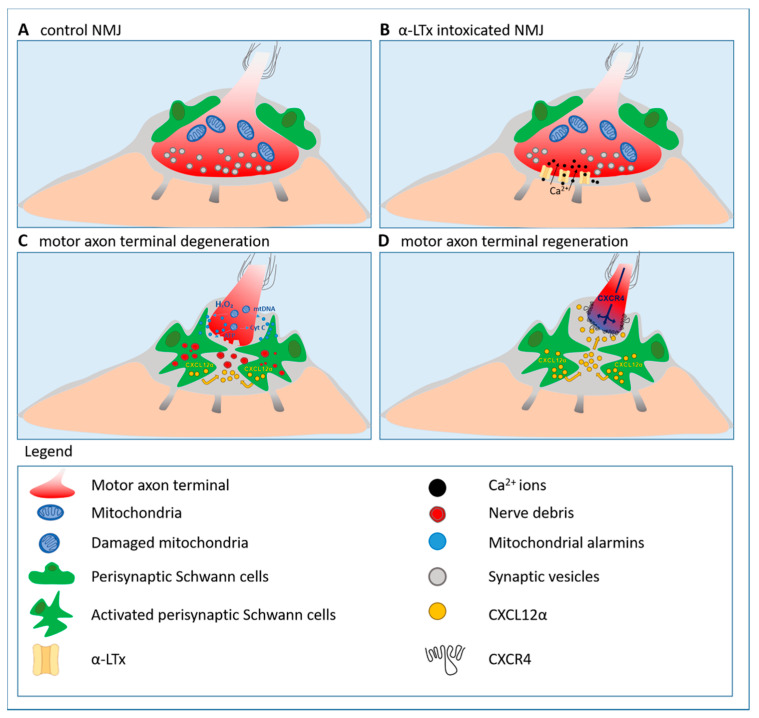
The peripheral nervous system has retained through evolution the capacity to repair and regenerate after assault from a variety of physical, chemical, or biological pathogens. Regeneration relies on the intrinsic abilities of peripheral neurons and on a permissive environment, and it is driven by an intense interplay among neurons, the glia, muscles, the basal lamina, and the immune system. Indeed, extrinsic signals from the milieu of the injury site superimpose on genetic and epigenetic mechanisms to modulate cell intrinsic programs. Here, we will review the main intrinsic and extrinsic mechanisms allowing severed peripheral axons to re-grow, and discuss some alarm mediators and pro-regenerative molecules and pathways involved in the process, highlighting the role of Schwann cells as central hubs coordinating multiple signals. A particular focus will be provided on regeneration at the neuromuscular junction, an ideal model system whose manipulation can contribute to the identification of crucial mediators of nerve re-growth. A brief overview on regeneration at sensory terminals is also included.
周围神经系统在进化过程中保留了在受到各种物理、化学或生物病原体攻击后进行修复和再生的能力。再生依赖于周围神经元的内在能力和允许的环境,并且由神经元、神经胶质、肌肉、基底膜和免疫系统之间的强烈相互作用驱动。事实上,损伤部位环境中的外在信号叠加在遗传和表观遗传机制上,以调节细胞内在程序。在这里,我们将回顾允许切断的周围轴突重新生长的主要内在和外在机制,并讨论涉及该过程的一些警报介质和促再生分子和途径,突出施万细胞作为协调多种信号的中心枢纽的作用。特别关注神经肌肉接头的再生,这是一个理想的模型系统,其操作可以有助于确定神经再生的关键介质。还包括对感觉末梢再生的简要概述。