U 1195 Inserm and University Paris Saclay, University Paris Sud, 94276 Le kremlin Bicêtre, France.
Int J Mol Sci. 2020 Jul 24;21(15):5271. doi: 10.3390/ijms21155271.
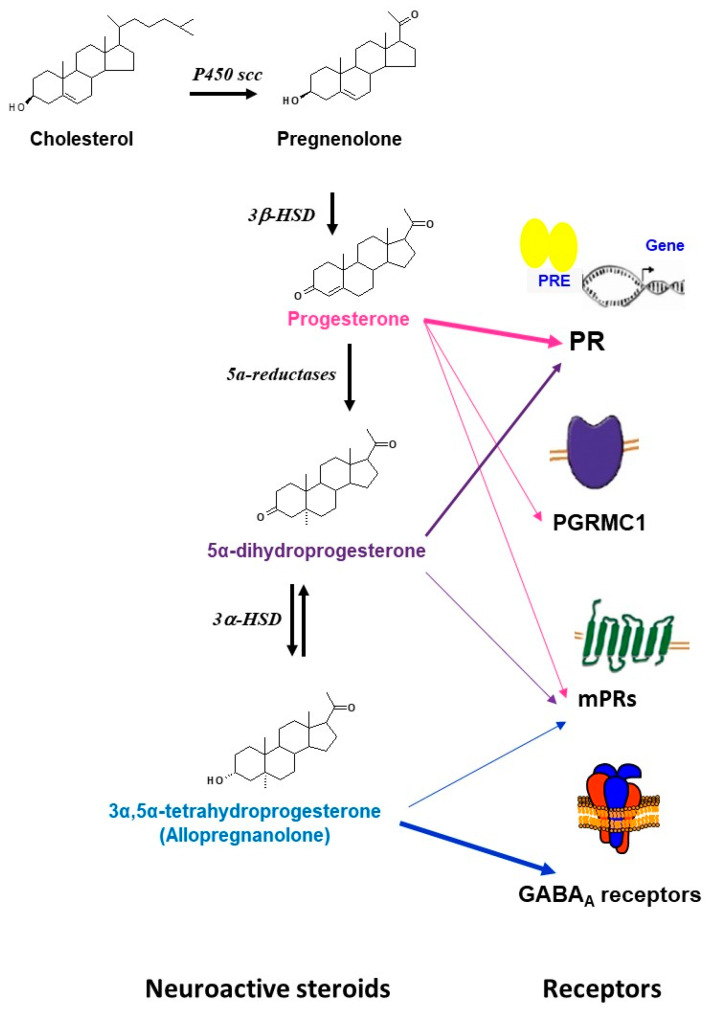
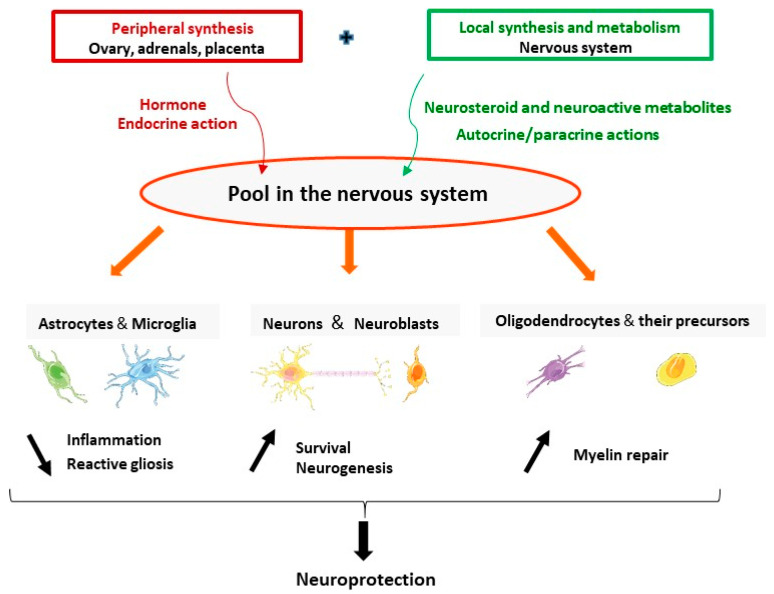
Progesterone has a broad spectrum of actions in the brain. Among these, the neuroprotective effects are well documented. Progesterone neural effects are mediated by multiple signaling pathways involving binding to specific receptors (intracellular progesterone receptors (PR); membrane-associated progesterone receptor membrane component 1 (PGRMC1); and membrane progesterone receptors (mPRs)) and local bioconversion to 3α,5α-tetrahydroprogesterone (3α,5α-THPROG), which modulates GABA receptors. This brief review aims to give an overview of the synthesis, metabolism, neuroprotective effects, and mechanism of action of progesterone in the rodent and human brain. First, we succinctly describe the biosynthetic pathways and the expression of enzymes and receptors of progesterone; as well as the changes observed after brain injuries and in neurological diseases. Then, we summarize current data on the differential fluctuations in brain levels of progesterone and its neuroactive metabolites according to sex, age, and neuropathological conditions. The third part is devoted to the neuroprotective effects of progesterone and 3α,5α-THPROG in different experimental models, with a focus on traumatic brain injury and stroke. Finally, we highlight the key role of the classical progesterone receptors (PR) in mediating the neuroprotective effects of progesterone after stroke.
孕激素在大脑中有广泛的作用。其中,神经保护作用已有充分的文献记载。孕激素的神经作用是通过多种信号通路介导的,包括与特定受体(细胞内孕激素受体(PR);膜相关孕激素受体膜成分 1(PGRMC1);和膜孕激素受体(mPRs))结合,以及局部生物转化为 3α,5α-四氢孕酮(3α,5α-THPROG),后者调节 GABA 受体。这篇简短的综述旨在概述孕激素在啮齿动物和人类大脑中的合成、代谢、神经保护作用和作用机制。首先,我们简洁地描述了孕激素的生物合成途径和酶及受体的表达;以及脑损伤和神经疾病后观察到的变化。然后,我们总结了目前关于根据性别、年龄和神经病理学条件,脑内孕激素及其神经活性代谢物水平的差异波动的资料。第三部分专门讨论了孕激素和 3α,5α-THPROG 在不同实验模型中的神经保护作用,重点是创伤性脑损伤和中风。最后,我们强调了经典孕激素受体(PR)在中风后介导孕激素的神经保护作用中的关键作用。