Rojas Maria I, Cavalcanti Giselle S, McNair Katelyn, Benler Sean, Alker Amanda T, Cobián-Güemes Ana G, Giluso Melissa, Levi Kyle, Rohwer Forest, Bailey Barbara A, Beyhan Sinem, Edwards Robert A, Shikuma Nicholas J
Viral Information Institute, San Diego State University, San Diego, California, USA.
Department of Biology, San Diego State University, San Diego, California, USA.
mSystems. 2020 Jul 28;5(4):e00648-20. doi: 10.1128/mSystems.00648-20.
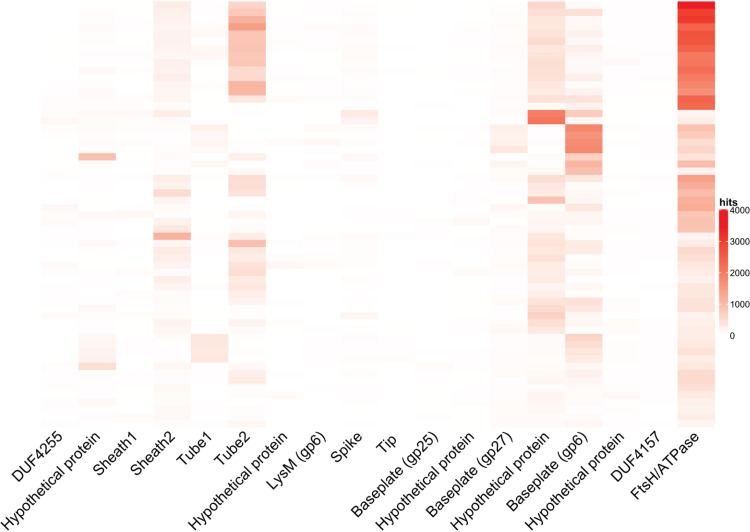
Many commensal bacteria antagonize each other or their host by producing syringe-like secretion systems called contractile injection systems (CIS). Members of the family have been shown to produce only one type of CIS-a contact-dependent type 6 secretion system that mediates bacterium-bacterium interactions. Here, we show that a second distinct cluster of genes from bacteria from the human microbiome may encode yet-uncharacterized injection systems that we term injection systems (BIS). We found that BIS genes are present in the gut microbiomes of 99% of individuals from the United States and Europe and that BIS genes are more prevalent in the gut microbiomes of healthy individuals than in those individuals suffering from inflammatory bowel disease. Gene clusters similar to that of the BIS mediate interactions between bacteria and diverse eukaryotes, like amoeba, insects, and tubeworms. Our findings highlight the ubiquity of the BIS gene cluster in the human gut and emphasize the relevance of the gut microbiome to the human host. These results warrant investigations into the structure and function of the BIS and how they might mediate interactions between bacteria and the human host or microbiome. To engage with host cells, diverse pathogenic bacteria produce syringe-like structures called contractile injection systems (CIS). CIS are evolutionarily related to the contractile tails of bacteriophages and are specialized to puncture membranes, often delivering effectors to target cells. Although CIS are key for pathogens to cause disease, paradoxically, similar injection systems have been identified within healthy human microbiome bacteria. Here, we show that gene clusters encoding a predicted CIS, which we term injection systems (BIS), are present in the microbiomes of nearly all adult humans tested from Western countries. BIS genes are enriched within human gut microbiomes and are expressed both and Further, a greater abundance of BIS genes is present within healthy gut microbiomes than in those humans with with inflammatory bowel disease (IBD). Our discovery provides a potentially distinct means by which our microbiome interacts with the human host or its microbiome.
许多共生细菌通过产生称为收缩注射系统(CIS)的类似注射器的分泌系统来相互拮抗或拮抗宿主。该家族的成员已被证明仅产生一种类型的CIS——一种介导细菌与细菌相互作用的接触依赖性6型分泌系统。在这里,我们表明,来自人类微生物组的细菌的第二个不同的基因簇可能编码尚未表征的注射系统,我们将其称为B型注射系统(BIS)。我们发现,BIS基因存在于来自美国和欧洲的99%的个体的肠道微生物组中,并且BIS基因在健康个体的肠道微生物组中比在患有炎症性肠病的个体中更普遍。与BIS相似的基因簇介导细菌与多种真核生物之间的相互作用,如变形虫、昆虫和管虫。我们的发现突出了BIS基因簇在人类肠道中的普遍性,并强调了肠道微生物组与人类宿主的相关性。这些结果值得对BIS的结构和功能以及它们如何介导细菌与人类宿主或微生物组之间的相互作用进行研究。为了与宿主细胞相互作用,多种致病细菌会产生称为收缩注射系统(CIS)的类似注射器的结构。CIS在进化上与噬菌体的收缩尾部相关,并且专门用于刺穿膜,通常将效应物传递到靶细胞。尽管CIS是病原体致病的关键,但矛盾的是,在健康的人类微生物组细菌中也发现了类似的注射系统。在这里,我们表明,编码预测的CIS(我们称为B型注射系统(BIS))的基因簇存在于来自西方国家测试的几乎所有成年人的微生物组中。BIS基因在人类肠道微生物组中富集,并且在体内和体外均有表达。此外,健康肠道微生物组中存在的BIS基因丰度高于患有炎症性肠病(IBD)的人类。我们的发现提供了一种潜在的独特方式,通过这种方式我们的微生物组与人类宿主或其微生物组相互作用。