Division of Oral Diseases, Department of Dental Medicine, Karolinska Institutet, Stockholm, Sweden.
Department of Medicine Solna, Karolinska Institutet, Stockholm, Sweden.
Inflamm Bowel Dis. 2020 Sep 18;26(10):1588-1596. doi: 10.1093/ibd/izaa190.
Inflammatory bowel disease (IBD) can manifest both macroscopically and microscopically in the oral cavity; however, little is known about salivary changes in IBD. Therefore, this study aimed to assess salivary and circulatory inflammatory profiles in IBD and to compare their potential to reflect the presence and activity of IBD.
We measured 92 known inflammatory proteins in serum and in unstimulated and stimulated whole saliva samples from patients with IBD with active intestinal inflammation (n = 21) and matched control patients (n = 22) by proximity extension assay. Fifteen of the patients with IBD returned 10 to 12 weeks after treatment escalation for resampling.
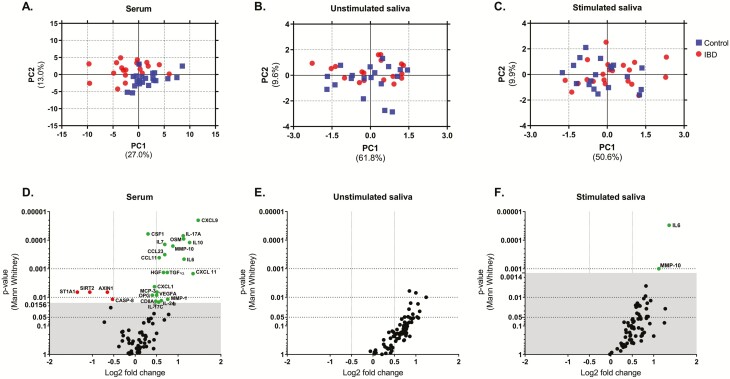
Sixty-seven of the proteins were detected in all 3 sample fluids but formed distinct clusters in serum and saliva. Twenty-one inflammatory proteins were significantly increased and 4 were significantly decreased in the serum of patients with IBD compared with that of the control patients. Two of the increased serum proteins, IL-6 and MMP-10, were also significantly increased in stimulated saliva of patients with IBD and correlated positively to their expressions in serum. None of the investigated proteins in serum or saliva were significantly altered by IBD treatment at follow-up. Overall, inflammatory proteins in serum correlated to biochemical status, and salivary proteins correlated positively to clinical parameters reflecting disease activity.
Saliva and serum inflammatory profiles in IBD share a similar composition but reflect different aspects of disease activity. The oral cavity reflects IBD through elevated IL-6 and MMP-10 in stimulated saliva.
炎症性肠病(IBD)可在口腔中表现为宏观和微观表现;然而,关于 IBD 唾液变化知之甚少。因此,本研究旨在评估 IBD 患者的唾液和循环炎症谱,并比较它们反映 IBD 存在和活动的潜力。
我们通过接近延伸测定法测量了 21 例有活动性肠道炎症的 IBD 患者和 22 例匹配的对照患者的血清和未刺激及刺激全唾液样本中的 92 种已知炎症蛋白。15 例 IBD 患者在治疗升级后 10 至 12 周返回进行重新取样。
67 种蛋白质在所有 3 种样本液中均被检测到,但在血清和唾液中形成了不同的簇。与对照组相比,21 种炎症蛋白在 IBD 患者的血清中显著增加,4 种炎症蛋白显著减少。两种增加的血清蛋白,IL-6 和 MMP-10,在 IBD 患者的刺激唾液中也显著增加,并与它们在血清中的表达呈正相关。在随访中,没有一种在血清或唾液中检测到的蛋白质因 IBD 治疗而发生显著变化。总的来说,血清中的炎症蛋白与生化状态相关,而唾液蛋白与反映疾病活动的临床参数呈正相关。
IBD 患者的唾液和血清炎症谱具有相似的组成,但反映了疾病活动的不同方面。口腔通过刺激唾液中升高的 IL-6 和 MMP-10 来反映 IBD。