Lee Keum Hwa, Yoon Sojung, Jeong Gwang Hun, Kim Jong Yeob, Han Young Joo, Hong Sung Hwi, Ryu Seohyun, Kim Jae Seok, Lee Jun Young, Yang Jae Won, Lee Jinhee, Solmi Marco, Koyanagi Ai, Dragioti Elena, Jacob Louis, Radua Joaquim, Smith Lee, Oh Hans, Tizaoui Kalthoum, Cargnin Sarah, Terrazzino Salvatore, Ghayda Ramy Abou, Kronbichler Andreas, Shin Jae Il
Department of Pediatrics, Yonsei University College of Medicine, Seoul 03722, Korea.
Yonsei University College of Medicine, Seoul 03722, Korea.
J Clin Med. 2020 Jul 27;9(8):2392. doi: 10.3390/jcm9082392.
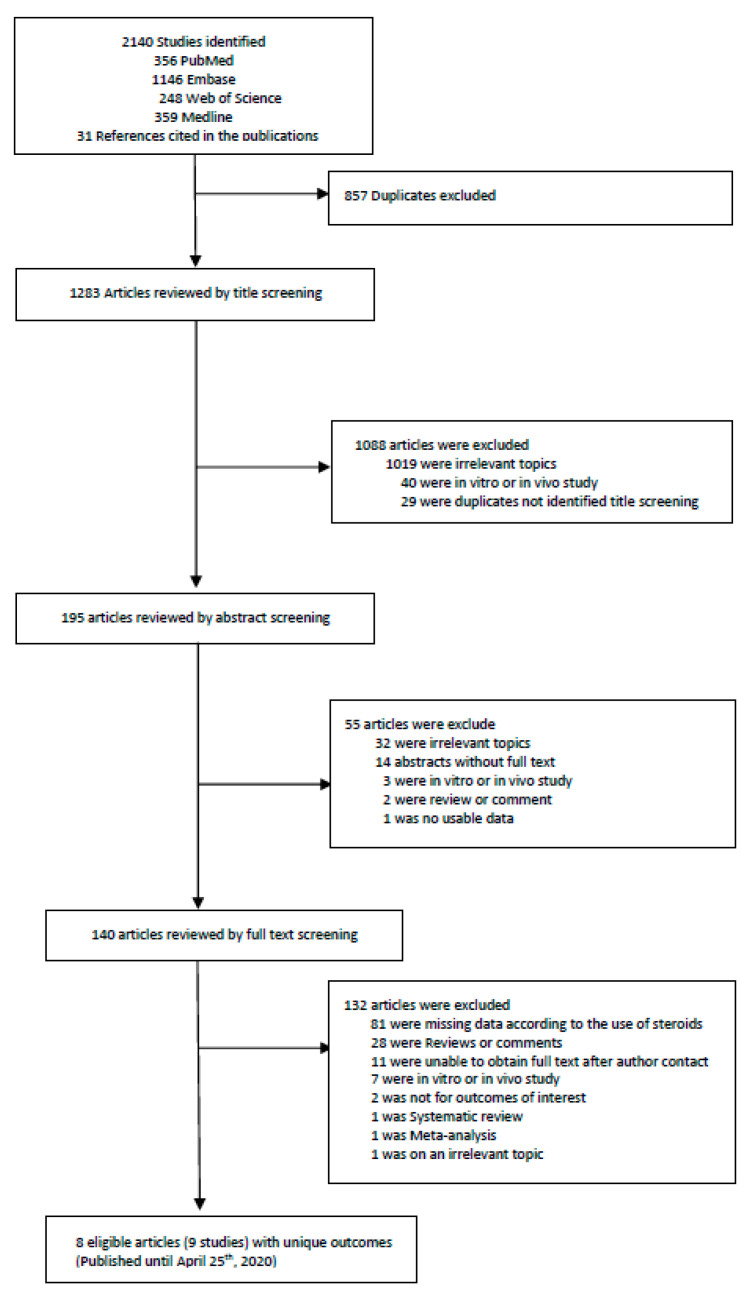
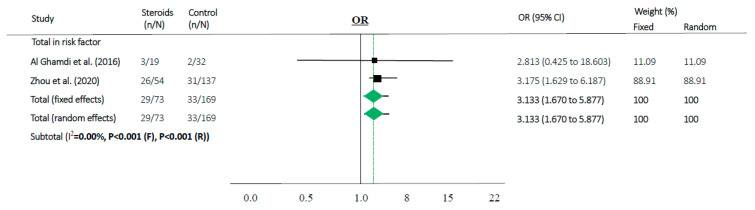
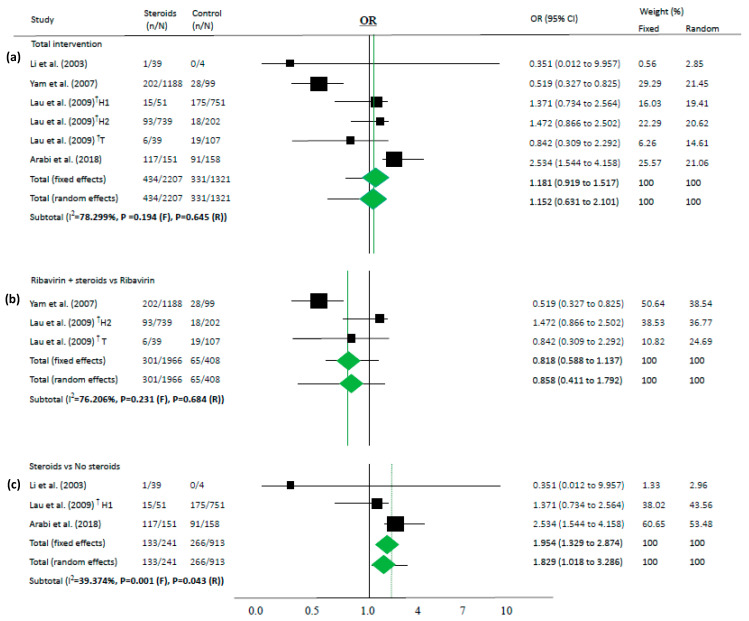
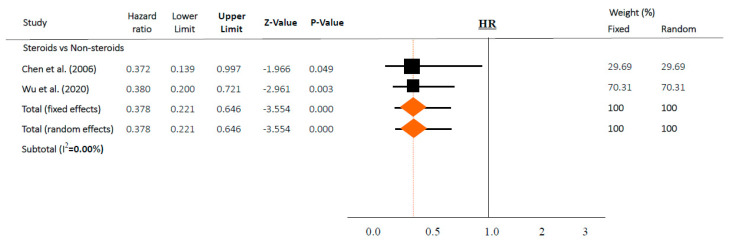
(1) Background: The use of corticosteroids in critical coronavirus infections, including severe acute respiratory syndrome (SARS), Middle East Respiratory Syndrome (MERS), or Coronavirus disease 2019 (COVID-19), has been controversial. However, a meta-analysis on the efficacy of steroids in treating these coronavirus infections is lacking. (2) Purpose: We assessed a methodological criticism on the quality of previous published meta-analyses and the risk of misleading conclusions with important therapeutic consequences. We also examined the evidence of the efficacy of corticosteroids in reducing mortality in SARS, MERS and COVID-19. (3) Methods: PubMed, MEDLINE, Embase, and Web of Science were used to identify studies published until 25 April 2020, that reported associations between steroid use and mortality in treating SARS/MERS/COVID-19. Two investigators screened and extracted data independently. Searches were restricted to studies on humans, and articles that did not report the exact number of patients in each group or data on mortality were excluded. We calculated odds ratios (ORs) or hazard ratios (HRs) under the fixed- and random-effect model. (4) Results: Eight articles (4051 patients) were eligible for inclusion. Among these selected studies, 3416 patients were diagnosed with SARS, 360 patients with MERS, and 275 with COVID-19; 60.3% patients were administered steroids. The meta-analyses including all studies showed no differences overall in terms of mortality (OR 1.152, 95% CI 0.631-2.101 in the random effects model, = 0.645). However, this conclusion might be biased, because, in some studies, the patients in the steroid group had more severe symptoms than those in the control group. In contrast, when the meta-analysis was performed restricting only to studies that used appropriate adjustment (e.g., time, disease severity), there was a significant difference between the two groups (HR 0.378, 95% CI 0.221-0.646 in the random effects model, < 0.0001). Although there was no difference in mortality when steroids were used in severe cases, there was a difference among the group with more underlying diseases (OR 3.133, 95% CI 1.670-5.877, < 0.001). (5) Conclusions: To our knowledge, this study is the first comprehensive systematic review and meta-analysis providing the most accurate evidence on the effect of steroids in coronavirus infections. If not contraindicated, and in the absence of side effects, the use of steroids should be considered in coronavirus infection including COVID-19.
(1)背景:在包括严重急性呼吸综合征(SARS)、中东呼吸综合征(MERS)或2019冠状病毒病(COVID - 19)在内的重症冠状病毒感染中使用皮质类固醇一直存在争议。然而,缺乏关于类固醇治疗这些冠状病毒感染疗效的荟萃分析。(2)目的:我们评估了对先前发表的荟萃分析质量的方法学批评以及得出具有重要治疗后果的误导性结论的风险。我们还研究了皮质类固醇在降低SARS、MERS和COVID - 19死亡率方面疗效的证据。(3)方法:使用PubMed、MEDLINE、Embase和科学网识别截至2020年4月25日发表的报告类固醇使用与治疗SARS/MERS/COVID - 19死亡率之间关联的研究。两名研究人员独立筛选和提取数据。搜索仅限于人类研究,未报告每组确切患者数量或死亡率数据的文章被排除。我们在固定效应模型和随机效应模型下计算比值比(OR)或风险比(HR)。(4)结果:八篇文章(4051名患者)符合纳入标准。在这些选定的研究中,3416名患者被诊断为SARS,360名患者为MERS,275名患者为COVID - 19;60.3%的患者接受了类固醇治疗。纳入所有研究的荟萃分析总体上在死亡率方面没有差异(随机效应模型中OR为1.152,95%置信区间为0.631 - 2.101,P = 0.645)。然而,这一结论可能存在偏差,因为在一些研究中,类固醇组的患者症状比对照组更严重。相比之下,当仅对使用适当调整(如时间、疾病严重程度)的研究进行荟萃分析时,两组之间存在显著差异(随机效应模型中HR为0.378,95%置信区间为0.221 - 0.646,P < 0.0001)。尽管在重症病例中使用类固醇时死亡率没有差异,但在合并基础疾病较多的组中存在差异(OR为3.133,95%置信区间为1.670 - 5.877,P < 0.001)。(5)结论:据我们所知,本研究是第一项全面的系统评价和荟萃分析,提供了关于类固醇在冠状病毒感染中作用的最准确证据。如果没有禁忌证且无副作用,在包括COVID - 19在内的冠状病毒感染中应考虑使用类固醇。