Department of Epidemiology, University of São Paulo, São Paulo, Brazil.
Department of Infectious Disease Epidemiology, London School of Hygiene and Tropical Medicine, Keppel Street, London, WC1E 7HT, UK.
Sci Rep. 2020 Jul 29;10(1):12673. doi: 10.1038/s41598-020-69235-0.
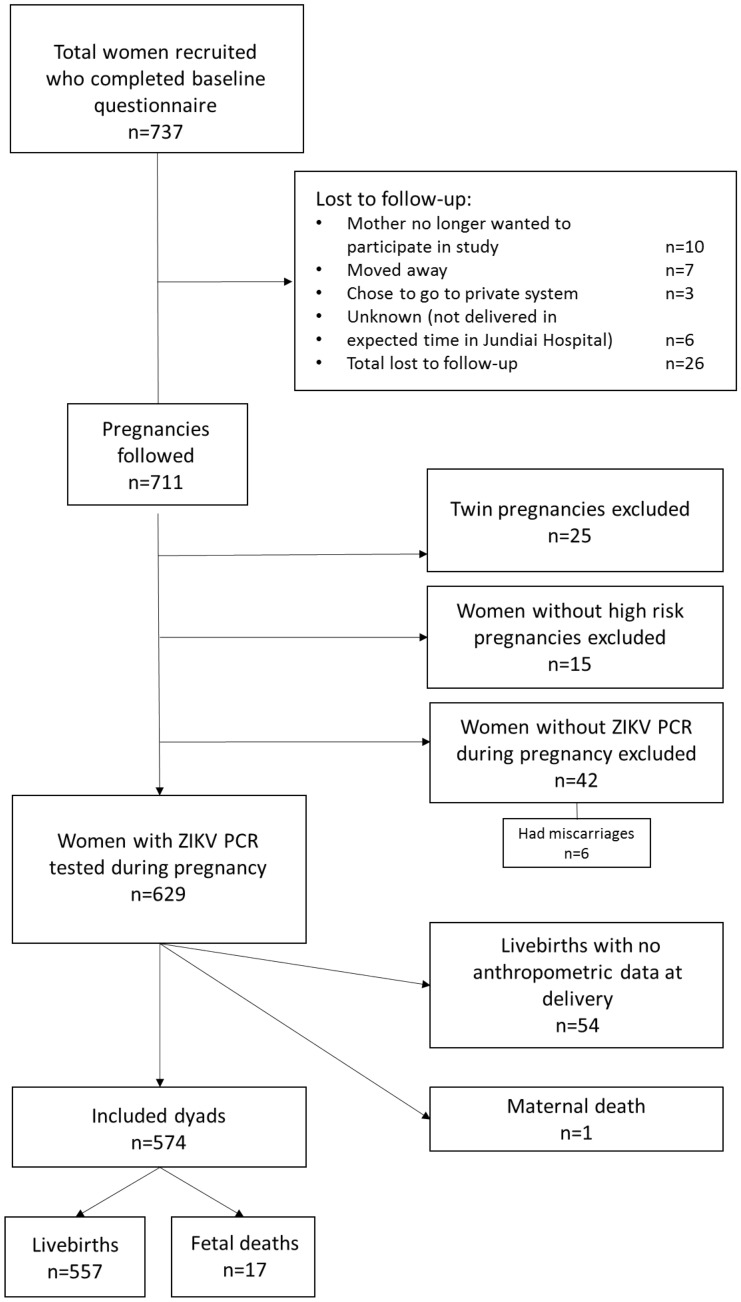
Robust epidemiological and biological evidence supports a causal link between prenatal Zika Virus (ZIKV) infection and congenital brain abnormalities including microcephaly. However, it remains uncertain if ZIKV infection in pregnancy also increases the risk for other adverse fetal and birth outcomes. In a prospective cohort study we investigated the influence of ZIKV on the prevalence of prematurity, low birth weight, small-for-gestational-age, and fetal death as well as microcephaly (i.e., overall and disproportionate) in the offspring of women attending a high-risk pregnancy clinic during the recent ZIKV outbreak in Brazil. During the recruitment period (01 March 2016-23 August 2017), urine samples were tested for ZIKV by RT-PCR from all women attending the high-risk pregnancy clinic at Jundiaí University Hospital and from the neonates after delivery. Of the 574 women evaluated, 44 (7.7%) were ZIKV RT-PCR positive during pregnancy. Of the 409 neonates tested, 19 (4.6%) were ZIKV RT-PCR positive in the first 10 days of life. In this cohort, maternal ZIKV exposure was not associated with increased risks of prematurity, low birth weight, small-for-gestational-age, or fetal death. However, relative to ZIKV-negative neonates, ZIKV-positive infants had a five-fold increased risk of microcephaly overall (RR 5.1, 95% CI 1.2-22.5) and a ten-fold increased risk of disproportionate microcephaly (RR 10.3, 95% CI 2.0-52.6). Our findings provide new evidence that, in a high-risk pregnancy cohort, ZIKV RT-PCR positivity in the neonate at birth is strongly associated with microcephaly. However, ZIKV infection during pregnancy does not appear to influence the risks of prematurity, low birth weight, small-for-gestational-age or fetal death in women who already have gestational comorbidities. The results suggest disproportion between neonatal head circumference and weight may be a useful screening indicator for the detection of congenital microcephaly associated with ZIKV infection.
强有力的流行病学和生物学证据支持 Zika 病毒(ZIKV)产前感染与包括小头畸形在内的先天性脑异常之间存在因果关系。然而,ZIKV 感染是否也会增加胎儿和分娩不良结局的风险仍不确定。在一项前瞻性队列研究中,我们调查了 ZIKV 对巴西最近 ZIKV 爆发期间高危妊娠诊所就诊的孕妇所生后代早产、低出生体重、小于胎龄和胎儿死亡以及小头畸形(即整体和不成比例)发生率的影响。在招募期间(2016 年 3 月 1 日至 2017 年 8 月 23 日),对朱尼达伊大学医院高危妊娠诊所就诊的所有女性和分娩后的新生儿尿液样本进行了 ZIKV 的 RT-PCR 检测。在评估的 574 名女性中,44 名(7.7%)在怀孕期间 ZIKV RT-PCR 阳性。在 409 名接受测试的新生儿中,19 名(4.6%)在生命的前 10 天 RT-PCR 阳性。在该队列中,母体 ZIKV 暴露与早产、低出生体重、小于胎龄或胎儿死亡的风险增加无关。然而,与 ZIKV 阴性的新生儿相比,ZIKV 阳性的婴儿整体上小头畸形的风险增加了五倍(RR 5.1,95%CI 1.2-22.5),不成比例的小头畸形的风险增加了十倍(RR 10.3,95%CI 2.0-52.6)。我们的研究结果提供了新的证据,表明在高危妊娠队列中,新生儿出生时 ZIKV RT-PCR 阳性与小头畸形密切相关。然而,在已经存在妊娠合并症的孕妇中,妊娠期间 ZIKV 感染似乎不会增加早产、低出生体重、小于胎龄或胎儿死亡的风险。结果表明,新生儿头围与体重之间的不成比例可能是检测与 ZIKV 感染相关的先天性小头畸形的有用筛查指标。