Huang Han, Fang Jiansong, Fan Xiude, Miyata Tatsunori, Hu Xiaoyue, Zhang Lihe, Zhang Liangren, Cui Yimin, Liu Zhenming, Wu Xiaoqin
State Key Laboratory of Natural and Biomimetic Drugs, School of Pharmaceutical Sciences, Peking University, Beijing, China.
Science and Technology Innovation Center, Guangzhou University of Chinese Medicine, Guangzhou, China.
Front Pharmacol. 2020 Jul 8;11:1009. doi: 10.3389/fphar.2020.01009. eCollection 2020.
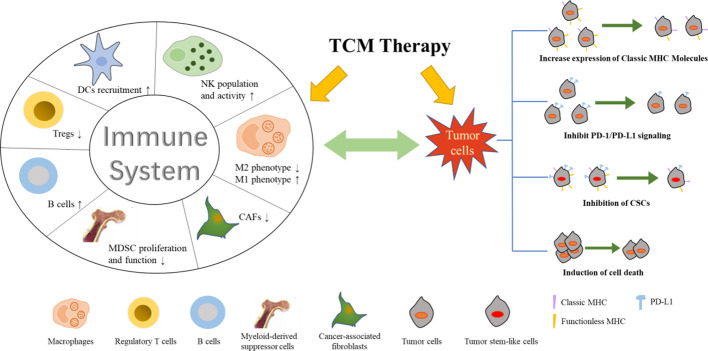
Traditional Chinese medicine (TCM) has been developed for thousands of years with its various biological activities. The interest in TCM in tumor prevention and treatment is rising with its synergistic effect on tumor cells and tumor immunosuppressive microenvironment (TIM). Characteristic of TCM fits well within the whole system and multi-target cancer treatment. Herein we discuss the underlying mechanisms of TCM actions in TIM regulating immunosuppressive cells, including restoring the antigen presentation function of dendritic cells, enhancing NK cells-mediated killing activity, restraining the functions of myeloid cell-derived suppressor cells, and inhibiting cancer-associated fibroblasts. TCM also regulates tumor progression through enhancing immune response, preventing immune escape and inducing cell death of tumor cells, which triggers immune response in nearby cells. In addition, we discuss TCM in clinical applications and the advantages and disadvantages of TCM in cancer prevention and treatment, as well as current therapeutic challenges and strategies. It might be helpful for understanding the therapeutic potential of TCM for cancer in clinic.
传统中医(TCM)已经发展了数千年,具有多种生物活性。随着其对肿瘤细胞和肿瘤免疫抑制微环境(TIM)的协同作用,中医在肿瘤预防和治疗方面的关注度不断提高。中医的特点非常适合整个系统和多靶点癌症治疗。在此,我们讨论中医在TIM中调节免疫抑制细胞的潜在机制,包括恢复树突状细胞的抗原呈递功能、增强自然杀伤细胞介导的杀伤活性、抑制髓系来源抑制细胞的功能以及抑制癌症相关成纤维细胞。中医还通过增强免疫反应、防止免疫逃逸和诱导肿瘤细胞死亡来调节肿瘤进展,从而触发附近细胞的免疫反应。此外,我们还讨论了中医在临床应用中的情况,以及中医在癌症预防和治疗中的优缺点,以及当前的治疗挑战和策略。这可能有助于理解中医在临床治疗癌症方面的潜力。