Department of Biomedical Sciences, Humanitas University, Pieve Emanuele, Italy.
Humanitas Clinical and Research Center - IRCCS, Rozzano, Italy.
Front Immunol. 2020 Jul 9;11:1259. doi: 10.3389/fimmu.2020.01259. eCollection 2020.
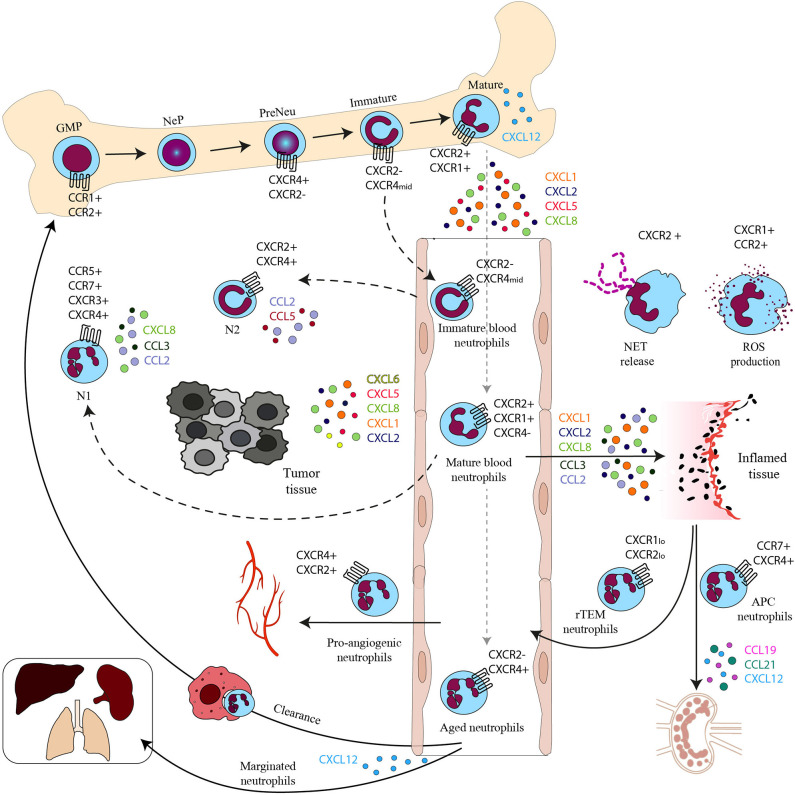
Chemokines are recognized as the most critical mediators for selective neutrophil recruitment during inflammatory conditions. Furthermore, they are considered fundamental regulators of neutrophil mobilization from the bone marrow (BM) to the bloodstream and for their homing back at the end of their life for apoptosis and clearance. However, chemokines are also important mediators of neutrophil effector functions including oxidative burst, degranulation, neutrophil extracellular trap (NET)osis, and production of inflammatory mediators. Neutrophils have been historically considered as a homogeneous population. In recent years, several maturation stages and subsets with different phenotypic profiles and effector functions were described both in physiological and pathological conditions such as infections, autoimmunity, and cancer. The aim of this review is to give an overview of the current evidence regarding the role of chemokines and chemokine receptors in neutrophil biology, including their possible role in neutrophil maturation, differentiation, and in defining emerging neutrophil subsets.
趋化因子被认为是炎症条件下选择性招募中性粒细胞的最关键介质。此外,它们被认为是调节中性粒细胞从骨髓(BM)动员到血液以及在其生命结束时归巢凋亡和清除的基本调节剂。然而,趋化因子也是中性粒细胞效应功能的重要介质,包括氧化爆发、脱颗粒、中性粒细胞胞外陷阱(NET)形成和炎症介质的产生。中性粒细胞在历史上被认为是一个同质群体。近年来,在生理和病理条件下,如感染、自身免疫和癌症,已经描述了几种成熟阶段和具有不同表型特征和效应功能的亚群。本综述的目的是概述趋化因子和趋化因子受体在中性粒细胞生物学中的作用的最新证据,包括它们在中性粒细胞成熟、分化和定义新兴中性粒细胞亚群中的可能作用。