Institute of Sport Science, University of Graz, Graz, Austria.
Research Group on Lifestyles and Health, University of Pernambuco, Recife, Brazil.
Scand J Med Sci Sports. 2021 Apr;31 Suppl 1(Suppl 1):15-22. doi: 10.1111/sms.13787.
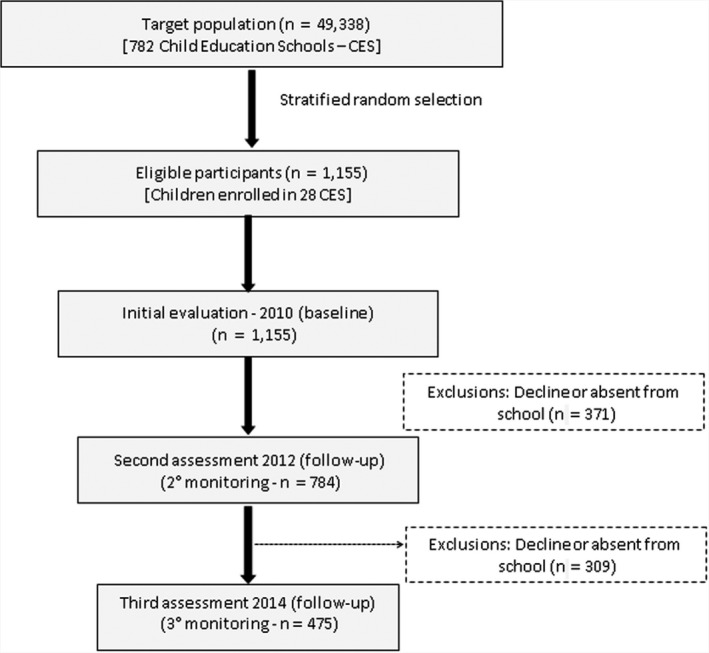
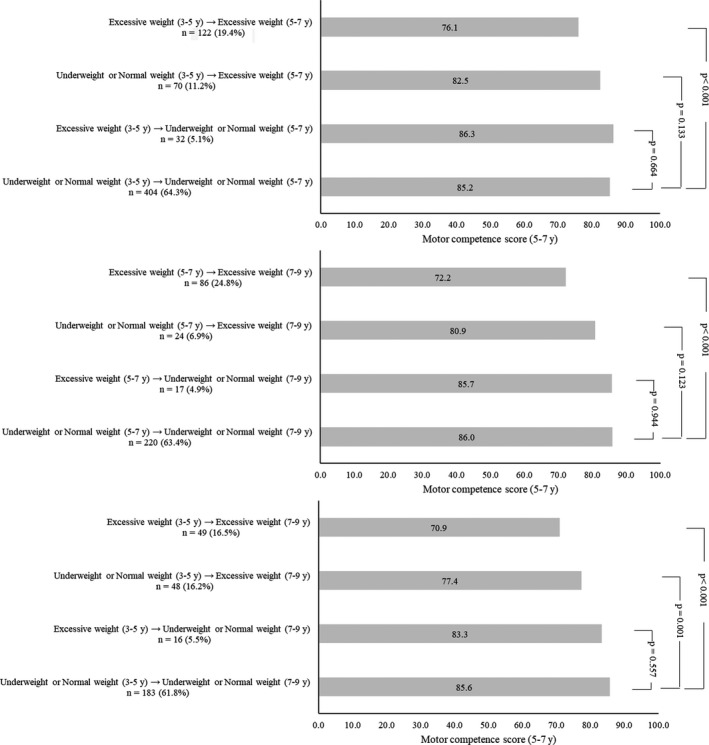
We evaluated the association between weight status and motor competence from preschool age (3-5 years of age) until middle childhood (7-9 years of age). Longitudinal study with three to five-year-old preschool children (n = 1155) enrolled in public and private preschools in Recife, Brazil. Children were followed twice (2010, 2012, and 2014) for four years. Köperkoordinationstest für kinder (KTK) assessed the children's motor competence (KTK Motor Quotient). Weight status (underweight, normal weight, overweight, and obesity) was classified according to the children's sex and age. Preschool children with normal weight exhibited higher motor competence at 5-7 years of age compared to preschool children with overweight (+3.73 MQ, P = .03) and obesity (+5.09 MQ, P < .01). Preschool children with normal weight presented higher motor competence at 7-9 years of age compared to their peers with overweight (+6.00 MQ, P = .03) and obesity (+5.88 MQ, P = .01). Children with normal weight at 5-7 years of age presented higher motor competence at 7-9 years of age compared to their peers with overweight (+3.33 MQ, P = .02) and obesity (+4.00 MQ, P = .02). Independent of the childhood phase and extension of the period evaluated (2- or 4-year period), children who had excessive weight (overweight or obesity) and changed their weight status to underweight or normal weight presented similar motor competence compared to children who continued underweight or normal weight. Weight status already at preschool age is an important predictor of the children's motor competence until middle childhood. Interventions improving the children's weight status, already at preschool age, might impact their motor competence development positively.
我们评估了学龄前(3-5 岁)至儿童中期(7-9 岁)体重状况与运动能力之间的关系。这项纵向研究纳入了巴西累西腓市公立和私立幼儿园的 3 至 5 岁学龄前儿童(n=1155)。儿童在四年内接受了两次(2010 年、2012 年和 2014 年)随访。采用儿童协调测试(Köperkoordinationstest für Kinder,KTK)评估儿童的运动能力(KTK 运动商数)。根据儿童的性别和年龄对体重状况(体重不足、正常体重、超重和肥胖)进行分类。与超重(+3.73 MQ,P=.03)和肥胖(+5.09 MQ,P<.01)的学龄前儿童相比,正常体重的学龄前儿童在 5-7 岁时表现出更高的运动能力。与超重(+6.00 MQ,P=.03)和肥胖(+5.88 MQ,P=.01)的同龄人相比,正常体重的学龄前儿童在 7-9 岁时表现出更高的运动能力。与超重(+3.33 MQ,P=.02)和肥胖(+4.00 MQ,P=.02)的同龄人相比,5-7 岁时体重正常的儿童在 7-9 岁时表现出更高的运动能力。无论儿童期阶段和评估期的长短(2 年或 4 年)如何,体重超重(超重或肥胖)并改变体重状况为体重不足或正常体重的儿童与持续体重不足或正常体重的儿童相比,其运动能力相似。学龄前儿童的体重状况是儿童中期运动能力的重要预测指标。已经在学龄前时期改善儿童的体重状况可能会对他们的运动能力发展产生积极影响。