Battaglia Giuseppe, Giustino Valerio, Tabacchi Garden, Lanza Massimo, Schena Federico, Biino Valentina, Giuriato Matteo, Gallotta Maria Chiara, Guidetti Laura, Baldari Carlo, Gennaro Antonino, Palma Antonio, Bellafiore Marianna
Sport and Exercise Sciences Research Unit, Department of Psychology, Educational Science and Human Movement, University of Palermo, Palermo, Italy.
Department of Neuroscience, Biomedicine and Movement, University of Verona, Veneto, Italy.
Front Pediatr. 2021 Sep 10;9:738294. doi: 10.3389/fped.2021.738294. eCollection 2021.
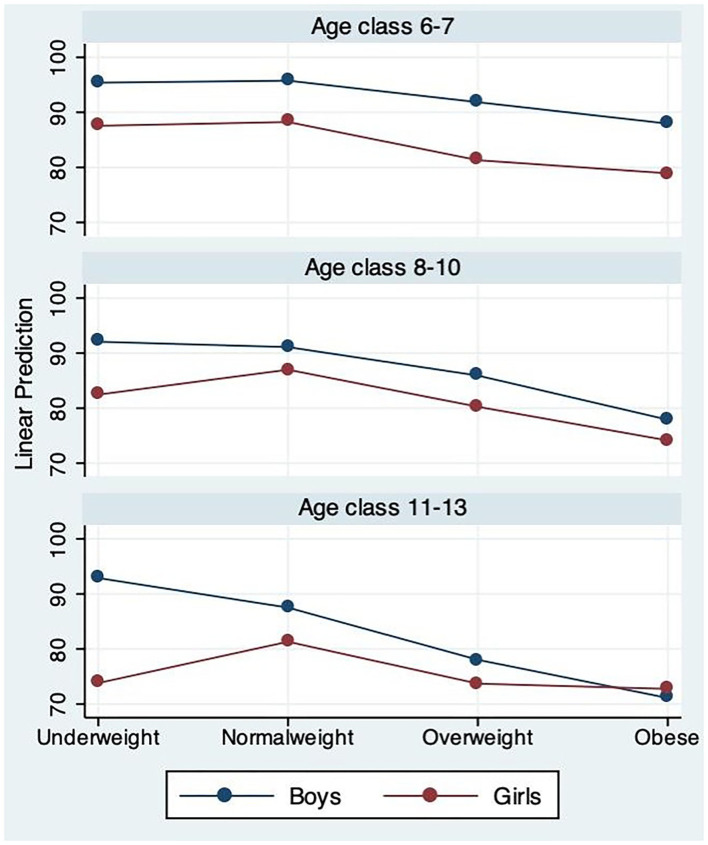
Although numerous evidences reported a negative correlation between motor coordination (MC) and overweight/obesity in children and adolescents, the interrelationship between age, gender, and weight status is still debatable. Hence, the aim of this cross-sectional study was to examine the association between MC and weight status according to age and gender across childhood and early adolescence in a large sample of Italian elementary and middle school students. A number of 1961 Italian school students (1,026 boys, 935 girls) was stratified in three consecutive age groups (6-7, 8-10, and 11-13 years) and four weight status categories (underweight, normal weight, overweight, and obese) according to Cole's body mass index (BMI) cut-off points for children. MC performance was assessed measuring motor quotient (MQ) with the Körperkoordinationstest für Kinder (KTK). Results showed significantly lower MQ levels in children in overweight (OW) and with obesity (OB) in both sexes for all age groups than peers in normal weight (NW), except in 6-7-year-old boys. Girls in OW and with OB had similar MQ levels across all age groups, while younger boys in OW and with OB showed higher MQ levels than older ones ( < 0.05). The 6-7-year-old boys showed better MQ levels than girls peers in NW, OW, and with OB, while 8-10-year-old boys in underweight (UW), NW, and OW; and 11-13-year-old boys only in NW ( < 0.05). No interaction effect was found between age, gender, and weight status on MQ levels. These outcomes showed the negative impact of higher weight status on MC performance according to age and gender, pointing out the importance of planning targeted motor programs that consider these variables to improve MC performance.
尽管大量证据表明儿童和青少年的运动协调性(MC)与超重/肥胖之间存在负相关,但年龄、性别和体重状况之间的相互关系仍存在争议。因此,这项横断面研究的目的是在一大群意大利中小学生中,根据年龄和性别,研究儿童期和青春期早期MC与体重状况之间的关联。1961名意大利在校学生(1026名男生,935名女生)按照科尔儿童体重指数(BMI)切点,被连续分为三个年龄组(6 - 7岁、8 - 10岁和11 - 13岁)和四个体重状况类别(体重过轻、正常体重、超重和肥胖)。使用儿童运动协调测试(KTK)测量运动商数(MQ)来评估MC表现。结果显示,在所有年龄组中,除6 - 7岁男孩外,超重(OW)和肥胖(OB)儿童的MQ水平显著低于正常体重(NW)的同龄人。OW和OB的女孩在所有年龄组中的MQ水平相似,而OW和OB的年幼男孩的MQ水平高于年长男孩(<0.05)。6 - 7岁男孩在NW、OW和OB组中的MQ水平高于同龄女孩,而8 - 10岁男孩在体重过轻(UW)、NW和OW组中;11 - 13岁男孩仅在NW组中(<0.05)。年龄、性别和体重状况对MQ水平没有交互作用。这些结果表明,根据年龄和性别,较高的体重状况对MC表现有负面影响,指出了制定考虑这些变量的针对性运动计划以提高MC表现的重要性。