Department of Surgery, University Hospital Zürich, Zürich, Switzerland.
Institute of Clinical Molecular Biology, Christian-Albrechts-University of Kiel, Kiel, Germany.
PLoS One. 2020 Jul 31;15(7):e0236936. doi: 10.1371/journal.pone.0236936. eCollection 2020.
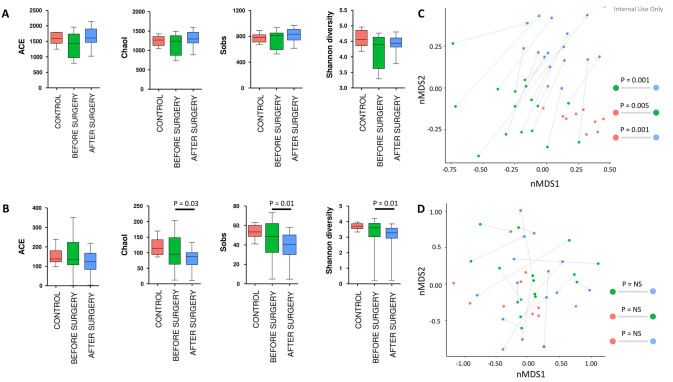
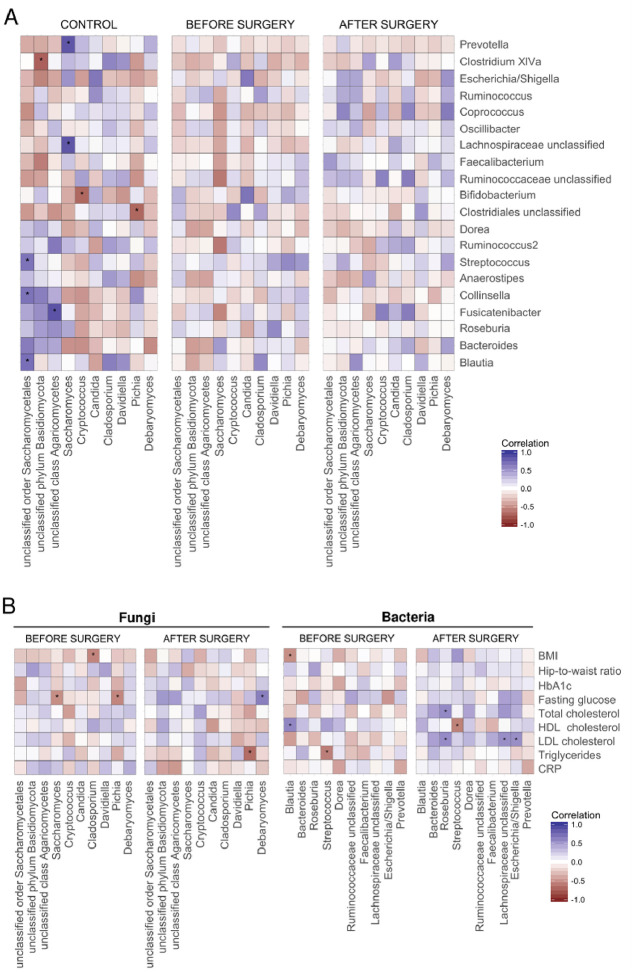
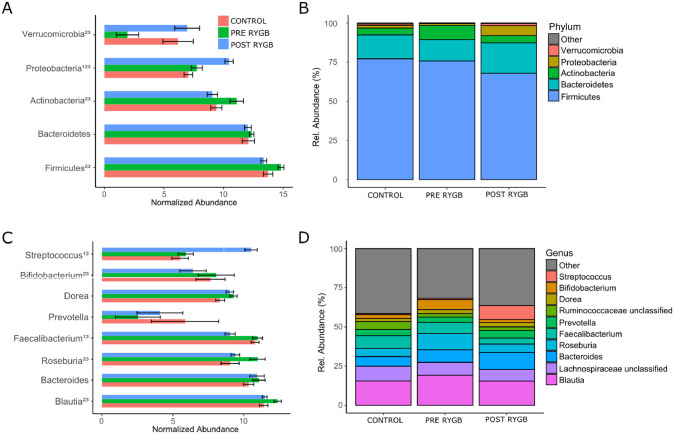
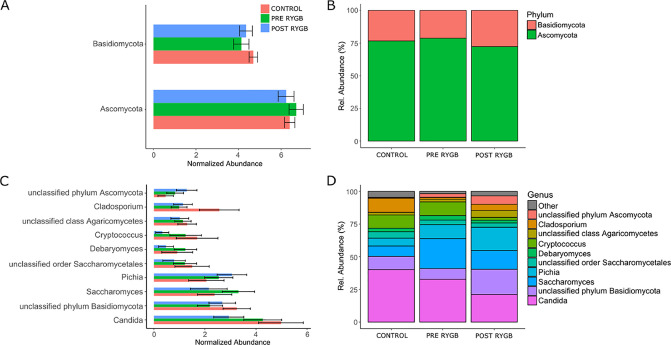
The Roux-en-Y gastric bypass (RYGB) remains the most effective treatment for morbidly obese patients to lower body weight and improve glycemic control. There is recent evidence that the mycobiome (fungal microbiome) can aggravate disease severity in a number of diseases including inflammatory bowel disease (IBD), irritable bowel syndrome (IBS) and hepatitis; moreover, a dysbiotic fungal microbiota has been reported in the obese. We characterized fungal and bacterial microbial composition in fecal samples of 16 morbidly obese patients before and three months after RYGB surgery and compared with nine healthy controls. We found that RYGB surgery induced a clear alteration in structure and composition of the gut fungal and bacterial microbiota. Beta diversity analysis revealed significant differences in bacterial microbiota between obese patients before surgery and healthy controls (P < 0.005) and a significant, unidirectional shift in RYGB patients after surgery (P < 0.001 vs. before surgery). In contrast, there was no significant difference in fungal microbiota between groups but individually specific changes after RYGB surgery. Interestingly, RYGB surgery induced a significant reduction in fungal alpha diversity namely Chao1, Sobs, and Shannon diversity index (P<0.05, respectively) which contrasts the trend for uniform changes in bacteria towards increased richness and diversity post-surgery. We did not observe any inter-kingdom relations in RYGB patients but in the healthy control cohort and there were several correlations between fungi and bacteria and clinical parameters (P<0.05, respectively) that warrant further research. Our study identifies changes in intestinal fungal communities in RYGB patients that are distinct to changes in the bacterial microbiota.
Roux-en-Y 胃旁路(RYGB)仍然是治疗病态肥胖患者降低体重和改善血糖控制的最有效方法。最近有证据表明,真菌群落(真菌微生物组)可以加重包括炎症性肠病(IBD)、肠易激综合征(IBS)和肝炎在内的许多疾病的严重程度;此外,肥胖患者中已经报道了失调的真菌微生物群。我们在 RYGB 手术前和手术后三个月对 16 名病态肥胖患者和 9 名健康对照者的粪便样本中的真菌和细菌微生物组成进行了特征描述。我们发现 RYGB 手术诱导了肠道真菌和细菌微生物群落结构和组成的明显改变。β多样性分析显示,肥胖患者手术前与健康对照组之间的细菌微生物群存在显著差异(P < 0.005),并且手术后 RYGB 患者存在显著的单向变化(P < 0.001 与手术前相比)。相比之下,各组之间的真菌微生物群没有显著差异,但手术后 RYGB 患者的个体特异性变化。有趣的是,RYGB 手术诱导了真菌α多样性的显著降低,即 Chao1、Sobs 和 Shannon 多样性指数(分别为 P<0.05),这与手术后细菌丰富度和多样性增加的趋势形成对比。我们在 RYGB 患者中没有观察到任何种间关系,但在健康对照组中观察到了,并且真菌和细菌与临床参数之间存在几种相关性(分别为 P<0.05),这值得进一步研究。我们的研究确定了 RYGB 患者肠道真菌群落的变化与细菌微生物群落的变化不同。