Moorthi Ranjani N, Liu Ziyue, El-Azab Sarah A, Lembcke Lauren R, Miller Matthew R, Broyles Andrea A, Imel Erik A
Department of Medicine, Indiana University School of Medicine, 1120 West Michigan Street CL 365, Indianapolis, Indiana, 46202-5111, USA.
Department of Biostatistics, Indiana University School of Public Health, Indianapolis, Indiana, 46202, USA.
BMC Musculoskelet Disord. 2020 Jul 31;21(1):508. doi: 10.1186/s12891-020-03522-9.
Sarcopenia, cachexia and frailty have overlapping features and clinical consequences, but often go unrecognized. The objective was to detect patients described by clinicians as having sarcopenia, cachexia or frailty within electronic health records (EHR) and compare clinical variables between cases and matched controls.
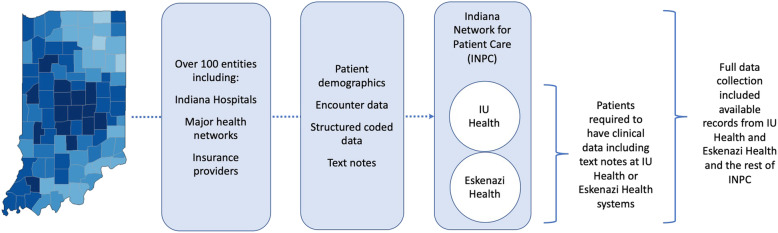
We conducted a case-control study using retrospective data from the Indiana Network for Patient Care multi-health system database from 2016 to 2017. The computable phenotype combined ICD codes for sarcopenia, cachexia and frailty, with clinical note text terms for sarcopenia, cachexia and frailty detected using natural language processing. Cases with these codes or text terms were matched to controls without these codes or text terms matched on birth year, sex and race. Two physicians reviewed EHR for all cases and a subset of controls. Comorbidity codes, laboratory values, and other coded clinical variables were compared between groups using Wilcoxon matched-pair sign-rank test for continuous variables and conditional logistic regression for binary variables.
Cohorts of 9594 cases and 9594 matched controls were generated. Cases were 59% female, 69% white, and a median (1st, 3rd quartiles) age 74.9 (62.2, 84.8) years. Most cases were detected by text terms without ICD codes n = 8285 (86.4%). All cases detected by ICD codes (total n = 1309) also had supportive text terms. Overall 1496 (15.6%) had concurrent terms or codes for two or more of the three conditions (sarcopenia, cachexia or frailty). Of text term occurrence, 97% were used positively for sarcopenia, 90% for cachexia, and 95% for frailty. The remaining occurrences were negative uses of the terms or applied to someone other than the patient. Cases had lower body mass index, albumin and prealbumin, and significantly higher odds ratios for diabetes, hypertension, cardiovascular and peripheral vascular diseases, chronic kidney disease, liver disease, malignancy, osteoporosis and fractures (all p < 0.05). Cases were more likely to be prescribed appetite stimulants and caloric supplements.
Patients detected with a computable phenotype for sarcopenia, cachexia and frailty differed from controls in several important clinical variables. Potential uses include detection among clinical cohorts for targeting recruitment for research and interventions.
肌肉减少症、恶病质和衰弱具有重叠的特征及临床后果,但往往未被识别。目的是在电子健康记录(EHR)中检测临床医生描述为患有肌肉减少症、恶病质或衰弱的患者,并比较病例组与匹配对照组之间的临床变量。
我们使用来自印第安纳患者护理网络多健康系统数据库2016年至2017年的回顾性数据进行了一项病例对照研究。可计算表型结合了肌肉减少症、恶病质和衰弱的ICD编码,以及使用自然语言处理检测到的肌肉减少症、恶病质和衰弱的临床笔记文本术语。有这些编码或文本术语的病例与没有这些编码或文本术语的对照组进行匹配,匹配因素包括出生年份、性别和种族。两名医生查看了所有病例和一部分对照组的EHR。使用Wilcoxon配对符号秩检验比较连续变量的合并症编码、实验室值和其他编码临床变量,使用条件逻辑回归比较二元变量。
生成了9594例病例和9594例匹配对照组。病例组中女性占59%,白人占69%,年龄中位数(第1、3四分位数)为74.9(62.2,84.8)岁。大多数病例是通过无ICD编码的文本术语检测到的,n = 8285(86.4%)。所有通过ICD编码检测到的病例(共n = 1309)也有支持性文本术语。总体而言,1496例(15.6%)有三种情况(肌肉减少症、恶病质或衰弱)中两种或更多种的并发术语或编码。在文本术语出现情况中,97%用于积极描述肌肉减少症,90%用于恶病质,95%用于衰弱。其余出现情况是术语的消极使用或应用于患者以外的其他人。病例组的体重指数、白蛋白和前白蛋白较低,患糖尿病、高血压、心血管和外周血管疾病、慢性肾病、肝病、恶性肿瘤、骨质疏松症和骨折的比值比显著更高(所有p < 0.05)。病例组更有可能被开具食欲刺激剂和热量补充剂。
通过可计算表型检测出患有肌肉减少症、恶病质和衰弱的患者在几个重要临床变量上与对照组不同。潜在用途包括在临床队列中进行检测,以便为研究和干预确定招募对象。