Schools of Architecture, Design and Conservation, The Royal Danish Academy of Fine Arts, Philip de Langes Allé 10, 1435, Copenhagen K, Denmark.
Medical Research Council Unit, The Gambia at the London School of Hygiene & Tropical Medicine, Fajara, The Gambia.
Malar J. 2020 Jul 31;19(1):273. doi: 10.1186/s12936-020-03327-0.
African houses are frequently too hot and uncomfortable to use a bed net at night. Indoor thermal comfort is often evaluated by measuring temperature and humidity, ignoring ventilation. This study explored ways to measure ventilation in single-roomed rural Gambian houses during the malaria transmission season and evaluated building designs that could increase airflow at night and help keep the occupants comfortable.
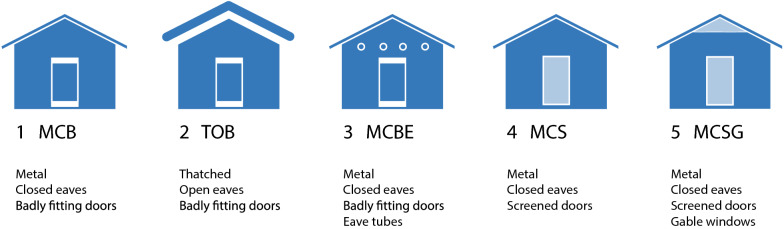
Two identical mud-walled houses were constructed with a metal roof, three doors and closed eaves. Experiment 1 compared five methods for measuring ventilation in a building: (1) using a blower door, (2) increasing carbon dioxide (CO) levels indoors using an artificial source of CO and then measuring the rate of gas decay, (3) using a similar approach with a natural source of CO, (4) measuring the rise of CO when people enter a building and (5) using hot-wire anemometers. Experiment 2 used CO data loggers to compare ventilation in a reference metal-roofed house with closed eaves and badly-fitting doors with a similar house with (1) thatched roof and open eaves, (2) eaves tubes, (3) screened doors and (4) screened doors and windows.
In experiment 1, CO data loggers placed indoors in two identical houses showed similar changes in airflow (p > 0.05) for all three methods recording either decreasing or increasing CO. Blower doors were unable to measure airflow in houses with open eaves or screened windows and the anemometers broke down under field conditions. In experiment 2, open eaves in thatched houses, screened doors alone, and screened doors and windows increased indoor ventilation compared to the reference metal-roofed house with closed eaves and badly fitting doors (p < 0.05). Eaves tubes did not increase ventilation in comparison to the reference house.
CO data loggers proved to be a simple and efficient method for measuring ventilation in rural houses at night. Ventilation of metal-roofed houses can be improved by adding two screened doors and windows on opposite walls. Improved ventilation will result in increased thermal comfort making it more likely that people will sleep under a bed net.
非洲的房屋在夜间通常非常炎热和不舒适,无法使用蚊帐。室内热舒适度通常通过测量温度和湿度来评估,而忽略了通风。本研究旨在探索在疟疾传播季节测量单房间冈比亚农村房屋通风的方法,并评估可以增加夜间气流并帮助居住者保持舒适的建筑设计。
用金属屋顶、三扇门和封闭的屋檐建造了两个相同的泥墙房屋。实验 1 比较了五种测量建筑物通风的方法:(1) 使用风机门,(2) 使用人工 CO 源增加室内 CO 水平,然后测量气体衰减率,(3) 使用天然 CO 源采用类似方法,(4) 测量人进入建筑物时 CO 的上升,(5) 使用热线风速仪。实验 2 使用 CO 数据记录器比较具有封闭屋檐和不合适门的参考金属屋顶房屋与具有 (1) 茅草屋顶和开放屋檐、(2) 屋檐管、(3) 筛门和 (4) 筛门窗的类似房屋的通风情况。
在实验 1 中,放置在两个相同房屋内的 CO 数据记录器显示出相似的气流变化(p>0.05),所有三种记录 CO 减少或增加的方法均如此。带有开放屋檐或筛网窗户的房屋,风机门无法测量气流,而野外条件下的风速计则发生故障。在实验 2 中,与具有封闭屋檐和不合适门的参考金属屋顶房屋相比,茅草屋顶房屋中的开放屋檐、单独的筛门以及筛门窗增加了室内通风(p<0.05)。与参考房屋相比,屋檐管并未增加通风。
CO 数据记录器被证明是测量夜间农村房屋通风的简单而有效的方法。在金属屋顶房屋上增加两个相对墙壁上的筛门窗可以改善通风。改善通风将提高热舒适度,使人们更有可能在蚊帐下入睡。