Dept. Translational Neuroscience, Brain Center Rudolf Magnus, University Medical Center Utrecht, Utrecht University, Utrecht, the Netherlands.
Dept. Psychology, Education and Child Studies, Erasmus University Rotterdam, the Netherlands; Primary Care Unit, School of Clinical Medicine, University of Cambridge, United Kingdom.
Dev Cogn Neurosci. 2020 Oct;45:100827. doi: 10.1016/j.dcn.2020.100827. Epub 2020 Jul 18.
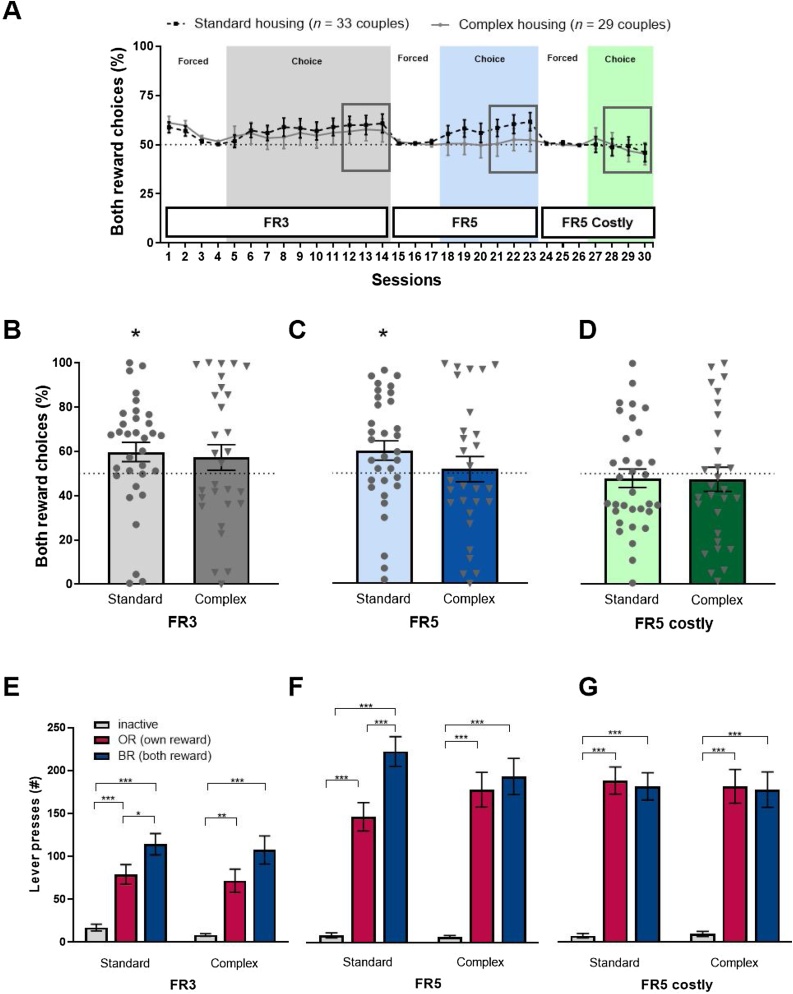
In this study, we aimed to develop a behavioral task that measures pro-social decision making in rats. A fully automated, operant pro-social two-choice task is introduced that quantifies pro-social preferences for a mutual food reward in a set-up with tightly controlled task contingencies. Pairs of same-sex adult Wistar rats were placed in an operant chamber divided into two compartments (one rat per compartment), separated by a transparent barrier with holes that allowed the rats to see, hear, smell, but not touch each other. Test rats could earn a sucrose pellet either for themselves (own reward) or for themselves and the partner (both reward) by means of lever pressing. On average, male rats showed a 60 % preference for the lever that yielded a food reward for both themselves and their partner. In contrast, females did not show lever preference, regardless of the estrous cycle phase. Next, the impact of juvenile environmental factors on male rat social decision making was studied. Males were group-housed from postnatal day 26 onwards in complex housing Marlau™ cages that provided social and physical enrichment and stimulation in the form of novelty. Complex housed males did not show a preference for the pro-social lever.
在这项研究中,我们旨在开发一种测量大鼠亲社会决策的行为任务。引入了一种完全自动化的操作性亲社会双选择任务,该任务在严格控制任务条件的设置下,量化了对共同食物奖励的亲社会偏好。将成年同性别 Wistar 大鼠放入操作室,分为两个隔间(每个隔间一只大鼠),透明隔板上有孔,使大鼠可以看到、听到、闻到彼此,但不能触摸。测试大鼠可以通过按压杠杆为自己(自身奖励)或自己和伙伴(两者奖励)获得蔗糖丸。平均而言,雄性大鼠对产生自己和伙伴食物奖励的杠杆表现出 60%的偏好。相比之下,雌性大鼠无论在发情周期的哪个阶段都没有表现出杠杆偏好。接下来,研究了幼年环境因素对雄性大鼠社会决策的影响。雄性大鼠从出生后第 26 天开始在复杂的 Marlau™笼中群居,这种笼子以新奇的形式提供社交和身体上的丰富和刺激。群居的雄性大鼠对亲社会杠杆没有表现出偏好。