Division of Rheumatology, University of Pennsylvania, Philadelphia, PA, USA.
Department of Biostatistics, Epidemiology, and Informatics, University of Pennsylvania, Philadelphia, PA, USA.
Curr Rheumatol Rep. 2020 Aug 1;22(9):56. doi: 10.1007/s11926-020-00933-4.
A growing number of studies have suggested that disease outcomes and response to therapy may be different in patients with rheumatoid arthritis (RA) who are obese. The goal of this review is to examine the most recent literature, with a focus on the impact of obesity on the assessment of disease activity and treatment outcomes in RA.
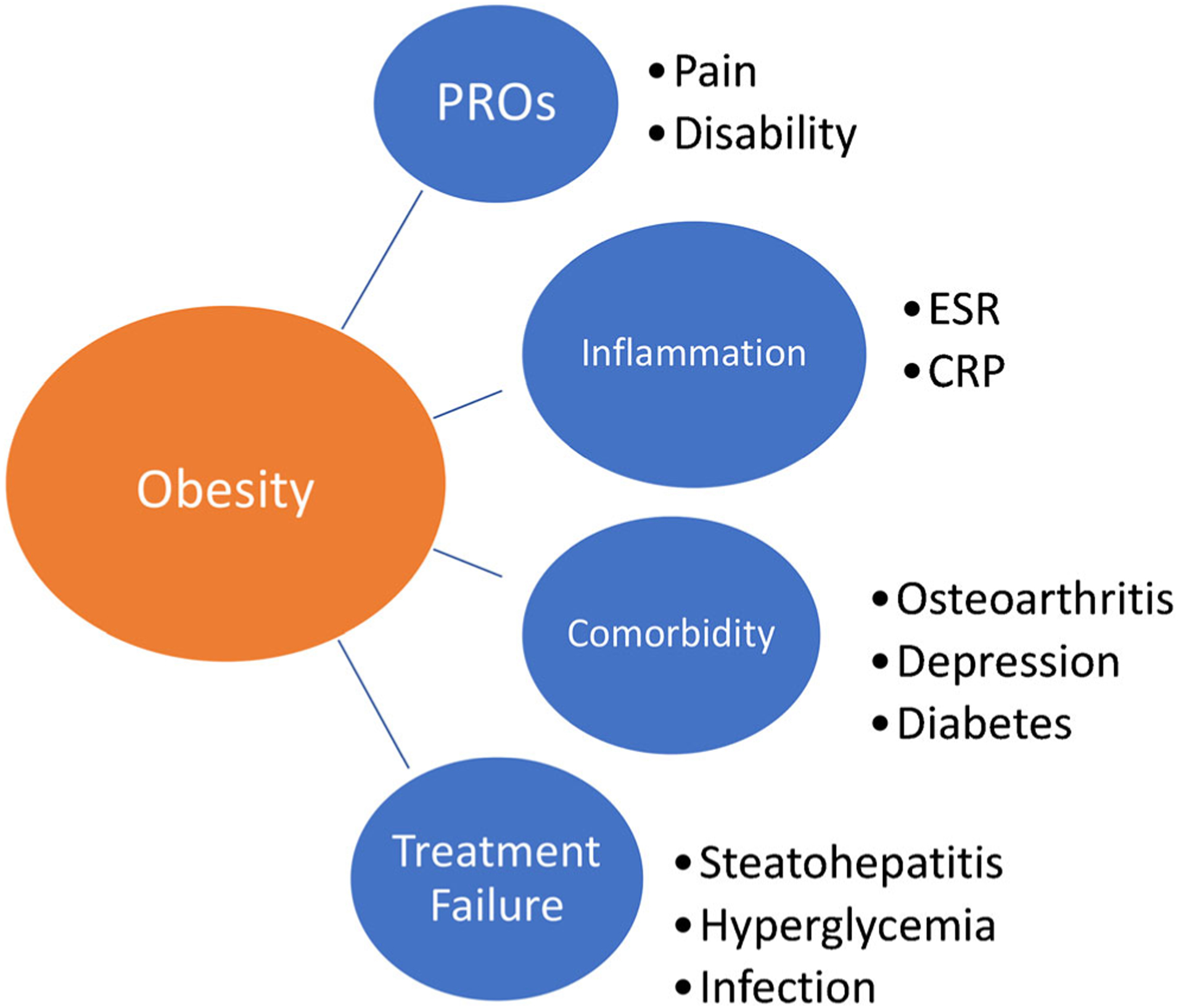
Obesity is common in patients with RA and can have a substantial impact on patient symptoms and outcomes. Obesity is associated with higher rates of chronic pain and opiate use, elevated inflammatory markers, and less reliable physical exam findings, making assessment of disease activity and treatment response more challenging. Despite seemingly worse clinical disease activity, evidence has accumulated demonstrating that obese patients with RA have less inflammation by imaging and lower rates of radiographic progression over time. Whether obesity influences the effectiveness of specific therapies remains controversial. Obesity is very common and is associated with more severe symptoms and higher rates of disability among RA patients. While clinical disease activity is frequently observed to be higher in obese patients with RA, it remains unclear whether poorer treatment response rates in this setting are related to reduced efficacy of therapies or are an artifact of biases in the accurate assessment of the disease.
越来越多的研究表明,肥胖的类风湿关节炎(RA)患者的疾病结局和治疗反应可能不同。本综述的目的是检查最新的文献,重点关注肥胖对 RA 患者疾病活动度评估和治疗结果的影响。
肥胖在 RA 患者中很常见,会对患者的症状和结局产生重大影响。肥胖与更高的慢性疼痛和阿片类药物使用率、更高的炎症标志物以及更不可靠的体格检查结果相关,这使得疾病活动度的评估和治疗反应更具挑战性。尽管临床疾病活动度似乎更差,但有证据表明,肥胖的 RA 患者通过影像学检查显示炎症水平较低,随着时间的推移放射学进展的速度较慢。肥胖是否影响特定治疗的有效性仍存在争议。肥胖非常常见,与 RA 患者更严重的症状和更高的残疾率相关。虽然经常观察到肥胖的 RA 患者的临床疾病活动度更高,但尚不清楚这种情况下治疗反应率较低是否与治疗效果降低有关,还是与疾病准确评估中的偏差有关。