Peyman Nooshin, Shahedi Fateme, Abdollahi Mahbubeh, Doosti Hassan, Zadehahmad Zohre
Department of Health Education and Health Promotion, School of Health, Mashhad University of Medical Sciences, Mashhad, Iran.
Department of Radiology, School of Paramedical Sciences, Torbat Heydariyeh University of Medical Sciences, Torbat Heydariyeh, Iran.
J Tehran Heart Cent. 2020 Jan;15(1):6-11.
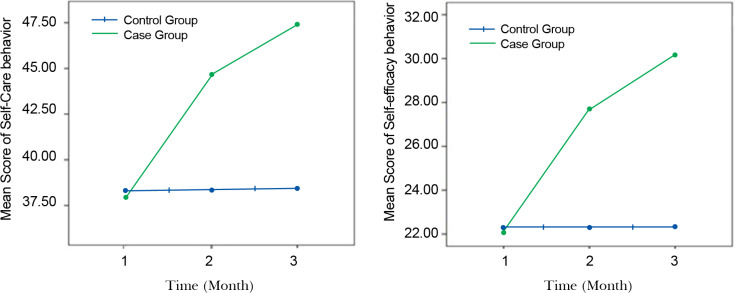
Self-efficacy in self-care behaviors is an effective framework for measuring patients' degree of ability to perform self-care behaviors that significantly affect their recovery process and quality of life. This study was designed to investigate the effects of education based on self-efficacy strategies on self-care behaviors in heart failure patients. : A semi-experimental study was conducted on 80 heart failure patients divided into 2 equal groups of test and control. The intervention group received three 60-minute practical and theoretical training sessions based on self-care and self-efficacy strategies, while the control group received the usual care services. Self-care behaviors and self-efficacy were evaluated before training, shortly after training, and 3 months after the training program using the Sullivan self-efficacy questionnaire for heart failure patients and the European self-care behaviors questionnaires. : The mean age of the patients was 55.00±8.48 and 51.61±8.51 years in the intervention and control groups, respectively. Women comprised 73.7% (n=59) of the study population. The mean score for the self-care and self-efficacy questionnaires in the experimental group was 23.50±6.58 and 18.57±6.64, correspondingly, before the intervention, which increased to 42.64±6.74 (P<0.014) and 32.29±7.06 (P<0.001), respectively, shortly after the intervention. A significant improvement also occurred at 3 months' follow-up (P<0.001). Self-care behaviors also revealed a positive correlation with self-efficacy shortly after the intervention (r=0.82, P<0.001) and 3 months after the intervention (r=0.85, P<0.001). : The implementation of educational interventions based on self-efficacy strategies could have positive effects on health-promoting behaviors among heart failure patients.
自我护理行为中的自我效能感是衡量患者执行自我护理行为能力程度的有效框架,这些行为会显著影响其康复过程和生活质量。本研究旨在调查基于自我效能感策略的教育对心力衰竭患者自我护理行为的影响。:对80名心力衰竭患者进行了一项半实验研究,将其分为测试组和对照组两组,每组人数相等。干预组接受了基于自我护理和自我效能感策略的三次60分钟的实践和理论培训课程,而对照组接受常规护理服务。使用针对心力衰竭患者的沙利文自我效能感问卷和欧洲自我护理行为问卷,在培训前、培训后不久以及培训项目结束3个月后对自我护理行为和自我效能感进行评估。:干预组和对照组患者的平均年龄分别为55.00±8.48岁和51.61±8.51岁。女性占研究人群的73.7%(n = 59)。干预前,实验组自我护理和自我效能感问卷的平均得分分别为23.50±6.58和18.57±6.64,干预后不久分别提高到42.64±6.74(P < 0.014)和32.29±7.06(P < 0.001)。在3个月的随访中也出现了显著改善(P < 0.001)。干预后不久(r = 0.82,P < 0.001)和干预后3个月(r = 0.85,P < 0.001),自我护理行为与自我效能感也呈现出正相关。:基于自我效能感策略的教育干预实施对心力衰竭患者的健康促进行为可能具有积极影响。