Bobrovskikh Aleksandr, Zubairova Ulyana, Kolodkin Alexey, Doroshkov Alexey
The Federal Research Center Institute of Cytology and Genetics, Siberian Branch of the Russian Academy of Sciences, Novosibirsk, Russian Federation.
Novosibirsk State University, Novosibirsk, Russian Federation.
PeerJ. 2020 Jul 16;8:e9451. doi: 10.7717/peerj.9451. eCollection 2020.
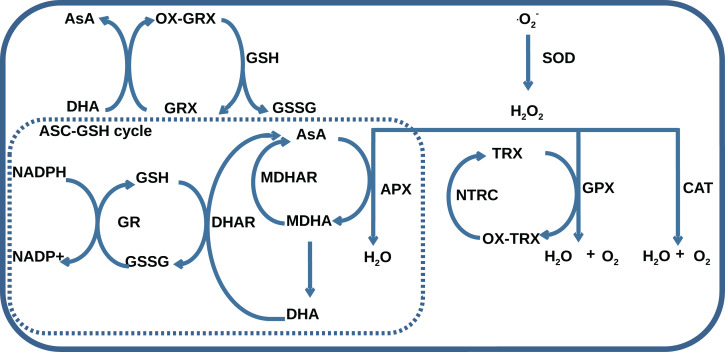
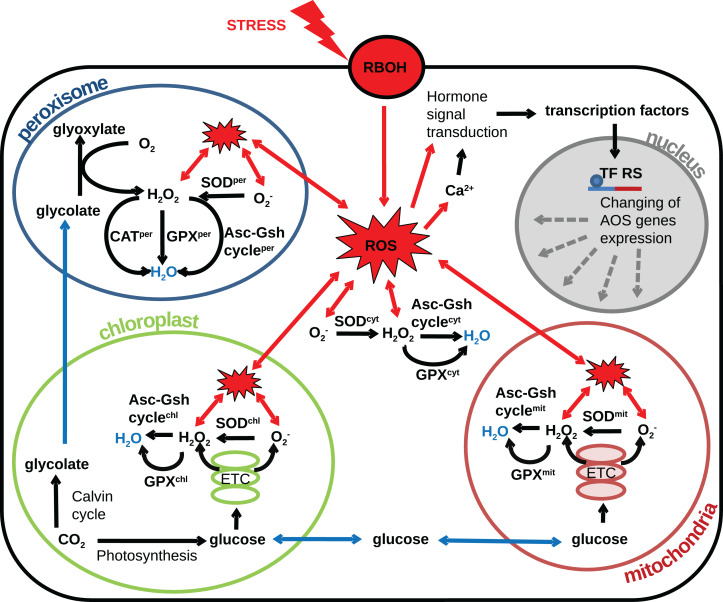
The antioxidant system (AOS) maintains the optimal concentration of reactive oxygen species (ROS) in a cell and protects it against oxidative stress. In plants, the AOS consists of seven main classes of antioxidant enzymes, low-molecular antioxidants (e.g., ascorbate, glutathione, and their oxidized forms) and thioredoxin/glutaredoxin systems which can serve as reducing agents for antioxidant enzymes. The number of genes encoding AOS enzymes varies between classes, and same class enzymes encoded by different gene copies may have different subcellular localizations, functional loads and modes of evolution. These facts hereafter reinforce the complex nature of AOS regulation and functioning. Further studies can describe new trends in the behavior and functioning of systems components, and provide new fundamental knowledge about systems regulation. The system is revealed to have a lot of interactions and interplay pathways between its components at the subcellular level (antioxidants, enzymes, ROS level, and hormonal and transcriptional regulation). These facts should be taken into account in further studies during the AOS modeling by describing the main pathways of generating and utilizing ROS, as well as the associated signaling processes and regulation of the system on cellular and organelle levels, which is a complicated and ambitious task. Another objective for studying the phenomenon of the AOS is related to the influence of cell dynamics and circadian rhythms on it. Therefore, the AOS requires an integrated and multi-level approach to study. We focused this review on the existing scientific background and experimental data used for the systems biology research of the plant AOS.
抗氧化系统(AOS)维持细胞内活性氧(ROS)的最佳浓度,并保护细胞免受氧化应激。在植物中,AOS由七类主要的抗氧化酶、低分子抗氧化剂(如抗坏血酸、谷胱甘肽及其氧化形式)以及硫氧还蛋白/谷氧还蛋白系统组成,这些系统可作为抗氧化酶的还原剂。编码AOS酶的基因数量在不同类别之间有所不同,并且由不同基因拷贝编码的同一类酶可能具有不同的亚细胞定位、功能负荷和进化模式。这些事实进一步强化了AOS调节和功能的复杂性。进一步的研究可以描述系统组件行为和功能的新趋势,并提供有关系统调节的新基础知识。该系统在亚细胞水平(抗氧化剂、酶、ROS水平以及激素和转录调节)的组件之间具有大量的相互作用和相互作用途径。在通过描述ROS产生和利用的主要途径以及细胞和细胞器水平上系统的相关信号传导过程和调节来对AOS进行建模的进一步研究中,应考虑这些事实,这是一项复杂且艰巨的任务。研究AOS现象的另一个目标与细胞动态和昼夜节律对它的影响有关。因此,AOS需要采用综合的多层次方法进行研究。我们将本综述聚焦于用于植物AOS系统生物学研究的现有科学背景和实验数据。