Neilan Anne M, Losina Elena, Bangs Audrey C, Flanagan Clare, Panella Christopher, Eskibozkurt G Ege, Mohareb Amir, Hyle Emily P, Scott Justine A, Weinstein Milton C, Siedner Mark J, Reddy Krishna P, Harling Guy, Freedberg Kenneth A, Shebl Fatma M, Kazemian Pooyan, Ciaranello Andrea L
Division of General Academic Pediatrics, Department of Pediatrics, Massachusetts General Hospital, Boston, MA.
Division of Infectious Diseases, Department of Medicine, Massachusetts General Hospital, Boston, MA.
medRxiv. 2020 Jul 24:2020.07.23.20160820. doi: 10.1101/2020.07.23.20160820.
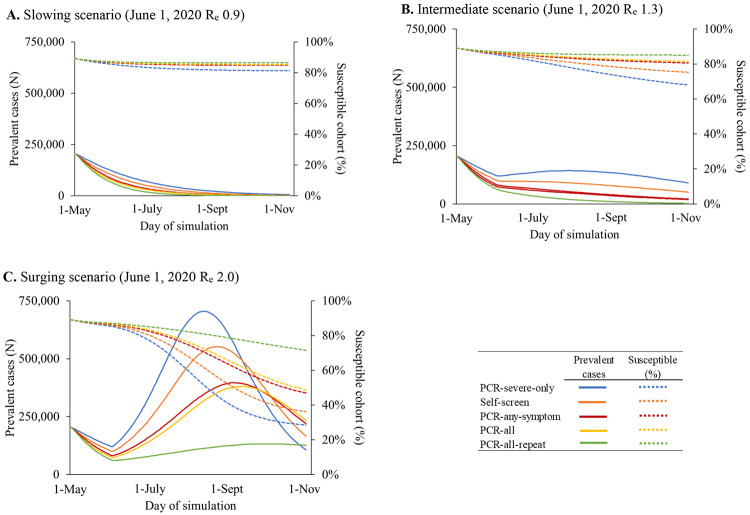
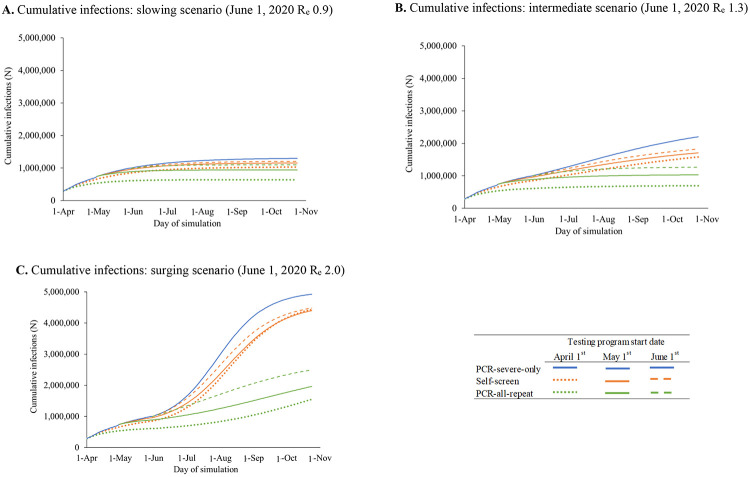
Background We projected the clinical and economic impact of alternative testing strategies on COVID-19 incidence and mortality in Massachusetts using a microsimulation model. Methods We compared five testing strategies: 1) PCR-severe-only: PCR testing only patients with severe/critical symptoms; 2) Self-screen: PCR-severe-only plus self-assessment of COVID-19-consistent symptoms with self-isolation if positive; 3) PCR-any-symptom: PCR for any COVID-19-consistent symptoms with self-isolation if positive; 4) PCR-all: PCR-any-symptom and one-time PCR for the entire population; and, 5) PCR-all-repeat: PCR-all with monthly re-testing. We examined effective reproduction numbers (R , 0.9-2.0) at which policy conclusions would change. We used published data on disease progression and mortality, transmission, PCR sensitivity/specificity (70/100%) and costs. Model-projected outcomes included infections, deaths, tests performed, hospital-days, and costs over 180-days, as well as incremental cost-effectiveness ratios (ICERs, $/quality-adjusted life-year [QALY]). Results In all scenarios, PCR-all-repeat would lead to the best clinical outcomes and PCR-severe-only would lead to the worst; at R 0.9, PCR-all-repeat vs. PCR-severe-only resulted in a 63% reduction in infections and a 44% reduction in deaths, but required >65-fold more tests/day with 4-fold higher costs. PCR-all-repeat had an ICER <$100,000/QALY only when R ≥1.8. At all R values, PCR-any-symptom was cost-saving compared to other strategies. Conclusions Testing people with any COVID-19-consistent symptoms would be cost-saving compared to restricting testing to only those with symptoms severe enough to warrant hospital care. Expanding PCR testing to asymptomatic people would decrease infections, deaths, and hospitalizations. Universal screening would be cost-effective when paired with monthly retesting in settings where the COVID-19 pandemic is surging.
背景 我们使用微观模拟模型预测了替代检测策略对马萨诸塞州新冠病毒疾病发病率和死亡率的临床及经济影响。方法 我们比较了五种检测策略:1)仅对重症患者进行聚合酶链反应(PCR)检测:仅对有严重/危急症状的患者进行PCR检测;2)自我筛查:在仅对重症患者进行PCR检测的基础上,加上对新冠病毒相关症状的自我评估,若呈阳性则进行自我隔离;3)有症状即进行PCR检测:对任何新冠病毒相关症状进行PCR检测,若呈阳性则进行自我隔离;4)全员PCR检测:对有症状即进行PCR检测,并对全体人群进行一次PCR检测;以及5)全员重复PCR检测:全员PCR检测并每月重新检测。我们研究了有效再生数(R,0.9 - 2.0),在此数值下政策结论会发生变化。我们使用了已发表的关于疾病进展和死亡率、传播、PCR敏感性/特异性(70/100%)及成本的数据。模型预测的结果包括180天内的感染数、死亡数、检测次数、住院天数及成本,以及增量成本效益比(ICER,美元/质量调整生命年[QALY])。结果 在所有情况下,全员重复PCR检测将带来最佳临床结果,而仅对重症患者进行PCR检测则会导致最差结果;在R = 0.9时,全员重复PCR检测与仅对重症患者进行PCR检测相比,感染数减少63%,死亡数减少44%,但每天所需检测次数增加超过65倍,成本高出4倍。仅当R≥1.8时,全员重复PCR检测的ICER < 100,000美元/QALY。在所有R值下,与其他策略相比,有症状即进行PCR检测节省成本。结论 与仅对症状严重到需要住院治疗的患者进行检测相比,对任何新冠病毒相关症状的人群进行检测将节省成本。将PCR检测扩展到无症状人群将减少感染、死亡和住院人数。在新冠疫情激增的环境中,当与每月重新检测相结合时,普遍筛查将具有成本效益。