Tohoku Medical Megabank Organization, Tohoku University, Sendai, Japan.
Innovation Division, KAGOME CO., LTD., Nasushiobara, Japan.
Nutr J. 2020 Aug 3;19(1):80. doi: 10.1186/s12937-020-00595-z.
Associations of fruit and vegetable consumption before and during pregnancy with birth weight of new-borns and the risk of low birth weight (LBW) remain unclear.
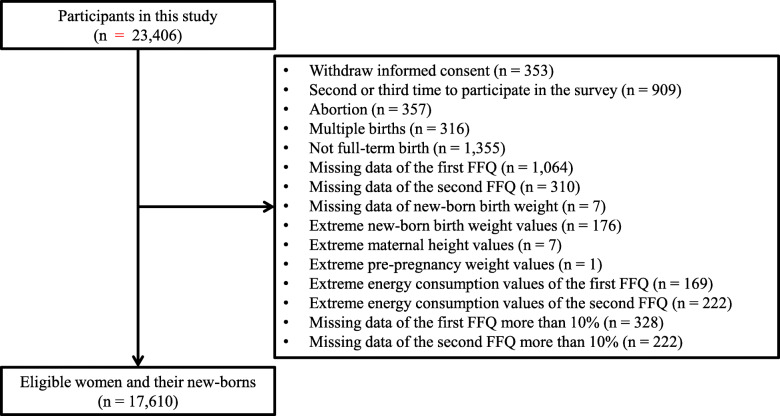
Between July 2013 and March 2017, we recruited 23,406 pregnant women in the Tohoku Medical Megabank Project Birth and Three-Generation Cohort Study (TMM BirThree Cohort Study). Fruit and vegetable consumption before and during pregnancy was calculated using food frequency questionnaires. Information regarding birth weight was obtained from medical records, and LBW was defined as < 2500 g. We used a multivariable linear regression model and a multivariate logistic regression model to assess associations between fruit and vegetable consumption and birth weight/risk of LBW.
In total, 17,610 women were included in the analysis. Mean birth weight was 3061.8 ± 354.1 g, and 5.4% of the new-borns had LBW. Compared to women in the lowest quartile of fruit consumption between pre- and early pregnancy, women in the highest quartile had heavier new-borns (β = 49.4; 95% CI: 34.1-64.7) and lower risk of LBW (OR: 0.79; 95% CI: 0.65-0.95). Women in the highest quartile of fruit consumption from early to mid-pregnancy also had heavier new-borns (β = 32.3; 95% CI: 17.1-47.6), and they tended to have lower risk of LBW (OR: 0.83; 95% CI: 0.69-1.01). Results of analysing the association between changes in fruit consumption from pre- to mid-pregnancy and birth outcomes revealed that women with continuous high fruit consumption from pre- to mid-pregnancy had heavier new-borns (β = 37.6; 95% CI: 25.0-50.3), but they did not have lower risk of LBW (OR: 0.90; 95% CI: 0.77-1.06). Associations involving vegetable consumption and birth weight/risk of LBW were not observed.
Fruit consumption before and during pregnancy was positively associated with birth weight of new-borns and negatively associated with risk of LBW.
在妊娠前后摄入水果和蔬菜与新生儿出生体重和低出生体重(LBW)风险之间的关系尚不清楚。
在 2013 年 7 月至 2017 年 3 月期间,我们在东北医科大学母婴三代队列研究(TMM BirThree 队列研究)中招募了 23406 名孕妇。妊娠前后的水果和蔬菜摄入量是通过食物频率问卷来计算的。出生体重信息来自医疗记录,LBW 定义为 <2500g。我们使用多变量线性回归模型和多变量逻辑回归模型来评估妊娠前后水果和蔬菜摄入与出生体重/ LBW 风险之间的关系。
共纳入 17610 名女性进行分析。新生儿的平均出生体重为 3061.8±354.1g,5.4%的新生儿为 LBW。与妊娠前和孕早期水果摄入量最低四分位的女性相比,水果摄入量最高四分位的女性的新生儿体重更重(β=49.4;95%CI:34.1-64.7),LBW 风险更低(OR:0.79;95%CI:0.65-0.95)。从孕早期到孕中期水果摄入量最高四分位的女性的新生儿体重也更重(β=32.3;95%CI:17.1-47.6),且 LBW 风险较低(OR:0.83;95%CI:0.69-1.01)。分析妊娠前到孕中期水果摄入量变化与出生结局之间的关系的结果显示,妊娠前到孕中期持续高水果摄入量的女性新生儿体重更重(β=37.6;95%CI:25.0-50.3),但 LBW 风险没有降低(OR:0.90;95%CI:0.77-1.06)。没有观察到蔬菜摄入与出生体重/LBW 风险之间的关系。
妊娠前后水果的摄入与新生儿出生体重呈正相关,与 LBW 风险呈负相关。