Leeds Orthopaedic and Trauma Sciences, Leeds Institute of Rheumatic and Musculoskeletal Medicine, University of Leeds, Leeds, UK.
Bradford Royal Infirmary, Bradford, UK.
Hip Int. 2021 Sep;31(5):609-617. doi: 10.1177/1120700020946716. Epub 2020 Aug 4.
The angle of acetabular (cup) radiographic inclination is an important measurement in total hip arthroplasty (THA) procedures. Abnormal radiographic inclination is associated with dislocation, edge loading and higher failure rates. Consistently achieving a satisfactory radiographic inclination remains a challenge. Inclinometers have been increasingly used over the last decade. This paper reviews the literature to determine whether using an inclinometer improves the accuracy of acetabular cup inclination in THA.
A systematic literature search was performed. The following search terms were used: ('hip' OR 'hip replacement' OR 'hip arthroplasty' OR 'primary hip replacement' OR 'THR' OR 'THA' OR 'Acetabular cup Inclination') AND ('Inclinometer'). Titles and abstracts were screened for relevance. Both radiographic and operative inclination comparisons were included.
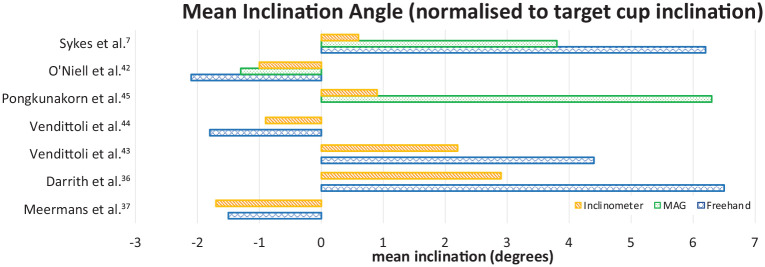
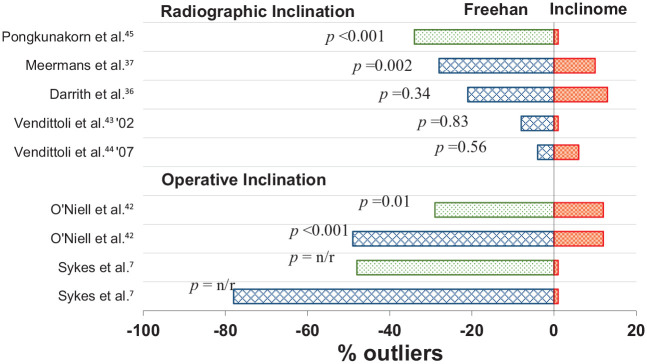
7 studies met the inclusion criteria. 2 were randomised control trials with level I evidence, and the remaining studies were cohort studies with level III/IV evidence. 5 were clinical and 2 experimental. In total there were 16 cohorts: 7 using an inclinometer, 6 freehand, and 3 using MAG techniques. All studies comparing radiographic inclination and 1 of 2 studies comparing operative inclination showed an improvement in the attainment of the optimal inclination. Similarly, the use of an inclinometer showed a reduction in the number of outliers when compared to MAG and freehand techniques.
This review demonstrates that using an inclinometer improved the surgeon's ability to achieve their intended inclination (both operative and radiographic) and reduced the incidence of positioning outside the safe-zone. However, only 2 of the studies were randomised control trials and these resulted in opposing conclusions. Therefore, further studies looking at the use of inclinometers would prove useful in understanding their true benefit.
髋臼(杯)放射倾斜角度是全髋关节置换术(THA)程序中的一个重要测量值。异常的放射倾斜角度与脱位、边缘负荷和更高的失败率有关。一致地达到满意的放射倾斜角度仍然是一个挑战。在过去的十年中,倾斜计的使用越来越多。本文综述了文献,以确定使用倾斜计是否能提高 THA 髋臼杯倾斜的准确性。
进行了系统的文献检索。使用了以下搜索词:(“髋”或“髋关节置换”或“髋关节成形术”或“原发性髋关节置换”或“THR”或“THA”或“髋臼杯倾斜”)和(“倾斜计”)。筛选标题和摘要以确定相关性。包括放射学和手术倾斜比较。
符合纳入标准的有 7 项研究。其中 2 项为随机对照试验,具有 I 级证据,其余研究为队列研究,具有 III/IV 级证据。5 项为临床研究,2 项为实验研究。共有 16 个队列:7 个使用倾斜计,6 个徒手,3 个使用 MAG 技术。所有比较放射学倾斜的研究和比较手术倾斜的 2 项研究中的 1 项都表明,在获得最佳倾斜方面有所改善。同样,与 MAG 和徒手技术相比,使用倾斜计可以减少离群值的数量。
本综述表明,使用倾斜计提高了外科医生达到预期倾斜度(手术和放射学)的能力,并降低了定位超出安全区的发生率。然而,只有 2 项研究为随机对照试验,这些研究得出了相反的结论。因此,进一步研究倾斜计的使用将有助于了解其真正的益处。