Centre for Medicine Use and Safety, Monash Institute of Pharmaceutical Sciences, Melbourne, Victoria, Australia.
Department of Epidemiology and Preventive Medicine, Melbourne, Victoria, Australia; Monash University, Melbourne Medical School, University of Melbourne, Melbourne, Victoria, Australia.
Mayo Clin Proc. 2020 Aug;95(8):1621-1631. doi: 10.1016/j.mayocp.2020.05.030. Epub 2020 Jun 6.
To estimate the prevalence of olfactory and gustatory dysfunctions (OGDs) among patients infected with novel coronavirus disease 2019 (COVID-19).
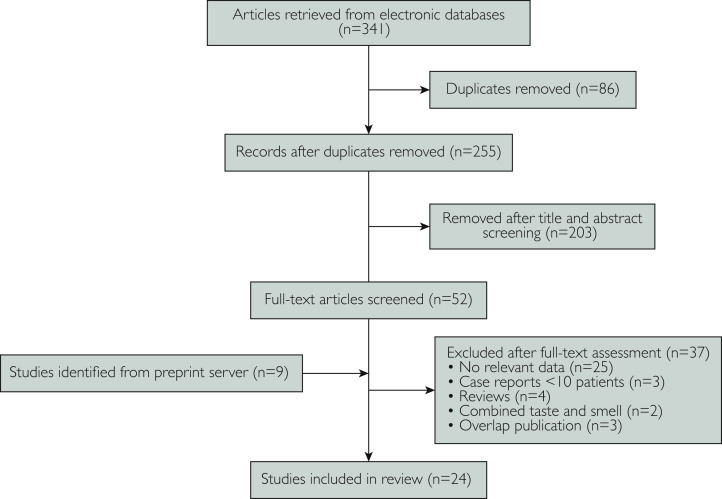
A systematic review was conducted by searching MEDLINE, EMBASE, and the preprint server MedRxiv from their inception until May 11, 2020, using the terms anosmia or hyposmia or dysosmia or olfactory dysfunction or olfaction disorder or smell dysfunction or ageusia or hypogeusia or dysgeusia or taste dysfunction or gustatory dysfunction or neurological and COVID-19 or 2019 novel coronavirus or 2019-nCoV or SARS-CoV-2. The references of included studies were also manually screened. Only studies involving patients with diagnostic-confirmed COVID-19 infection were included. Random-effects meta-analysis was performed.
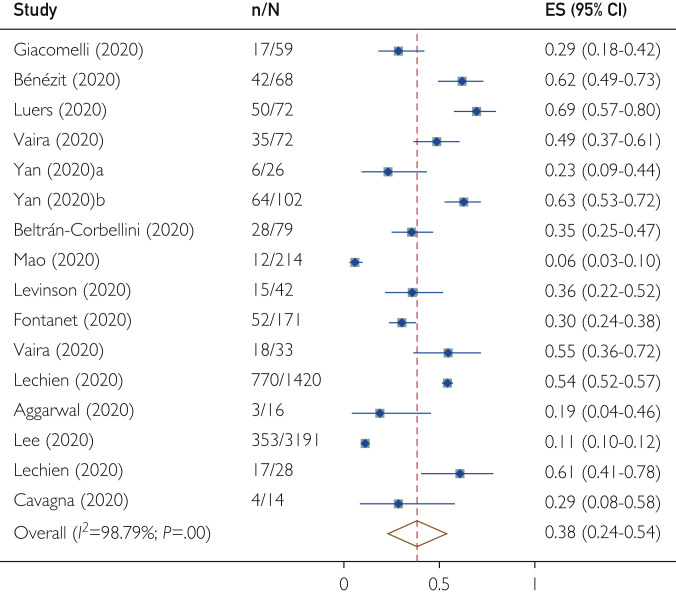
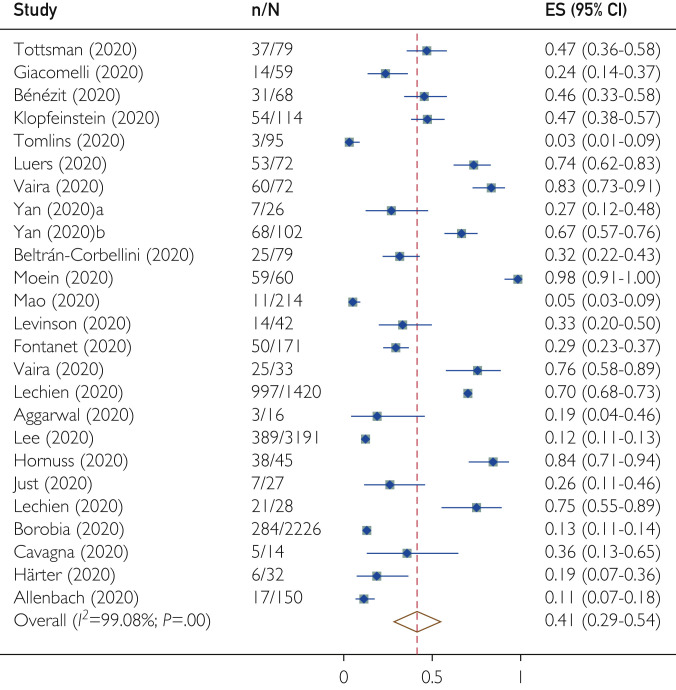
Twenty-four studies with data from 8438 patients with test-confirmed COVID-19 infection from 13 countries were included. The pooled proportions of patients presenting with olfactory dysfunction and gustatory dysfunction were 41.0% (95% CI, 28.5% to 53.9%) and 38.2% (95% CI, 24.0% to 53.6%), respectively. Increasing mean age correlated with lower prevalence of olfactory (coefficient = -0.076; P=.02) and gustatory (coefficient = -0.073; P=.03) dysfunctions. There was a higher prevalence of olfactory dysfunctions with the use of objective measurements compared with self-reports (coefficient = 2.33; P=.01). No significant moderation of the prevalence of OGDs by sex was observed.
There is a high prevalence of OGDs among patients infected with COVID-19. Routine screening for these conditions could contribute to improved case detection in the ongoing COVID-19 pandemic. However, to better inform population screening measures, further studies are needed to establish causality.
评估新型冠状病毒病 2019(COVID-19)患者嗅觉和味觉功能障碍(OGD)的患病率。
通过检索 MEDLINE、EMBASE 和预印本服务器 MedRxiv,从其成立到 2020 年 5 月 11 日,使用术语 anosmia 或 hyposmia 或 dysosmia 或嗅觉功能障碍或嗅觉障碍或嗅觉功能障碍或 ageusia 或 hypogeusia 或 dysgeusia 或味觉功能障碍或味觉障碍或神经和 COVID-19 或 2019 年新型冠状病毒或 2019-nCoV 或 SARS-CoV-2。还对纳入研究的参考文献进行了手动筛选。仅纳入涉及诊断确诊 COVID-19 感染患者的研究。进行随机效应荟萃分析。
纳入了来自 13 个国家的 8438 例经试验确诊的 COVID-19 感染患者的 24 项研究的数据。嗅觉功能障碍和味觉功能障碍患者的总患病率分别为 41.0%(95%CI,28.5%至 53.9%)和 38.2%(95%CI,24.0%至 53.6%)。平均年龄的增加与嗅觉(系数=-0.076;P=0.02)和味觉(系数=-0.073;P=0.03)功能障碍的患病率降低相关。与自我报告相比,使用客观测量方法的嗅觉功能障碍患病率更高(系数=2.33;P=0.01)。未观察到性别对 OGD 患病率的调节作用。
COVID-19 感染患者的 OGD 患病率很高。对这些疾病进行常规筛查可能有助于在当前的 COVID-19 大流行中提高病例检出率。然而,为了更好地为人群筛查措施提供信息,还需要进一步的研究来确定因果关系。