Neuroscience Graduate Program, University of Southern California, United States.
Department of Integrative Anatomical Sciences, Keck School of Medicine of the University of Southern California, Los Angeles, CA 90033, United States.
Psychoneuroendocrinology. 2020 Nov;121:104803. doi: 10.1016/j.psyneuen.2020.104803. Epub 2020 Aug 2.
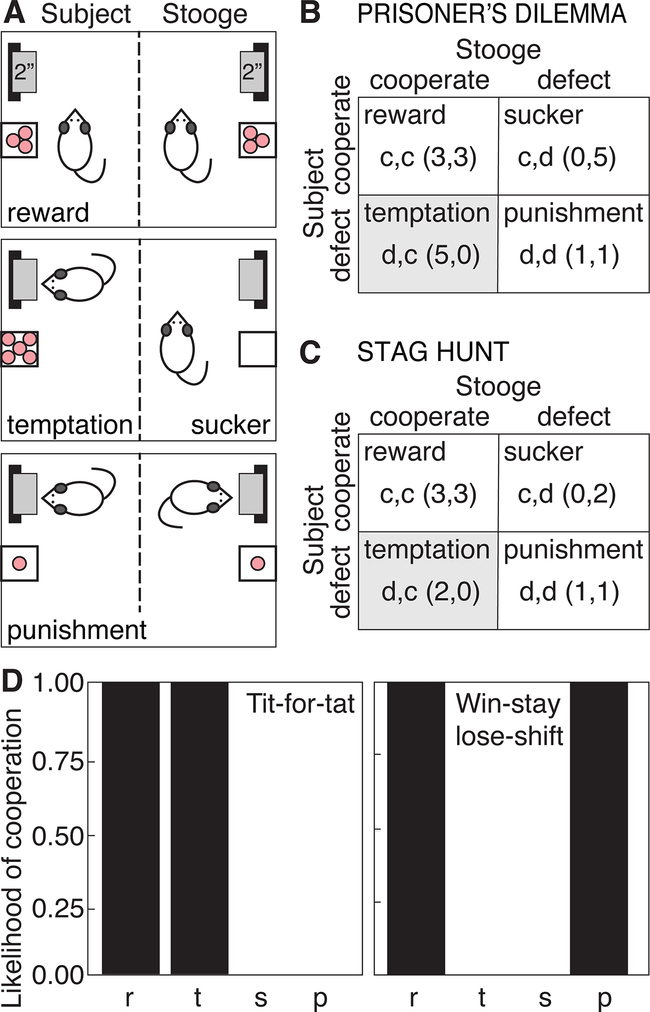
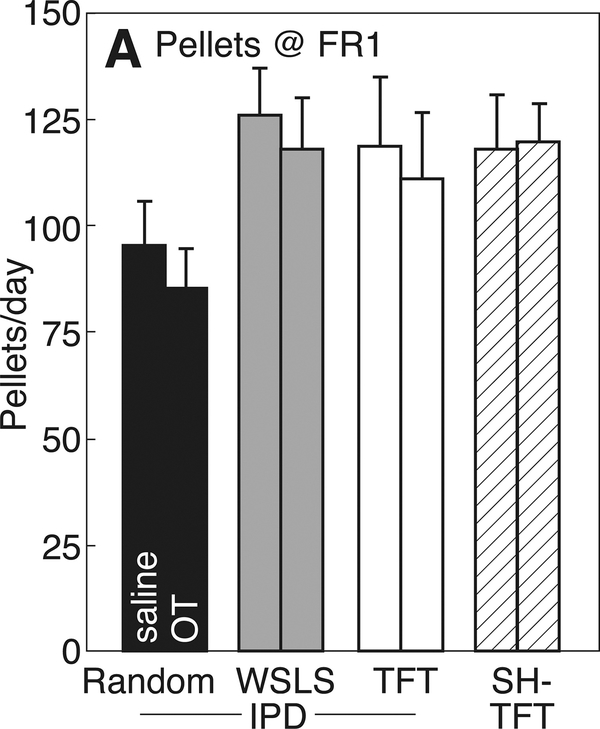
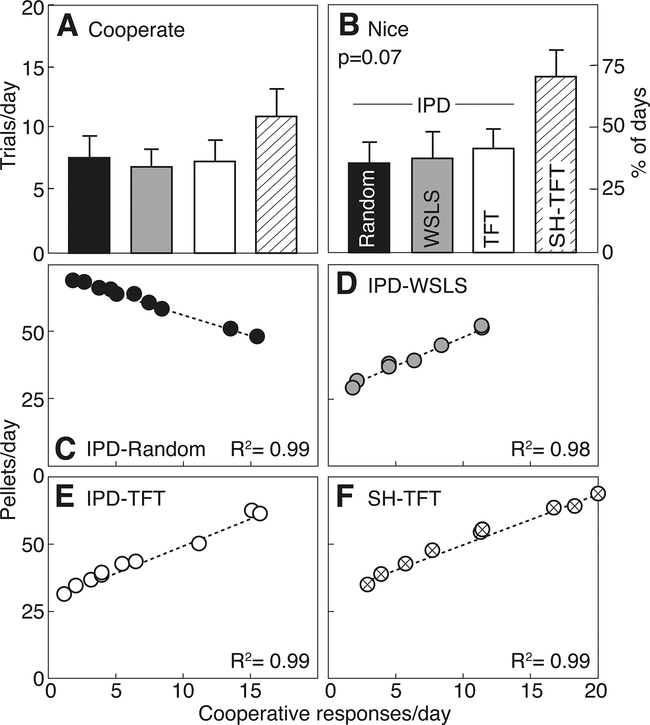
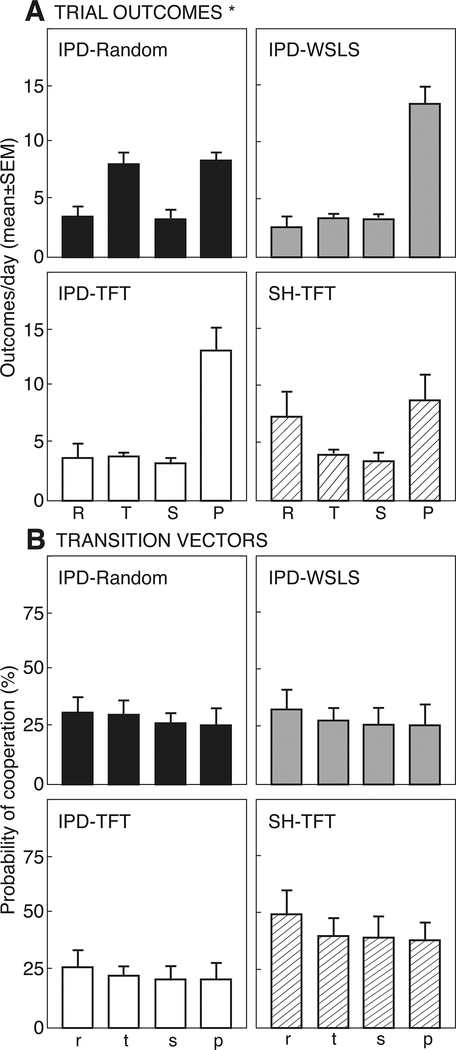
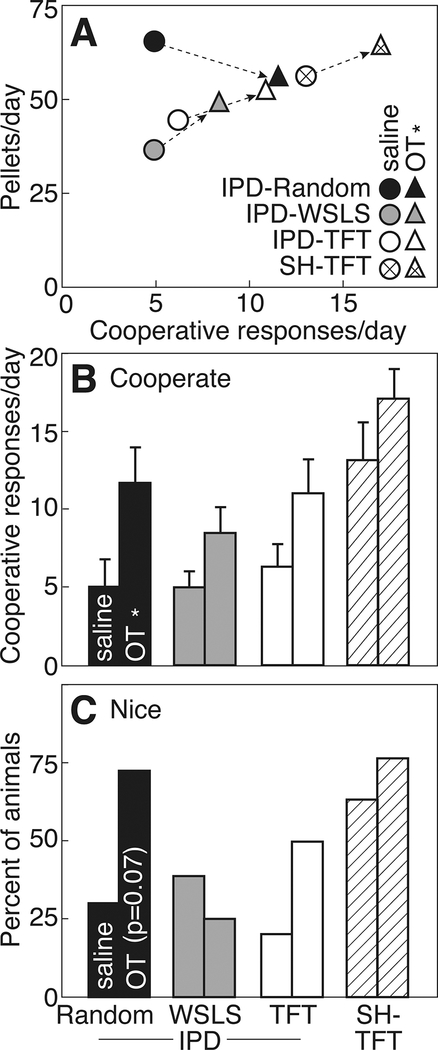
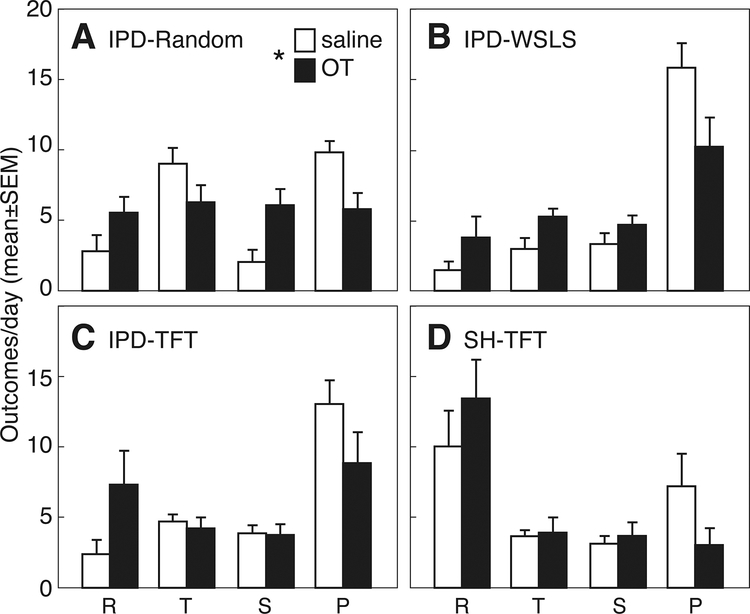
The present study tested cooperation in rats playing a 2 × 2 game (2 players, 2 responses) in an operant chamber, where players choose to cooperate or defect without knowledge of their partner's choice. We evaluated cooperative responses in rats (Subjects) playing different games [iterated Prisoner's Dilemma (IPD), Stag Hunt] with a Stooge partner utilizing different response strategies [Tit-for-tat (TFT), Win-stay, Lose-shift (WSLS), Random], and we determined the effects of oxytocin (OT). IPD trial outcomes and payoffs included mutual cooperation (reward, R, 3 sugar pellets each), mutual defection (punishment, P, 1 pellet each), or unilateral defection (temptation, T, 5 pellets) and cooperation (sucker, S, 0 pellets). Stag Hunt was similar, except that T = 2 pellets. We hypothesized that Subjects would make more cooperative responses when playing Stag Hunt vs IPD, when playing IPD with a Stooge using TFT vs WSLS or Random, and when treated with OT. At baseline, Subjects' overall likelihood of cooperation was unaffected by the game (IPD vs SH) or by the Stooges' response strategy (TFT, WSLS, Random). Cooperative responses earned Subjects more pellets, except when playing with a Stooge using a random strategy. Trial outcomes (R, T, S or P) also varied by game and strategy, although the mutual defection (P) was the most common. Systemic pretreatment with OT increased Subjects' cooperative responses, resulting in fewer P and more R outcomes. In particular, IPD-Random Subjects were more cooperative, even at the expense of earning fewer pellets. These results demonstrate that OT increases cooperative behavior in rats playing 2 × 2 games.
本研究在操作箱中测试了大鼠在 2×2 游戏(2 名玩家,2 种反应)中的合作行为,其中玩家在不知道其伙伴选择的情况下选择合作或背叛。我们评估了与愚蠢伙伴一起玩不同游戏[迭代囚徒困境(IPD)、 stag hunt]的大鼠(受试者)的合作反应,使用不同的反应策略[针锋相对(TFT)、赢留输走(WSLS)、随机],并确定了催产素(OT)的作用。IPD 试验结果和收益包括相互合作(奖励,R,每个 3 个糖丸)、相互背叛(惩罚,P,每个 1 个丸)或单边背叛(诱惑,T,每个 5 个丸)和合作(诱饵,S,0 个丸)。Stag Hunt 与之类似,只是 T=2 个丸。我们假设当受试者与愚蠢伙伴一起玩 IPD 时使用 TFT 比 WSLS 或随机策略更有可能做出合作反应,并且当用 OT 治疗时也是如此。在基线时,受试者的总体合作可能性不受游戏(IPD 与 SH)或愚蠢伙伴反应策略(TFT、WSLS、随机)的影响。合作反应使受试者获得更多的丸,但当与愚蠢伙伴使用随机策略时除外。试验结果(R、T、S 或 P)也因游戏和策略而异,尽管相互背叛(P)是最常见的。OT 的系统预处理增加了受试者的合作反应,导致 P 减少和 R 增加。特别是,与愚蠢伙伴玩 IPD 随机策略的受试者更具合作性,甚至以获得较少丸为代价。这些结果表明,OT 增加了大鼠在玩 2×2 游戏时的合作行为。