Stougaard J, Kennedy C
Agricultural and Food Research Council, University of Sussex, Brighton, United Kingdom.
J Bacteriol. 1988 Jan;170(1):250-7. doi: 10.1128/jb.170.1.250-257.1988.
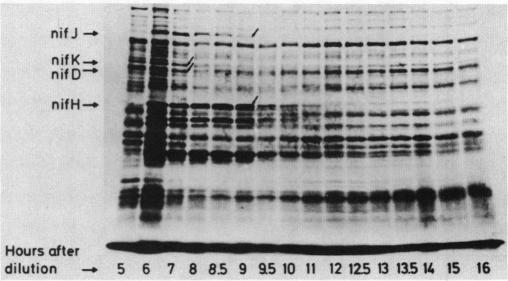
A histidine auxotrophic (hisA) mutant of Klebsiella pneumoniae is phenotypically Nif- when grown with 20 micrograms of histidine ml-1 but Nif+ when supplied with histidine at 100 micrograms ml-1. Reversion to Nif+ at 20 micrograms of histidine ml-1 occurs phenotypically by the addition of 2-thiazolyl-DL-alanine or genetically by mutation in hisG; 2-thiazolyl-DL-alanine inhibits and hisG encodes phosphoribosyl phosphotransferase, the first enzyme of the histidine biosynthetic pathway which consumes ATP. Physiological studies of the hisA mutant JS85 showed that after removal of NH4+ from a culture of the mutant grown with 20 micrograms of histidine ml-1, synthesis of nitrogenase polypeptides occurred at a rate similar to that in the wild type for about 3 h and acetylene reduction activity reached about 10% of the fully derepressed wild-type level. Shortly thereafter the concentration of intracellular adenylates decreased; in particular, ATP fell to about 10% of normal levels. Also, nitrogenase proteins (nifHDK products) and the nifJ gene product stopped being synthesized. These effects were not due to impairment of growth or protein synthesis by histidine starvation. Inhibition of phosphoribosyl phosphotransferase with 2-thiazolyl-DL-alanine restored nitrogenase activity and synthesis, indicating that the effect of the hisA mutation on nif expression was probably a consequence of lowered energy resources that occurred during anaerobic N starvation. The loss of ATP was not associated with nitrogenase synthesis or activity, since hisA nifA and hisA nifH double mutants underwent a loss of ATP in derepressing conditions. Transcription from the nifL, nifN, and nifH promoters was examined in hisA strains with Mu d(Ap lac) fusions in these nif genes. Transcription was not significantly influenced under conditions where adenylates were decreased in concentration. Also nif mRNA apparently accumulated in cultures unable to synthesize nitrogenase, suggesting that translational control of nif gene product synthesis occurs under unfavorable energetic conditions.
肺炎克雷伯菌的组氨酸营养缺陷型(hisA)突变体在含有20微克/毫升组氨酸的培养基中生长时表型为固氮酶阴性(Nif-),但在提供100微克/毫升组氨酸时则为固氮酶阳性(Nif+)。在20微克/毫升组氨酸条件下,通过添加2-噻唑基-DL-丙氨酸表型上可回复为Nif+,或者通过hisG基因突变在遗传上实现回复;2-噻唑基-DL-丙氨酸具有抑制作用,且hisG编码磷酸核糖磷酸转移酶,该酶是组氨酸生物合成途径中消耗ATP的首个酶。对hisA突变体JS85的生理学研究表明,在从含有20微克/毫升组氨酸的突变体培养物中去除NH4+后,固氮酶多肽的合成速率在约3小时内与野生型相似,乙炔还原活性达到完全去阻遏野生型水平的约10%。此后不久,细胞内腺苷酸浓度下降;特别是ATP降至正常水平的约10%。此外,固氮酶蛋白(nifHDK产物)和nifJ基因产物停止合成。这些影响并非由于组氨酸饥饿导致生长或蛋白质合成受损。用2-噻唑基-DL-丙氨酸抑制磷酸核糖磷酸转移酶可恢复固氮酶活性和合成,这表明hisA突变对nif表达的影响可能是厌氧氮饥饿期间能量资源降低的结果。ATP的损失与固氮酶的合成或活性无关,因为hisA nifA和hisA nifH双突变体在去阻遏条件下也会出现ATP的损失。在这些nif基因中带有Mu d(Ap lac)融合的hisA菌株中检测了nifL、nifN和nifH启动子的转录。在腺苷酸浓度降低的条件下,转录没有受到显著影响。此外,nif mRNA显然在无法合成固氮酶的培养物中积累,这表明在不利的能量条件下发生了nif基因产物合成的翻译控制。