Dodds Richard M, Syddall Holly E, Cooper Rachel, Benzeval Michaela, Deary Ian J, Dennison Elaine M, Der Geoff, Gale Catharine R, Inskip Hazel M, Jagger Carol, Kirkwood Thomas B, Lawlor Debbie A, Robinson Sian M, Starr John M, Steptoe Andrew, Tilling Kate, Kuh Diana, Cooper Cyrus, Sayer Avan Aihie
MRC Lifecourse Epidemiology Unit, University of Southampton, Southampton, United Kingdom.
MRC Unit for Lifelong Health and Ageing at UCL, London, United Kingdom.
PLoS One. 2014 Dec 4;9(12):e113637. doi: 10.1371/journal.pone.0113637. eCollection 2014.
Epidemiological studies have shown that weaker grip strength in later life is associated with disability, morbidity, and mortality. Grip strength is a key component of the sarcopenia and frailty phenotypes and yet it is unclear how individual measurements should be interpreted. Our objective was to produce cross-sectional centile values for grip strength across the life course. A secondary objective was to examine the impact of different aspects of measurement protocol.
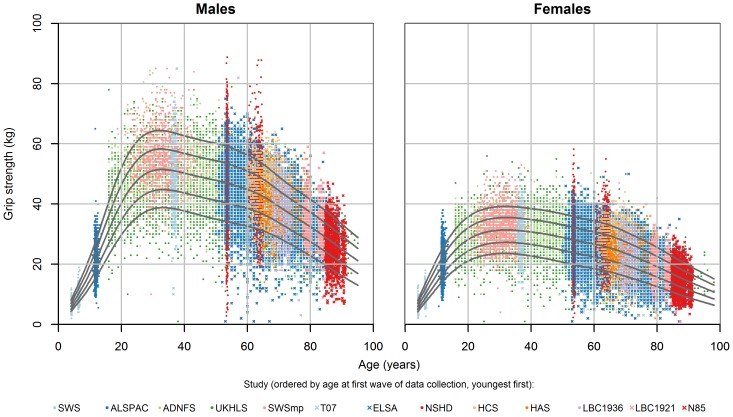
We combined 60,803 observations from 49,964 participants (26,687 female) of 12 general population studies in Great Britain. We produced centile curves for ages 4 to 90 and investigated the prevalence of weak grip, defined as strength at least 2.5 SDs below the gender-specific peak mean. We carried out a series of sensitivity analyses to assess the impact of dynamometer type and measurement position (seated or standing).
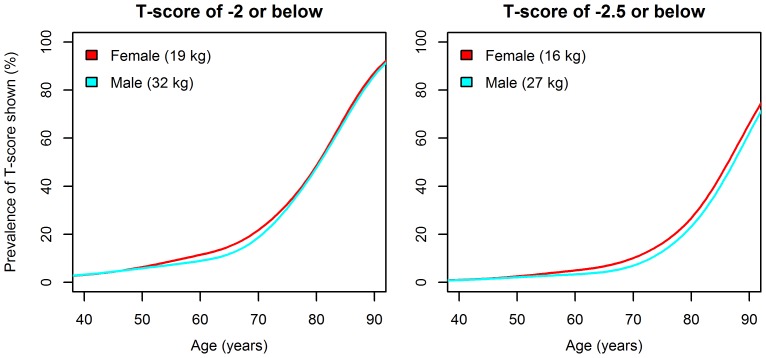
Our results suggested three overall periods: an increase to peak in early adult life, maintenance through to midlife, and decline from midlife onwards. Males were on average stronger than females from adolescence onwards: males' peak median grip was 51 kg between ages 29 and 39, compared to 31 kg in females between ages 26 and 42. Weak grip strength, defined as strength at least 2.5 SDs below the gender-specific peak mean, increased sharply with age, reaching a prevalence of 23% in males and 27% in females by age 80. Sensitivity analyses suggested our findings were robust to differences in dynamometer type and measurement position.
This is the first study to provide normative data for grip strength across the life course. These centile values have the potential to inform the clinical assessment of grip strength which is recognised as an important part of the identification of people with sarcopenia and frailty.
流行病学研究表明,晚年握力较弱与残疾、发病和死亡有关。握力是肌肉减少症和衰弱表型的关键组成部分,但目前尚不清楚应如何解读个体测量结果。我们的目标是得出一生中握力的横断面百分位数。第二个目标是研究测量方案不同方面的影响。
我们合并了来自英国12项一般人群研究的49964名参与者(26687名女性)的60803条观察数据。我们绘制了4至90岁的百分位数曲线,并调查了握力弱的患病率,握力弱定义为力量至少比特定性别的峰值平均值低2.5个标准差。我们进行了一系列敏感性分析,以评估测力计类型和测量姿势(坐姿或站姿)的影响。
我们的结果表明存在三个总体阶段:成年早期握力增加至峰值,中年期保持稳定,中年以后开始下降。从青春期开始,男性的平均握力强于女性:男性在29至39岁之间的握力峰值中位数为51千克,而女性在26至42岁之间为31千克。握力弱定义为力量至少比特定性别的峰值平均值低2.5个标准差,其患病率随年龄急剧增加,到80岁时,男性患病率达到23%,女性达到27%。敏感性分析表明,我们的研究结果不受测力计类型和测量姿势差异的影响。
这是第一项提供一生中握力规范数据的研究。这些百分位数有可能为握力的临床评估提供参考,握力评估被认为是识别肌肉减少症和衰弱人群的重要组成部分。