Division of Academic Psychiatry, Institute of Psychiatry, Psychology and Neuroscience, King's College London, London SE5 8AF, UK.
Age Ageing. 2024 Nov 1;53(11). doi: 10.1093/ageing/afae261.
Cannabinoid-based medicines (CBMs) are being used widely in older people. However, information on the incidence of adverse events (AEs) is limited.
To quantify the incidence rate difference (IRD) of AEs in middle aged and older adults of age ≥50 years receiving CBMs and also examine associations with weekly doses.
Systematic review and meta-analysis.
MEDLINE, PubMed, EMBASE, CINAHL, PsychInfo, Cochrane Library and ClinicalTrials.gov (1st Jan 1990-12th June 2023).
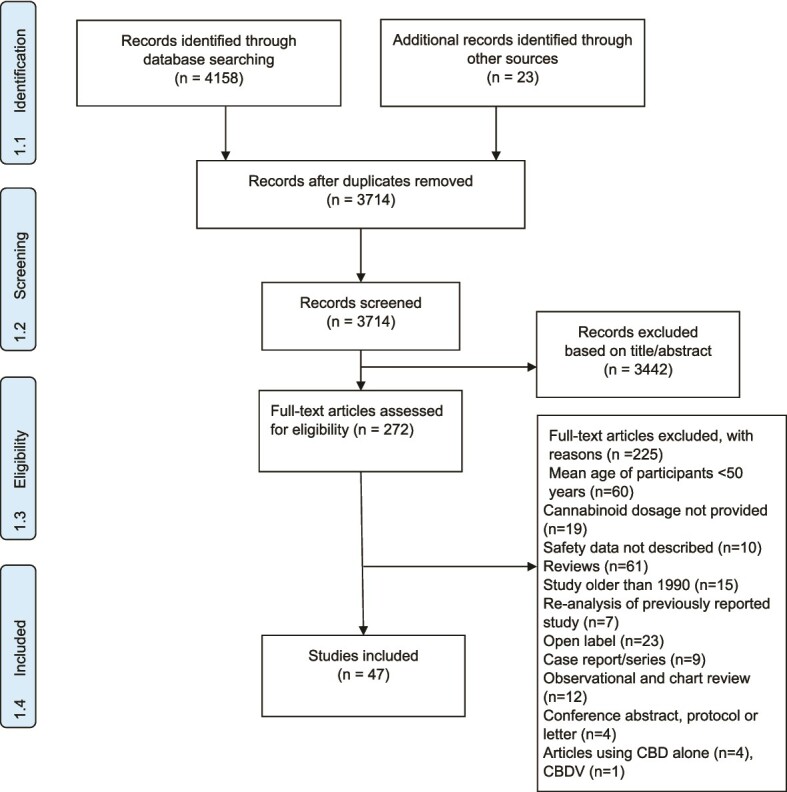
We included randomised clinical trials (RCTs) using CBMs with mean participant age ≥50 years for medicinal purposes for all clinical indications. Paired reviewers independently screened studies, extracted data and appraised risk of bias. We estimated pooled effect-sizes IRD under the random-effects model.
Data from 58 RCTs (37 moderate-high quality studies, pooled n = 6611, mean age range 50-87 years, 50% male, n = 3450 receiving CBMs) showed that compared with controls, the incidence of all-cause and treatment-related AEs attributable to delta-9-tetrahydrocannabinol (THC)-containing CBMs were: THC alone [IRD:18.83(95% Confidence Interval [CI], 1.47-55.79) and 16.35(95% CI, 1.25-48.56)] respectively; THC:cannabidiol (CBD) combination [IRD:19.37(95% CI, 4.24-45.47) and 11.36(95% CI, 2.55-26.48)] respectively. IRDs of serious AEs, withdrawals and deaths were not significantly greater for CBMs containing THC with or without CBD. THC dose-dependently increased the incidence of dry mouth, dizziness/lightheadedness, mobility/balance/coordination difficulties, dissociative/thinking/perception problems and somnolence/drowsiness. The interaction of weekly THC:CBD doses played a role in mostly neurological, psychiatric and cardiac side-effects.
Although CBMs in general are safe and acceptable in middle aged and older adults, one needs to be mindful of certain common dose-dependent side-effects of THC-containing CBMs.
大麻素类药物(CBMs)在老年人中广泛使用。然而,关于不良事件(AEs)发生率的信息有限。
定量比较年龄≥50 岁的中老年人使用 CBMs 后 AE 的发生率差异(IRD),并探讨其与每周剂量的关系。
系统评价和荟萃分析。
MEDLINE、PubMed、EMBASE、CINAHL、PsychInfo、Cochrane 图书馆和 ClinicalTrials.gov(1990 年 1 月 1 日至 2023 年 6 月 12 日)。
我们纳入了使用 CBMs 治疗各种临床适应证的随机临床试验(RCTs),参与者的平均年龄≥50 岁。由两名配对的审阅者独立筛选研究、提取数据并评估偏倚风险。我们采用随机效应模型估计了汇总的效应大小 IRD。
来自 58 项 RCTs(37 项为中高度质量研究,汇总 n=6611,平均年龄 50-87 岁,50%为男性,n=3450 接受 CBMs)的数据显示,与对照组相比,含 delta-9-四氢大麻酚(THC)的 CBMs 引起的全因和治疗相关 AE 的发生率分别为:THC 单独[IRD:18.83(95%置信区间 [CI],1.47-55.79)和 16.35(95% CI,1.25-48.56)];THC-大麻二酚(CBD)联合[IRD:19.37(95% CI,4.24-45.47)和 11.36(95% CI,2.55-26.48)]。含 THC 或不含 CBD 的 CBMs 的严重 AE、停药和死亡的 IRD 均无显著增加。THC 剂量依赖性地增加了口干、头晕/头晕、活动/平衡/协调困难、分离/思维/感知问题和嗜睡/昏昏欲睡的发生率。每周 THC:CBD 剂量的相互作用在大多数神经、精神和心脏副作用中起作用。
尽管 CBMs 在中年和老年人中通常是安全且可接受的,但人们需要注意含 THC 的 CBMs 某些常见的剂量依赖性副作用。