Department of Public Health, Ambo University, Ambo, Ethiopia.
Flinders Digital Health Research Centre, College of Nursing & Health Sciences, Flinders University, Adelaide SA 5001, Australia.
Int J Environ Res Public Health. 2020 Aug 4;17(15):5626. doi: 10.3390/ijerph17155626.
Tuberculosis (TB) is a major global public health problem and one of the leading causes of death among infectious diseases. Although TB can be cured with first-line antibiotics treatment of 6 months regimen, non-adherence to the treatment remains the main challenge for TB prevention and control. Interventions to promote adherence need to address multiple underlying factors linked to non-adherence, which requires a synthesis of studies to understand these factors in the local context. Our review accordingly examines these factors for TB treatment in Ethiopia.
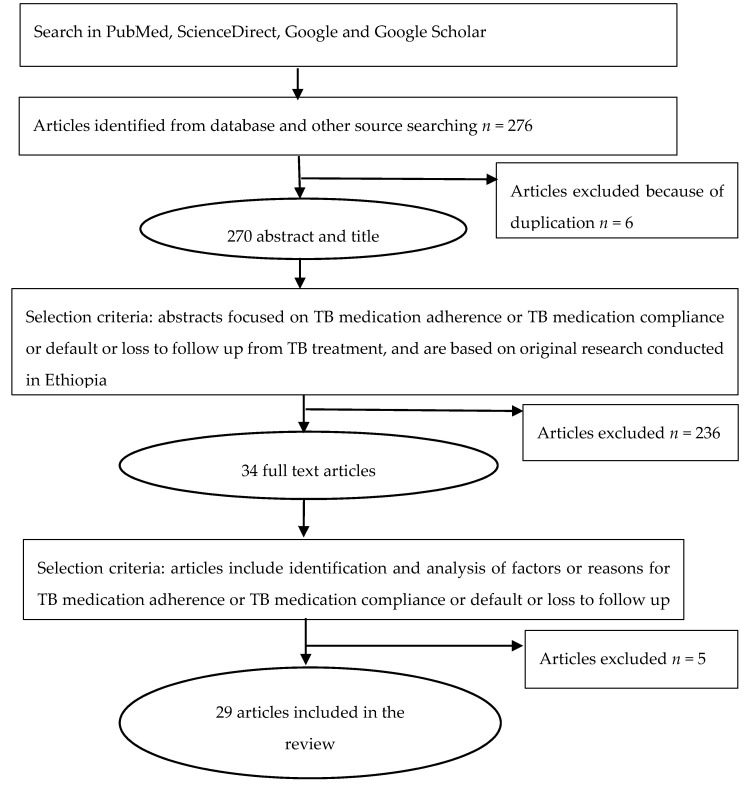
Articles were searched from PubMed and ScienceDirect databases, as well as manual searches through Google and Google Scholar search engines. Both quantitative and qualitative studies that showed factors associated with or reasons for non-adherence, default or loss to follow up from TB treatment were included. A total of 276 articles were screened, and 29 articles were ultimately included in the review.
The extracted factors were synthesized thematically into seven dimensions of patient-centred, social, economic, health system, therapy, lifestyle, and geographic access factors. More than 20 distinct factors were identified under these headings. Some of these factors may also apply quite widely in other settings, with greater or lesser influence, but some are particularly applicable to the Ethiopian setting.
Helping patients to achieve full adherence to TB medication is a complex problem as it is influenced by interplay between many factors. Healthcare managers, providers, and researchers need to consider and address multiple underlying factors when designing adherence interventions. This work provides a reference set of such factors for Ethiopian interventions.
结核病(TB)是一个重大的全球公共卫生问题,也是传染病死亡的主要原因之一。虽然结核病可以通过一线抗生素治疗 6 个月的方案治愈,但不遵守治疗方案仍然是结核病防控的主要挑战。促进遵守治疗方案的干预措施需要解决与不遵守治疗方案相关的多个潜在因素,这需要综合研究来了解当地的这些因素。因此,我们的综述检查了埃塞俄比亚结核病治疗中的这些因素。
文章从 PubMed 和 ScienceDirect 数据库中搜索,并通过 Google 和 Google Scholar 搜索引擎进行手动搜索。纳入了显示与不遵守、不遵从或从结核病治疗中失访相关的因素或原因的定量和定性研究。共筛选了 276 篇文章,最终有 29 篇文章纳入综述。
提取的因素被主题合成到以患者为中心、社会、经济、卫生系统、治疗、生活方式和地理可及性七个维度中。在这些标题下确定了 20 多个不同的因素。其中一些因素可能在其他环境中也有相当大的影响,但也有一些因素特别是适用于埃塞俄比亚的环境。
帮助患者完全遵守结核病药物治疗是一个复杂的问题,因为它受到许多因素的相互作用的影响。医疗保健管理人员、提供者和研究人员在设计遵守治疗方案的干预措施时需要考虑和解决多个潜在因素。这项工作为埃塞俄比亚的干预措施提供了一组这样的因素的参考。