Yoo Seung Hoon, Geng Hui, Chiu Tin Lok, Yu Siu Ki, Cho Dae Chul, Heo Jin, Choi Min Sung, Choi Il Hyun, Cung Van Cong, Nhung Nguen Viet, Min Byung Jun, Lee Ho
Medical Physics and Research Department, Hong Kong Sanatorium & Hospital, Happy Valley, Hong Kong.
Artificial Intelligent Research Lab, Radisen, Seoul, South Korea.
Front Med (Lausanne). 2020 Jul 14;7:427. doi: 10.3389/fmed.2020.00427. eCollection 2020.
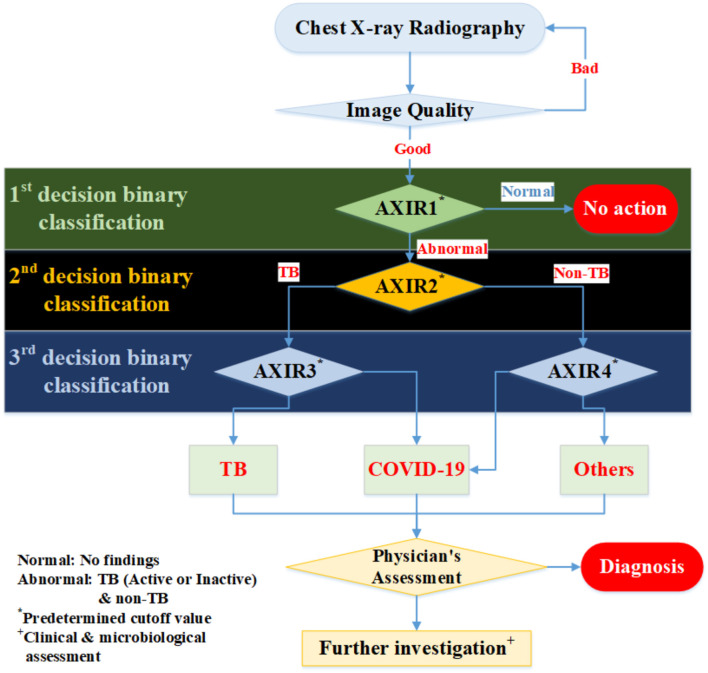
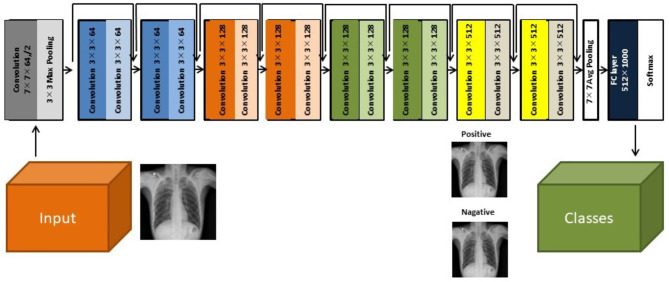
The global pandemic of coronavirus disease 2019 (COVID-19) has resulted in an increased demand for testing, diagnosis, and treatment. Reverse transcription polymerase chain reaction (RT-PCR) is the definitive test for the diagnosis of COVID-19; however, chest X-ray radiography (CXR) is a fast, effective, and affordable test that identifies the possible COVID-19-related pneumonia. This study investigates the feasibility of using a deep learning-based decision-tree classifier for detecting COVID-19 from CXR images. The proposed classifier comprises three binary decision trees, each trained by a deep learning model with convolution neural network based on the PyTorch frame. The first decision tree classifies the CXR images as normal or abnormal. The second tree identifies the abnormal images that contain signs of tuberculosis, whereas the third does the same for COVID-19. The accuracies of the first and second decision trees are 98 and 80%, respectively, whereas the average accuracy of the third decision tree is 95%. The proposed deep learning-based decision-tree classifier may be used in pre-screening patients to conduct triage and fast-track decision making before RT-PCR results are available.
2019年冠状病毒病(COVID-19)的全球大流行导致对检测、诊断和治疗的需求增加。逆转录聚合酶链反应(RT-PCR)是诊断COVID-19的决定性检测方法;然而,胸部X线摄影(CXR)是一种快速、有效且经济实惠的检测方法,可识别可能与COVID-19相关的肺炎。本研究探讨了使用基于深度学习的决策树分类器从CXR图像中检测COVID-19的可行性。所提出的分类器由三个二叉决策树组成,每个决策树由基于PyTorch框架的卷积神经网络深度学习模型训练。第一个决策树将CXR图像分类为正常或异常。第二个决策树识别包含结核病迹象的异常图像,而第三个决策树对COVID-19图像进行同样的识别。第一个和第二个决策树的准确率分别为98%和80%,而第三个决策树的平均准确率为95%。所提出的基于深度学习的决策树分类器可用于在RT-PCR结果出来之前对患者进行预筛查,以进行分诊和快速决策。