College of Health and Life Sciences, Brunel University London, UK.
Centre for Cognitive Neuroscience, Brunel University London, UK.
J Gerontol B Psychol Sci Soc Sci. 2020 Oct 16;75(9):1911-1920. doi: 10.1093/geronb/gbaa081.
Older adults anxious about falling will often consciously process walking movements in an attempt to avoid falling. They also fixate their gaze on the present step rather than looking ahead to plan future actions. The present work examined whether conscious movement strategies result in such restricted visual planning.
A total of 18 community-dwelling older adults (agemean = 71.22; SD = 5.75) walked along a path and stepped into two raised targets. Repeated-measures analyses of variance were used to compare gaze behavior and movement kinematics when participants walked: (a) at baseline (ground level); (b) under conditions designed to induce fall-related anxiety (walkway elevated 0.6 m); and (c) in the absence of anxiety (ground level), but with explicit instructions to consciously process movements.
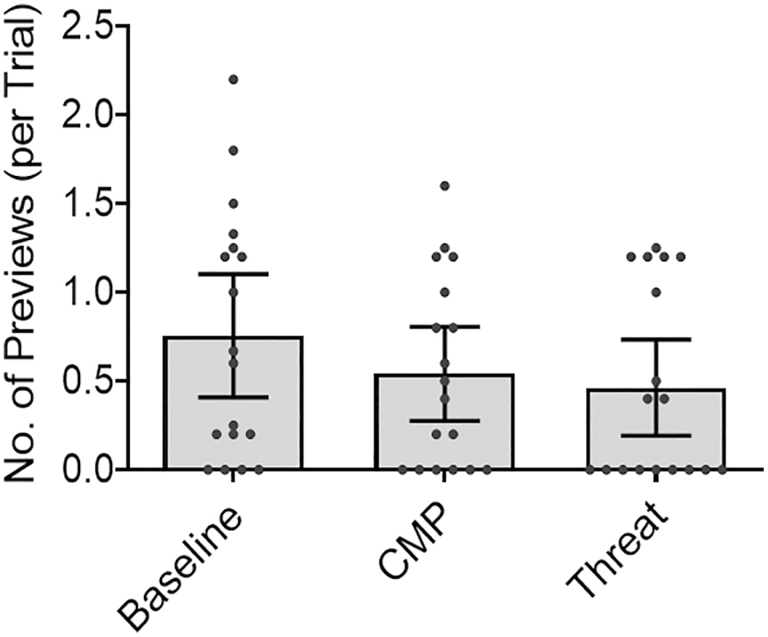
Participants reported increased conscious movement processing when walking both on the elevated walkway (fall-related anxiety condition) and at ground level when instructed to consciously process gait. During both conditions, participants altered their gaze behavior, visually prioritizing the immediate walkway 1-2 steps ahead (areas needed for the on-line visual control of individual steps) at the expense of previewing distal areas of the walking path required to plan future steps. These alterations were accompanied by significantly slower gait and increased stance durations prior to target steps.
Consciously processing movement (in the relative absence of anxiety) resulted in gaze behavior comparable to that observed during conditions of fall-related anxiety. As anxious participants also self-reported directing greater attention toward movement, this suggests that fall-related anxiety may disrupt the visual control of gait through increased conscious movement processing.
担心跌倒的老年人通常会有意识地处理行走动作,以避免跌倒。他们还会将目光固定在当前的脚步上,而不是向前看以规划未来的行动。本研究旨在探讨有意识的运动策略是否会导致这种受限的视觉规划。
共有 18 名居住在社区的老年人(年龄平均=71.22;SD=5.75)沿着一条小路行走并踏入两个凸起的目标。使用重复测量方差分析比较参与者在以下三种情况下的注视行为和运动运动学:(a)基线时(地面水平);(b)设计用于引起与跌倒相关的焦虑的条件下(步道升高 0.6 米);(c)在没有焦虑(地面水平)的情况下,但有明确的指示要有意识地处理运动。
参与者在行走时(在与跌倒相关的焦虑条件下)以及在地面水平时,报告了增加的有意识的运动处理,当时他们被指示有意识地处理步态。在这两种情况下,参与者改变了他们的注视行为,优先关注即时的步道 1-2 步(在线控制个体步长所需的区域),而忽略了规划未来步长所需的步道远端区域。这些变化伴随着步态明显变慢和目标步之前的站立时间增加。
有意识地处理运动(在相对没有焦虑的情况下)导致的注视行为与与跌倒相关的焦虑条件下观察到的行为相似。由于焦虑的参与者还自我报告将更多的注意力集中在运动上,这表明与跌倒相关的焦虑可能会通过增加有意识的运动处理来破坏步态的视觉控制。