Translational Psychiatry Research Group, Research Department of Mental Health Neuroscience, Division of Psychiatry, Institute of Mental Health, University College London, London, UK.
Clinical Psychopharmacology Unit, Research Department of Clinical, Educational and Health Psychology, University College London, London, UK.
J Psychopharmacol. 2020 Sep;34(9):981-989. doi: 10.1177/0269881120936419. Epub 2020 Aug 7.
Cannabidiol (CBD) is being investigated as a potential treatment for several medical indications, many of which are characterised by altered memory processing. However, the mechanisms underlying these effects are unclear.
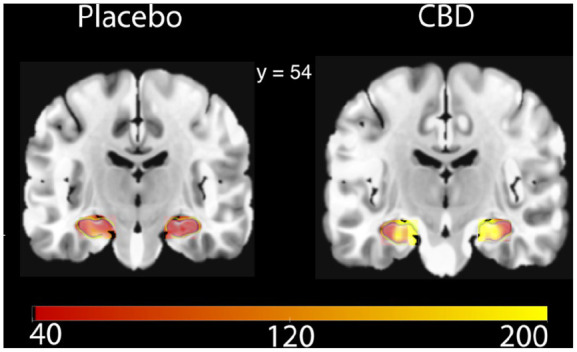
Our primary aim was to investigate how CBD influences cerebral blood flow (CBF) in regions involved in memory processing. Our secondary aim was to determine if the effects of CBD on CBF were associated with differences in working and episodic memory task performance.
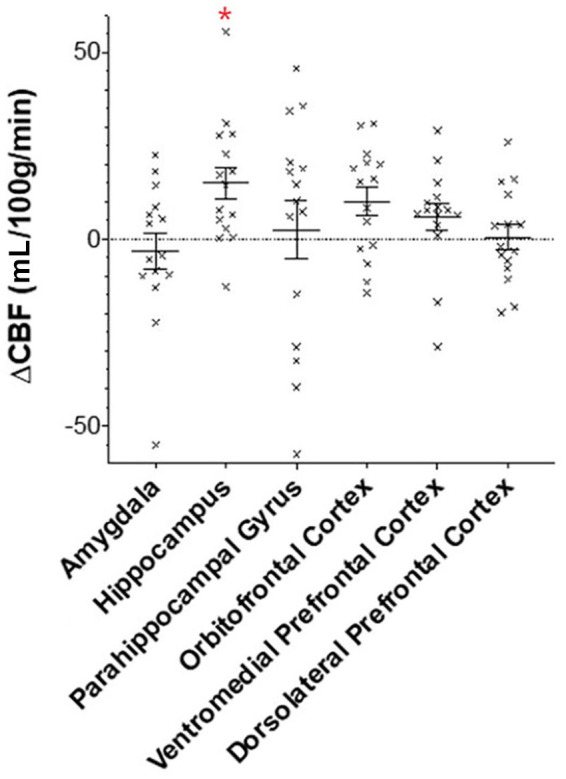
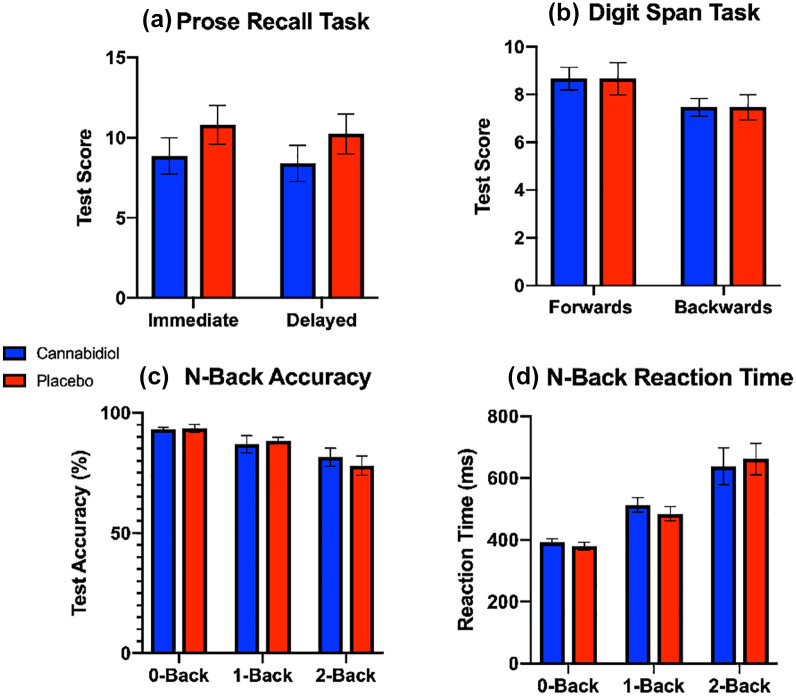
We used a randomised, crossover, double-blind design in which 15 healthy participants were administered 600 mg oral CBD or placebo on separate days. We measured regional CBF at rest using arterial spin labelling 3 h after drug ingestion. We assessed working memory with the digit span (forward, backward) and n-back (0-back, 1-back, 2-back) tasks, and we used a prose recall task (immediate and delayed) to assess episodic memory.
CBD increased CBF in the hippocampus (mean (95% confidence intervals) = 15.00 (5.78-24.21) mL/100 g/min, = 3.489, Cohen's = 0.75, = 0.004). There were no differences in memory task performance, but there was a significant correlation whereby greater CBD-induced increases in orbitofrontal CBF were associated with reduced reaction time on the 2-back working memory task ( = -0.73, = 0.005).
These findings suggest that CBD increases CBF to key regions involved in memory processing, particularly the hippocampus. These results identify potential mechanisms of CBD for a range of conditions associated with altered memory processing, including Alzheimer's disease, schizophrenia, post-traumatic stress disorder and cannabis-use disorders.
大麻二酚(CBD)正在被研究作为几种医学适应症的潜在治疗方法,其中许多适应症的特征是记忆处理改变。然而,这些影响的机制尚不清楚。
我们的主要目的是研究 CBD 如何影响参与记忆处理的区域的脑血流(CBF)。我们的次要目的是确定 CBD 对 CBF 的影响是否与工作记忆和情景记忆任务表现的差异有关。
我们使用随机、交叉、双盲设计,其中 15 名健康参与者在不同的日子分别服用 600mg 口服 CBD 或安慰剂。我们在药物摄入后 3 小时使用动脉自旋标记测量静息时的区域 CBF。我们使用数字跨度(前向、后向)和 n-回(0-回、1-回、2-回)任务评估工作记忆,并用一篇文章回忆任务(即时和延迟)评估情景记忆。
CBD 增加了海马体的 CBF(平均值(95%置信区间)= 15.00(5.78-24.21)mL/100g/min, = 3.489,Cohen's = 0.75, = 0.004)。记忆任务表现没有差异,但存在显著相关性,即额眶皮质 CBF 的 CBD 诱导增加与 2 回工作记忆任务的反应时间缩短有关( = -0.73, = 0.005)。
这些发现表明,CBD 增加了参与记忆处理的关键区域的 CBF,特别是海马体。这些结果确定了 CBD 对一系列与记忆处理改变相关的疾病的潜在机制,包括阿尔茨海默病、精神分裂症、创伤后应激障碍和大麻使用障碍。