Division of Clinical Geriatrics, Center for Alzheimer Research, Department of Neurobiology, Care Sciences and Society, Karolinska Institutet, Stockholm, Sweden
Institute of Clinical Medicine, Department of Neurology, University of Eastern Finland, Kuopio, Finland.
BMJ Open. 2020 Aug 6;10(8):e037050. doi: 10.1136/bmjopen-2020-037050.
Prevention of cardiovascular disease (CVD) and dementia is a key health priority among older adults. Understanding individuals' attitudes to, the prevention of these conditions, particularly when delivered through novel eHealth tools, could help in designing effective prevention programmes. The aim of the study was to explore the attitudes of older adults at increased risk of CVD and dementia regarding engagement in eHealth self-management prevention programmes, and to describe the facilitators and barriers.
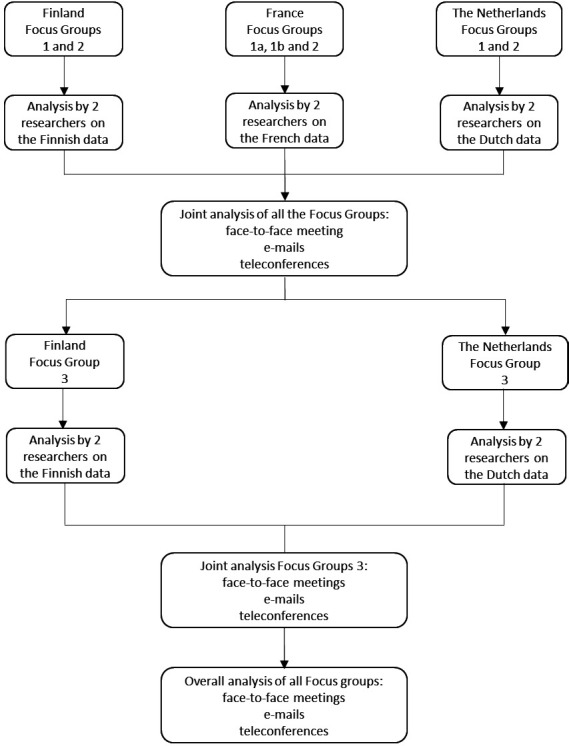
A qualitative research approach was used. Data were collected through eight focus groups in Finland, France and the Netherlands. Data were analysed following the principles of grounded theory.
Forty-four community-dwellers aged 65+ at risk of CVD were recruited from a previous trial cohort in Finland, and through general practices in France and the Netherlands.
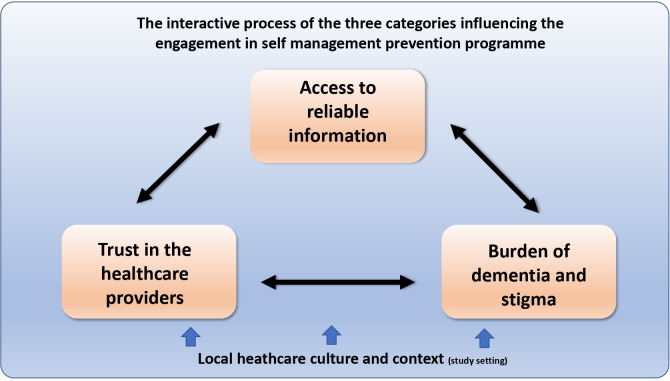
The study identified three categories: access to reliable information, trust in the healthcare providers and burden and stigma of dementia. A core category was also identified: the interactive process of the three categories influencing engagement in self-management prevention programme. The categories were interconnected through an interactive process and influenced by the local healthcare culture and context which shaped them differently, becoming either facilitators or barriers to engage in eHealth self-management prevention programmes.
The study emphasises the importance of considering the interactions between the identified categories in this study, grounded in the local healthcare culture and context in further developments of eHealth self-management interventions that aim to prevent CVD and dementia.
ISRCTN48151589.
预防心血管疾病(CVD)和痴呆是老年人的主要健康重点。了解个体对这些疾病的态度,特别是通过新型电子健康工具进行预防,可以帮助设计有效的预防计划。本研究旨在探讨处于 CVD 和痴呆风险增加的老年人对参与电子健康自我管理预防计划的态度,并描述其促进因素和障碍。
采用定性研究方法。数据通过芬兰、法国和荷兰的 8 个焦点小组收集。数据分析遵循扎根理论原则。
从芬兰的一项先前试验队列中招募了 44 名年龄在 65 岁以上、有 CVD 风险的社区居民,并通过法国和荷兰的普通诊所招募。
研究确定了三个类别:获得可靠信息、对医疗保健提供者的信任以及痴呆的负担和耻辱感。还确定了一个核心类别:这三个类别的相互作用过程影响参与自我管理预防计划的过程。这些类别通过相互作用相互关联,并受到当地医疗保健文化和背景的影响,这些文化和背景以不同的方式塑造了它们,成为参与电子健康自我管理预防计划的促进因素或障碍。
该研究强调了在进一步开发旨在预防 CVD 和痴呆的电子健康自我管理干预措施时,考虑本研究中确定的类别之间相互作用的重要性,这些类别根植于当地医疗保健文化和背景。
ISRCTN48151589。