Institute of Social Medicine, Occupational Health and Public Health (ISAP), University of Leipzig, Leipzig, Germany.
Alzheimer Centrum Limburg, Department of Psychiatry and Neuropsychology, School for Mental Health and Neuroscience (MHeNs), Maastricht University, Maastricht, the Netherlands.
BMC Public Health. 2023 Nov 23;23(1):2321. doi: 10.1186/s12889-023-17247-6.
Evidence on modifiable risk factors for dementia is accumulating rapidly, including e.g. smoking, hypertension, and diabetes. Comparing knowledge of risk factors for dementia and factors associated with knowledge and motivation to learn about dementia risk reduction in different countries may support the design of tailored public health campaigns. We investigated (1) differences in knowledge of risk and protective factors for dementia between the Netherlands and Germany, and interest in (2) information on brain health and (3) eHealth for brain health.
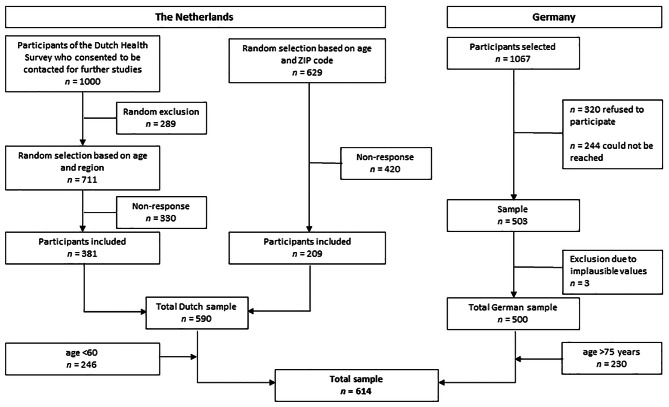
Population-based telephone (Germany) or web-based surveys (Netherlands) were conducted among adults aged 60-75 (n=614; Germany: n = 270; Netherlands: n = 344), assessing sociodemographic factors, knowledge of risk and protective factors for dementia, interest in information on brain health and respective eHealth-tools. Correlates of knowledge, interest in information on brain health and eHealth for brain health were analyzed using multivariable regression, by country and in pooled analyses.
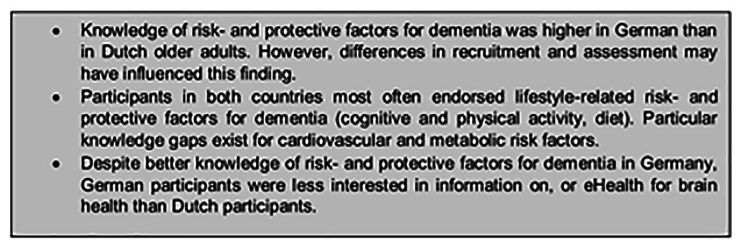
In the total sample (M: 67.3 (SD: 4.3) years; %: 48.6), knowledge of risk and protective factors (sum score assessing number of correctly identified factors) was higher among German participants (M (SD) = 7.6 (2.5) vs. 6.0 (4.3), p < .001). This was confirmed using linear regression analyses, controlling for sociodemographic covariates (b = 1.51; 95% CI: 1.00; 2.01). High education was linked to better knowledge of risk and protective factors (b = 1.61; 95% CI: 0.89; 2.34). Controlling for covariates, interest in information on brain health (OR: 0.05, 95% CI: 0.02; 0.09) and eHealth for brain health (OR: 0.40, 95% CI: 0.25; 0.65) was lower in German participants. Widowed participants were less interested in information on brain health, while widowed and single participants expressed less interest in eHealth for brain health in pooled analyses. Further associations between sociodemographic factors, interest in information on brain health and eHealth for brain health by country were detected.
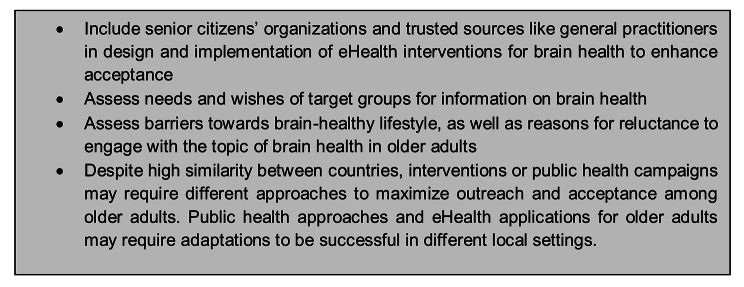
Engaging older adults in the design of eHealth interventions and cooperation with trusted sources, e.g., general practitioners, might enhance appreciation of eHealth for brain health. Education on risk and protective factors for dementia is warranted in both countries. However, differences in recruitment and assessment need to be acknowledged.
有关痴呆症可改变风险因素的证据正在迅速积累,包括例如吸烟、高血压和糖尿病。比较不同国家对痴呆症风险因素的了解以及与了解和学习痴呆症风险降低相关因素的知识和动机,可能有助于制定有针对性的公共卫生运动。我们调查了(1)荷兰和德国之间痴呆症风险和保护因素的知识差异,以及(2)对脑健康信息和(3)脑健康电子健康的兴趣。
在年龄在 60-75 岁的成年人中进行了基于人群的电话(德国)或基于网络的调查(荷兰)(n=614;德国:n=270;荷兰:n=344),评估了社会人口统计学因素、痴呆症风险和保护因素的知识、对脑健康信息和各自的电子健康工具的兴趣。使用多变量回归分析了知识、对脑健康信息的兴趣和脑健康电子健康的相关性,分别在国家和汇总分析中进行。
在总样本中(M:67.3(SD:4.3)岁;%:48.6),德国参与者的风险和保护因素知识(评估正确识别因素数量的总和得分)较高(M(SD)=7.6(2.5)与 6.0(4.3)相比,p<0.001)。这一点通过控制社会人口统计学协变量的线性回归分析得到了证实(b=1.51;95%CI:1.00;2.01)。高教育程度与更好的风险和保护因素知识相关(b=1.61;95%CI:0.89;2.34)。控制协变量后,德国参与者对脑健康信息的兴趣(OR:0.05,95%CI:0.02;0.09)和脑健康电子健康的兴趣(OR:0.40,95%CI:0.25;0.65)较低。在汇总分析中,丧偶参与者对脑健康信息的兴趣较低,而丧偶和单身参与者对脑健康电子健康的兴趣较低。还检测到了社会人口统计学因素、对脑健康信息的兴趣和电子健康对脑健康的兴趣之间的其他关联。
让老年人参与电子健康干预措施的设计并与值得信赖的来源(例如全科医生)合作,可能会提高对电子健康对脑健康的认识。两国都需要对痴呆症的风险和保护因素进行教育。但是,需要承认招募和评估方面的差异。