Department of Biological Sciences, Graduate School of Science, University of Tokyo, Hongo, Bunkyo-ku, Tokyo, Japan.
Genetic Strains Research Center, National Institute of Genetics, Yata, Mishima, Shizuoka, Japan.
PLoS Genet. 2020 Aug 7;16(8):e1008942. doi: 10.1371/journal.pgen.1008942. eCollection 2020 Aug.
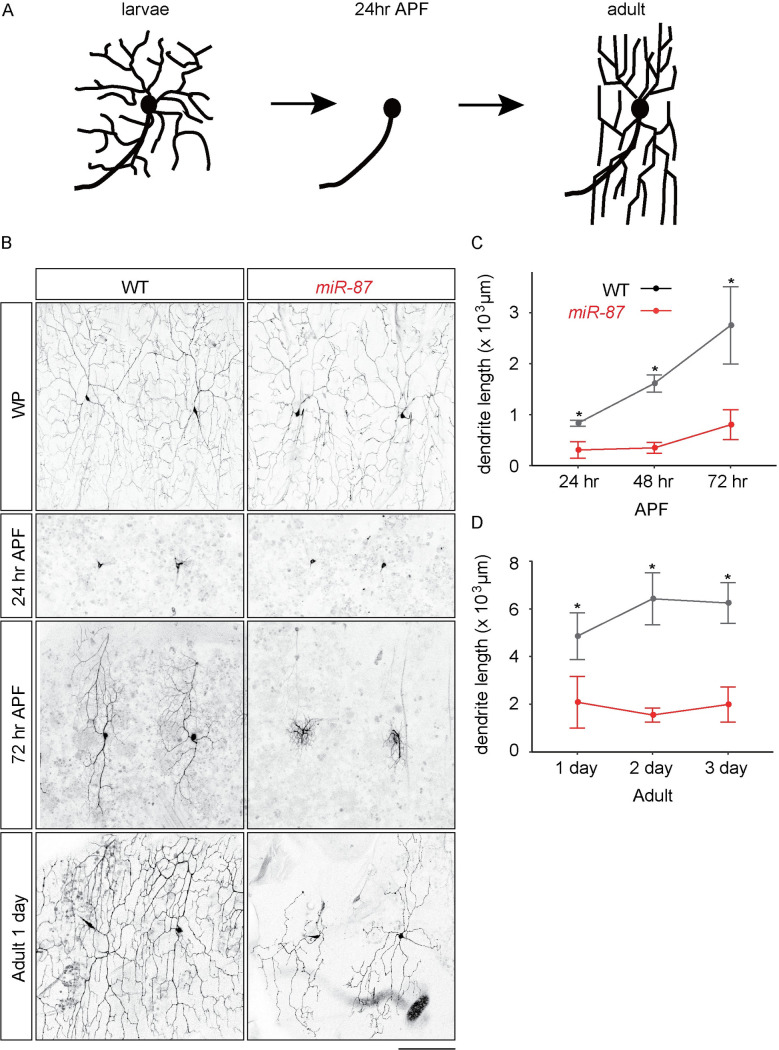
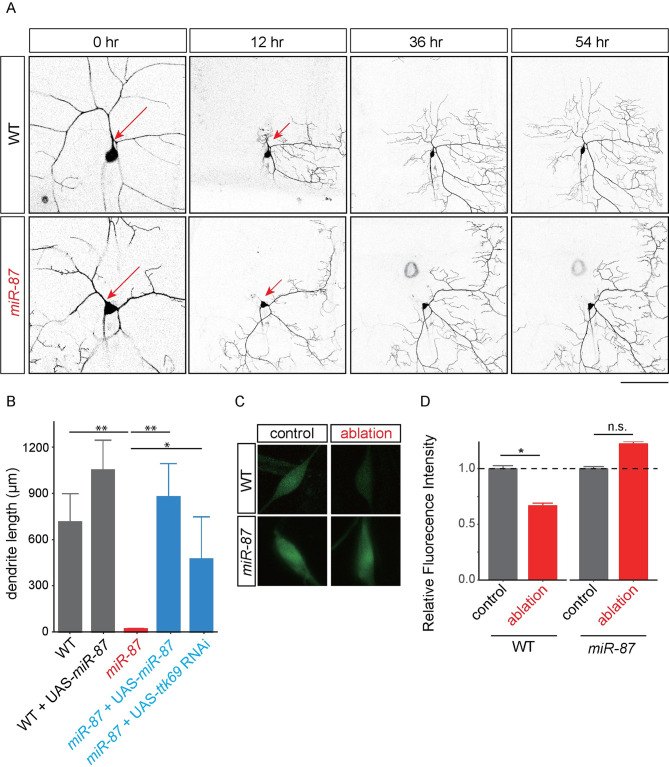
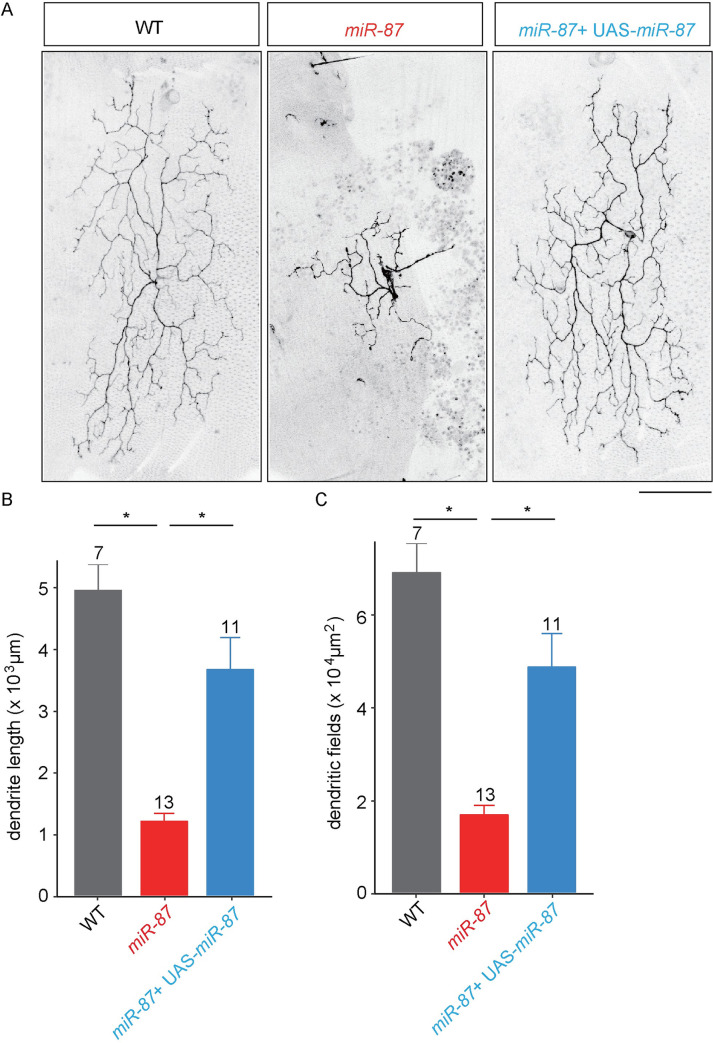
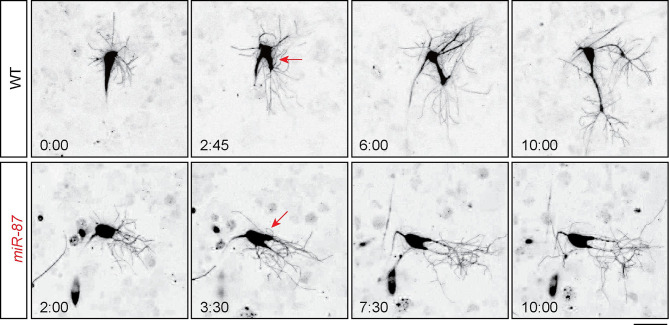
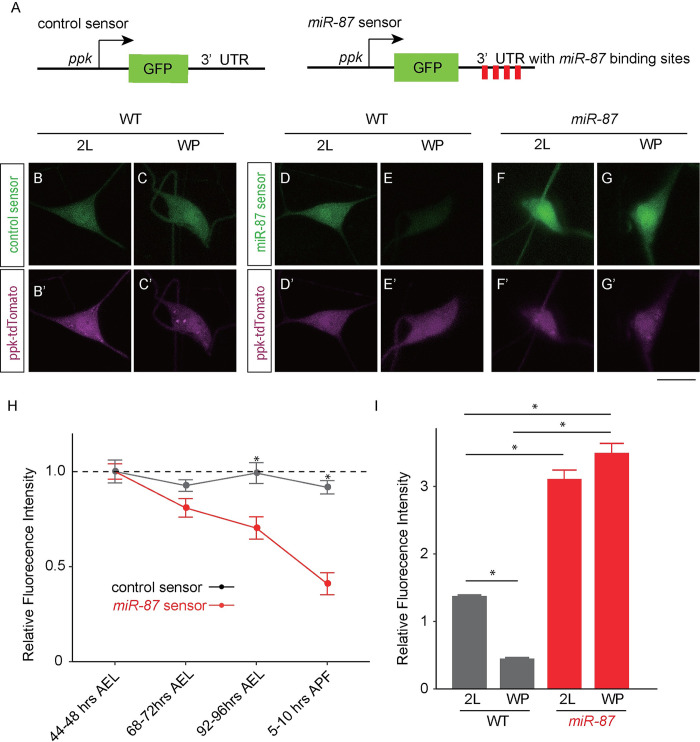
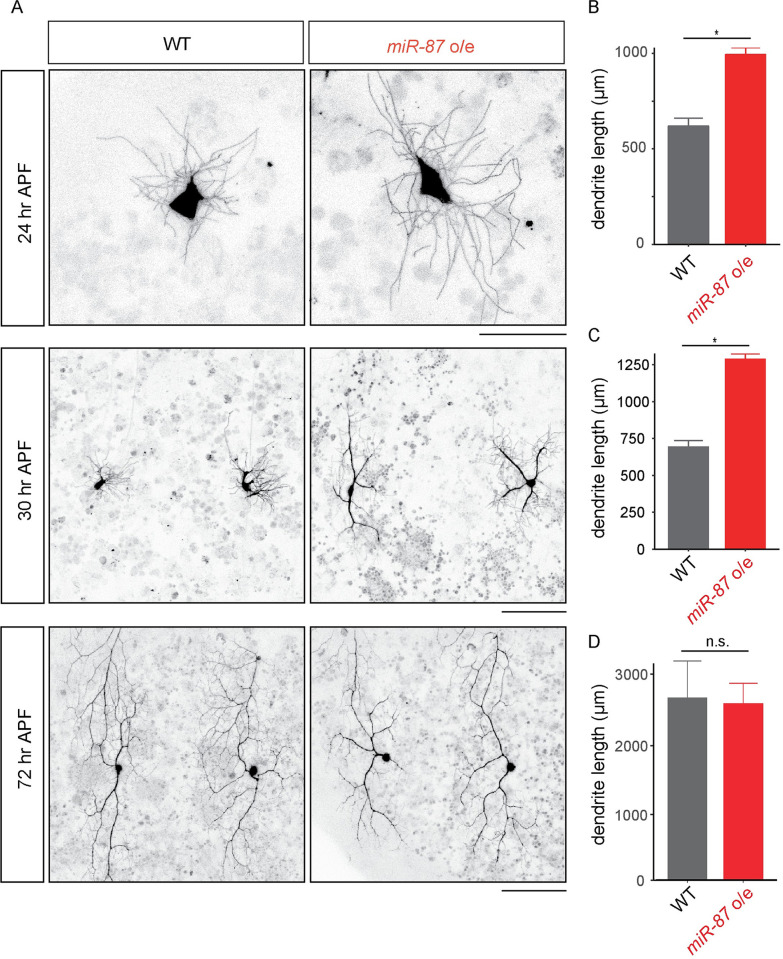
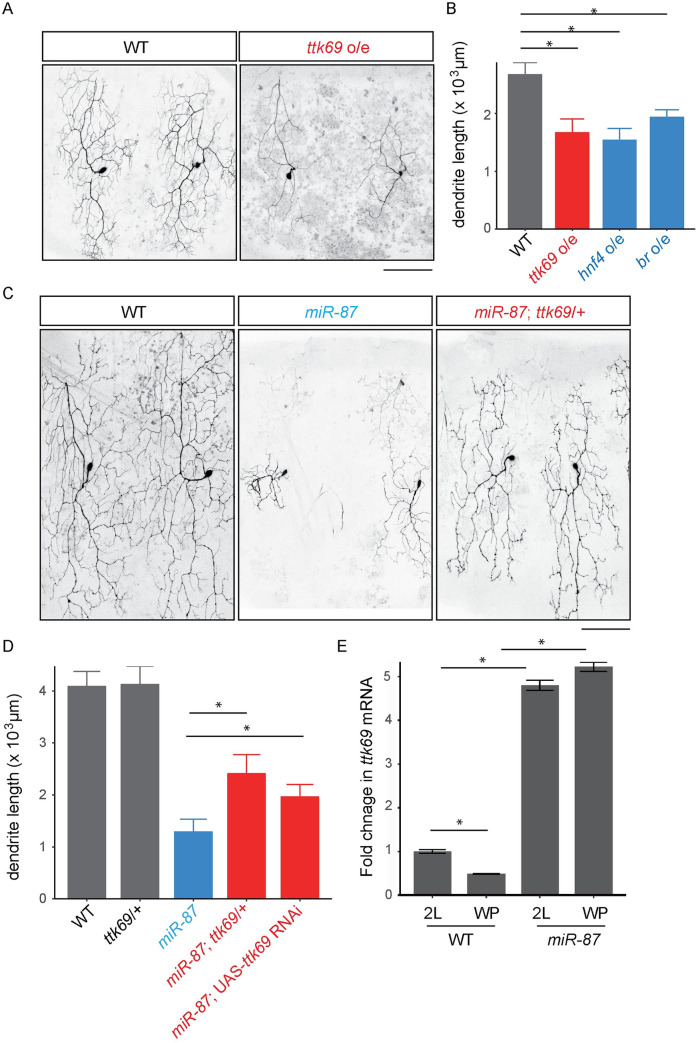
To remodel functional neuronal connectivity, neurons often alter dendrite arbors through elimination and subsequent regeneration of dendritic branches. However, the intrinsic mechanisms underlying this developmentally programmed dendrite regeneration and whether it shares common machinery with injury-induced regeneration remain largely unknown. Drosophila class IV dendrite arborization (C4da) sensory neurons regenerate adult-specific dendrites after eliminating larval dendrites during metamorphosis. Here we show that the microRNA miR-87 is a critical regulator of dendrite regeneration in Drosophila. miR-87 knockout impairs dendrite regeneration after developmentally-programmed pruning, whereas miR-87 overexpression in C4da neurons leads to precocious initiation of dendrite regeneration. Genetic analyses indicate that the transcriptional repressor Tramtrack69 (Ttk69) is a functional target for miR-87-mediated repression as ttk69 expression is increased in miR-87 knockout neurons and reducing ttk69 expression restores dendrite regeneration to mutants lacking miR-87 function. We further show that miR-87 is required for dendrite regeneration after acute injury in the larval stage, providing a mechanistic link between developmentally programmed and injury-induced dendrite regeneration. These findings thus indicate that miR-87 promotes dendrite regrowth during regeneration at least in part through suppressing Ttk69 in Drosophila sensory neurons and suggest that developmental and injury-induced dendrite regeneration share a common intrinsic mechanism to reactivate dendrite growth.
为了重塑功能性神经元连接,神经元通常通过消除和随后再生树突分支来改变树突树。然而,这种发育编程的树突再生的内在机制,以及它是否与损伤诱导的再生共享共同的机制,在很大程度上仍然未知。果蝇 IV 类树突分支(C4da)感觉神经元在变态期间消除幼虫树突后会再生成人特异性树突。在这里,我们表明 microRNA miR-87 是果蝇中树突再生的关键调节因子。miR-87 敲除会损害发育编程性修剪后的树突再生,而在 C4da 神经元中过表达 miR-87 会导致树突再生的过早起始。遗传分析表明,转录抑制剂 Tramtrack69(Ttk69)是 miR-87 介导的抑制的功能靶标,因为在 miR-87 敲除神经元中 ttk69 的表达增加,并且降低 ttk69 的表达可将缺乏 miR-87 功能的突变体中的树突再生恢复正常。我们进一步表明,miR-87 是幼虫阶段急性损伤后树突再生所必需的,为发育编程和损伤诱导的树突再生之间提供了一种机制联系。这些发现表明,miR-87 通过在果蝇感觉神经元中抑制 Ttk69 来促进再生过程中的树突再生,至少部分地表明发育和损伤诱导的树突再生共享一种共同的内在机制来重新激活树突生长。