Yin Xuan, Li Wei, Wu Huangan, Dong Bo, Ma Jie, Li Shanshan, Lao Lixing, Xu Shifen
Department of Acupuncture and Moxibustion, Shanghai Municipal Hospital of Traditional Chinese Medicine, Shanghai University of Traditional Chinese Medicine, Shanghai, 200071, People's Republic of China.
School of Basic Medicine, Guangzhou University of Chinese Medicine, Guangzhou, 510006, People's Republic of China.
Nat Sci Sleep. 2020 Jul 21;12:497-508. doi: 10.2147/NSS.S253320. eCollection 2020.
To evaluate the efficacy of electroacupuncture (EA) on treating insomnia in patients with depression.
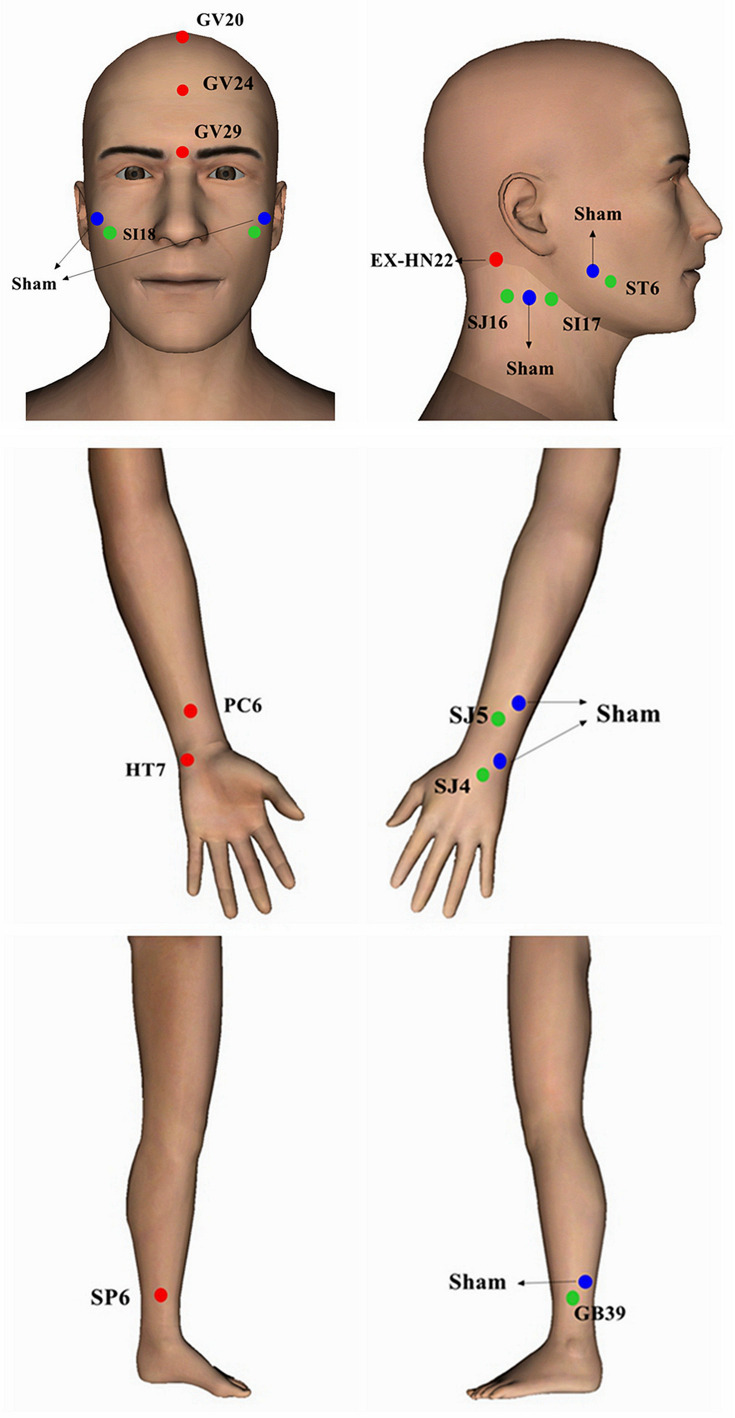
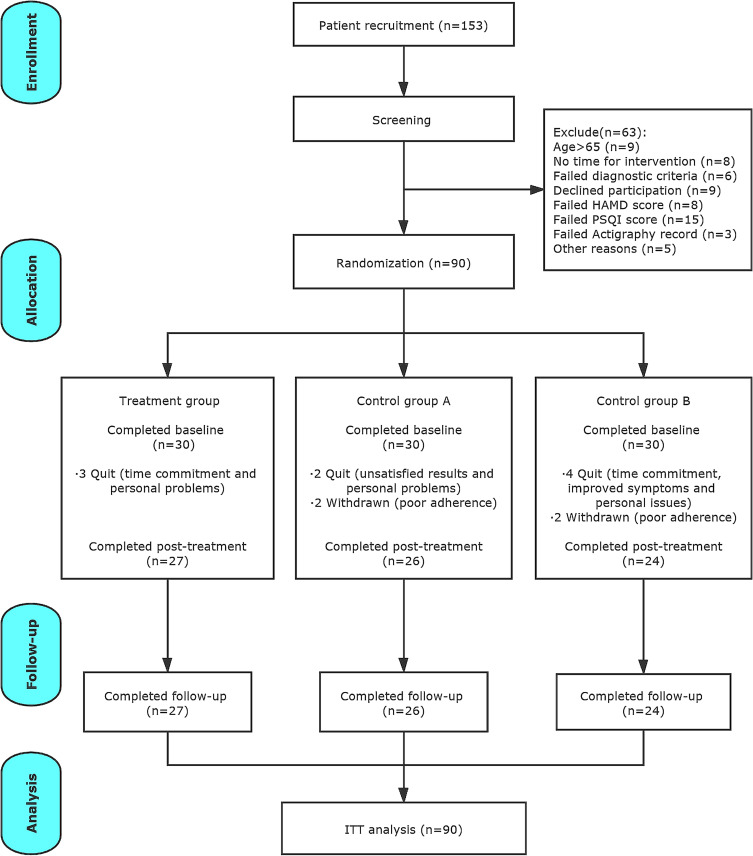
In a patient-assessor-blind, randomized and sham controlled trial, 90 depression patients with insomnia were assigned into three different groups, receiving EA in the treatment group, superficial acupuncture at sham points in the control group A, or Streitberger non-insertion sham acupuncture in the control group B. Treatment was applied 3 times weekly for 8 consecutive weeks. The primary outcome was measured using the Pittsburgh Sleep Quality Index (PSQI). Secondary outcomes were sleep parameters including sleep efficiency (SE), total sleep time (TST) and numbers of sleep awakenings (SA) recorded in the actigraphy, as well as applying the Hamilton Rating Scale for Depression (HAMD-17), Self-Rating Depression Scale (SDS) and Hamilton Rating Scale for Anxiety (HAMA). Assessments were performed at the baseline (week 0), week 4, week 8, and week 12. Linear mixed-effects models were used for analyses and all statistical tests were two-sided.
Patients in the EA group had more significant improvement in PSQI scores than those in the control groups over time (respectively <0.001 and =0.04 for treatment and time interaction). At 8-week posttreatment, the EA group reported a reduction of -6.64 points in PSQI scores compared with -2.23 points in the control group A (95% CI= -5.74 to -2.39) and -2.94 points in the control group B (95% CI= -5.73 to -2.47). Compared with the two control groups, significant between-group differences were seen in SE (both <0.01) and TST (both <0.01) at week 8; similar results can be found in HAMD-17, SDS, and HAMA scores as well. However, there were no between-group differences in SA (respectively =0.24 and =0.08) after 8-weeks of treatment.
Electroacupuncture may improve the sleep quality of patients with depression.
Chinese Clinical Trial Registry (ChiCTR); URL: http://www.chictr.org.cn/showproj.aspx?proj=12327; Trial ID: ChiCTR-IIR-16008058.
评估电针治疗抑郁症患者失眠症的疗效。
在一项患者及评估者双盲、随机、假针刺对照试验中,将90例伴有失眠症的抑郁症患者分为三组,治疗组接受电针治疗,A对照组在假穴位进行浅刺,B对照组采用 Streitberger 非针刺式假针刺。每周治疗3次,连续治疗8周。主要疗效指标采用匹兹堡睡眠质量指数(PSQI)进行测量。次要疗效指标为睡眠参数,包括通过活动记录仪记录的睡眠效率(SE)、总睡眠时间(TST)和睡眠觉醒次数(SA),同时应用汉密尔顿抑郁量表(HAMD-17)、自评抑郁量表(SDS)和汉密尔顿焦虑量表(HAMA)。在基线期(第0周)、第4周、第8周和第12周进行评估。采用线性混合效应模型进行分析,所有统计检验均为双侧检验。
随着时间推移,电针组患者的PSQI评分改善程度比对照组更显著(治疗与时间交互作用的P值分别为<0.001和=0.04)。治疗8周后,电针组PSQI评分降低6.64分,而A对照组降低了2.23分(95%CI = -5.74至-2.39),B对照组降低了2.94分(95%CI = -5.73至-2.47)。与两个对照组相比,在第8周时,电针组在SE(均<0.01)和TST(均<0.01)方面存在显著的组间差异;在HAMD-17、SDS和HAMA评分方面也有类似结果。然而,治疗8周后,三组在SA方面无组间差异(P值分别为=0.24和=0.08)。
电针可能改善抑郁症患者的睡眠质量。
中国临床试验注册中心(ChiCTR);网址:http://www.chictr.org.cn/showproj.aspx?proj=12327;试验注册号:ChiCTR-IIR-16008058。