Li Shaoyuan, Wang Yu, Gao Guojian, Guo Xiao, Zhang Yue, Zhang Zixuan, Wang Yifei, Zhang Jinling, Wang Junying, Li Liang, Yang Yongsheng, Rong Peijing
Institute of Acupuncture and Moxibustion, China Academy of Chinese Medical Sciences, Beijing, China.
China Academy of Chinese Medical Sciences, Beijing, China.
Front Neurosci. 2020 Jul 15;14:680. doi: 10.3389/fnins.2020.00680. eCollection 2020.
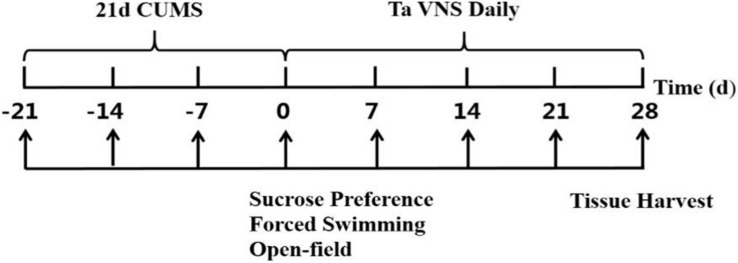
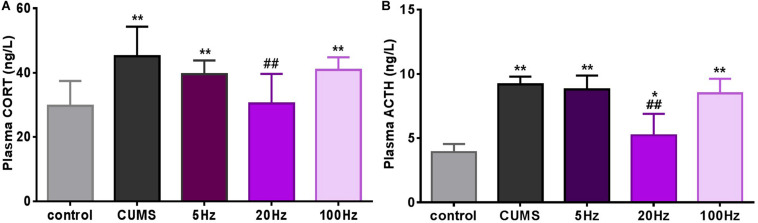
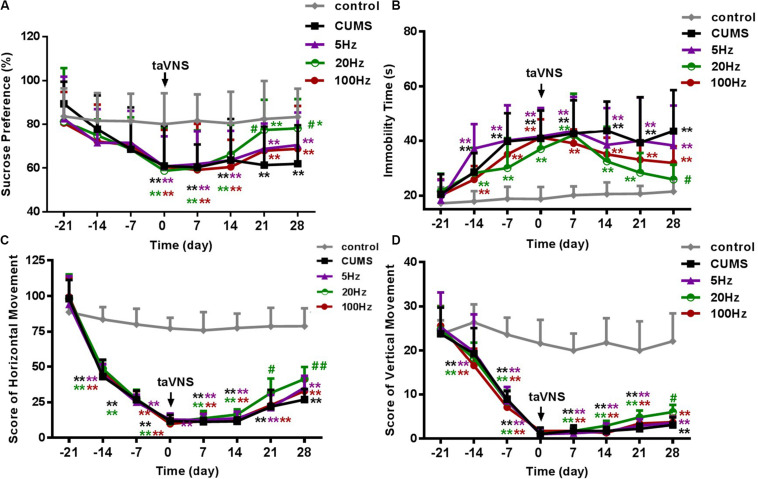
Transcutaneous auricular vagus nerve stimulation (taVNS) has gained growing interest as a non-invasive and non-pharmacologic treatment option in various neurological and psychiatric disorders. Animal experiments and clinical trials confirm that taVNS at the auricular concha region has beneficial effects on depression. However, stimulation frequencies are selected empirically, and there is no evidence showing that any frequency is superior to the others. This study explores antidepressant-like effects of three frequencies of taVNS on rats subjected to chronic unpredictable mild stress (CUMS). Sprague-Dawley rats were randomly divided into five groups, i.e., the control, CUMS, 5 Hz-taVNS, 20 Hz-taVNS, and 100 Hz-taVNS groups. The three different frequencies were administered during the 30-min taVNS procedure once a day for 28 consecutive days. Rats exposed to CUMS showed signs of depression-like behaviors, including reduction in sucrose preference and increased immobility time in forced swimming and open field tests as well as significant dysfunction of the hypothalamic-pituitary-adrenal (HPA) axis as detected by plasma corticosterone and adrenocorticotropic hormone concentration. The 28 days' taVNS sessions with three frequencies elicited quite different consequences. Although 20 Hz taVNS significantly reversed the depression-like behaviors and downregulated the hyperactivity of the HPA axis, neither 5 nor 100 Hz showed any antidepressant-like effect on CUMS-induced rat behavior. Based on these results, we propose that, out of the three frequencies for taVNS intervention on depression, 20 Hz may be the optimized frequency to have a better modulation effect on HPA axis function by activating the auricular vagus nerve.
经皮耳迷走神经刺激(taVNS)作为一种针对各种神经和精神疾病的非侵入性、非药物治疗选择,已越来越受到关注。动物实验和临床试验证实,在耳甲区域进行taVNS对抑郁症有有益影响。然而,刺激频率是凭经验选择的,没有证据表明任何一种频率优于其他频率。本研究探讨了三种频率的taVNS对遭受慢性不可预测轻度应激(CUMS)的大鼠的抗抑郁样作用。将Sprague-Dawley大鼠随机分为五组,即对照组、CUMS组、5 Hz-taVNS组、20 Hz-taVNS组和100 Hz-taVNS组。在每天一次、持续28天的30分钟taVNS过程中施加三种不同频率的刺激。暴露于CUMS的大鼠表现出抑郁样行为迹象,包括蔗糖偏好降低、在强迫游泳和旷场试验中不动时间增加,以及通过血浆皮质酮和促肾上腺皮质激素浓度检测到的下丘脑-垂体-肾上腺(HPA)轴明显功能障碍。三种频率的28天taVNS疗程产生了截然不同的结果。尽管20 Hz taVNS显著逆转了抑郁样行为并下调了HPA轴的亢进,但5 Hz和100 Hz对CUMS诱导的大鼠行为均未显示出任何抗抑郁样作用。基于这些结果,我们提出,在用于抑郁症干预的taVNS三种频率中,20 Hz可能是通过激活耳迷走神经对HPA轴功能具有更好调节作用的优化频率。