Chen Zhen, Padmanabhan Krishnan
Department of Brain and Cognitive Sciences, University of Rochester, Rochester, NY, United States.
Department of Neuroscience, University of Rochester School of Medicine and Dentistry, Rochester, NY, United States.
Front Comput Neurosci. 2020 Jul 13;14:59. doi: 10.3389/fncom.2020.00059. eCollection 2020.
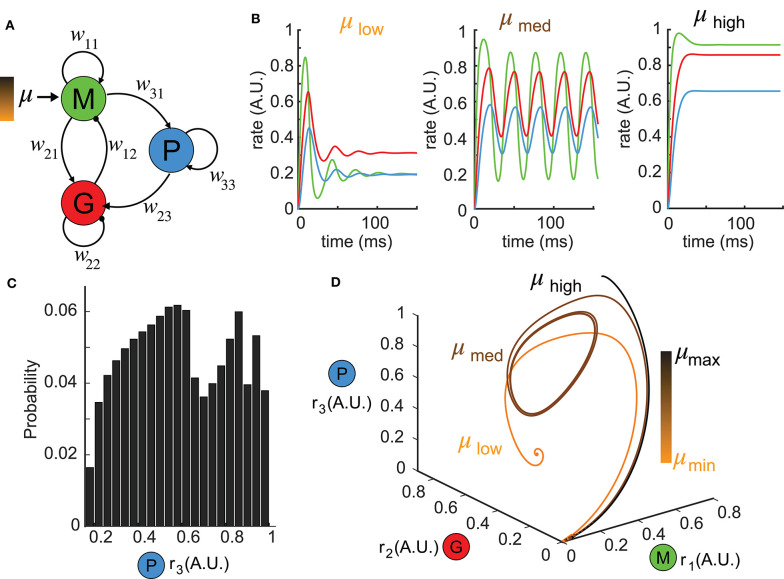
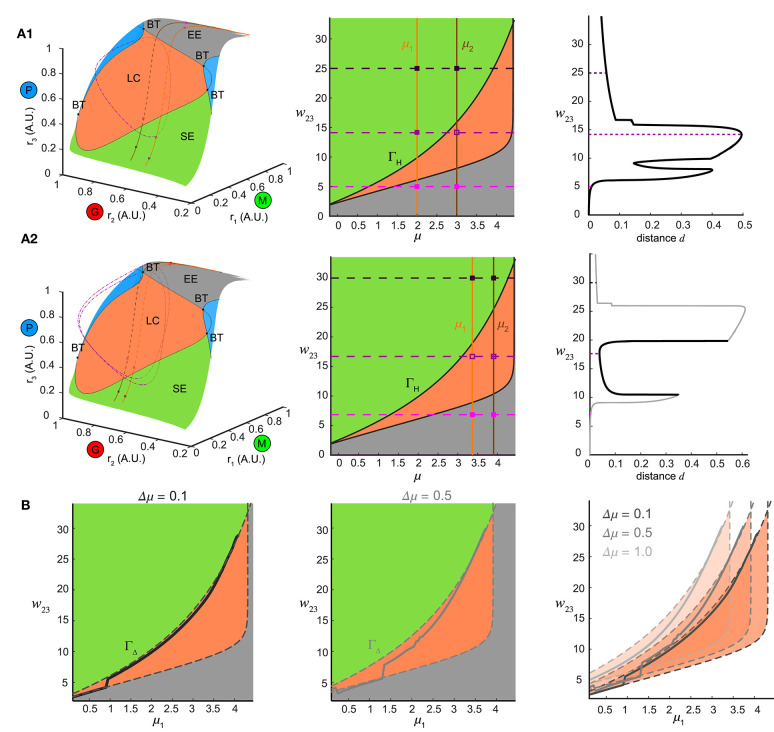
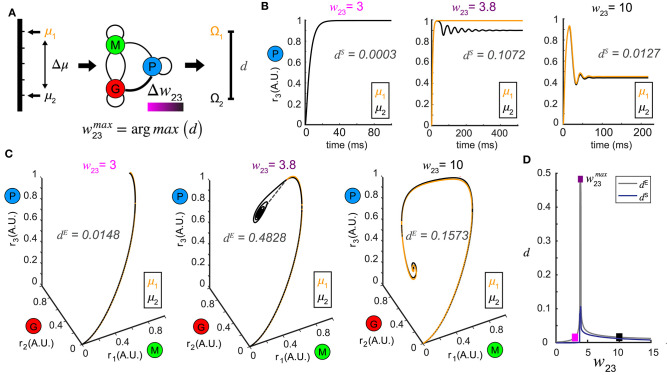
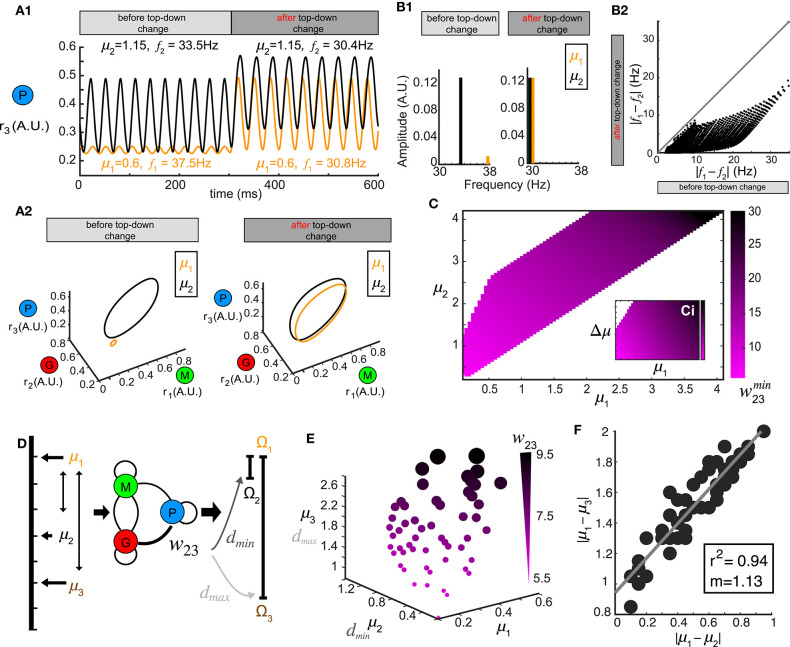
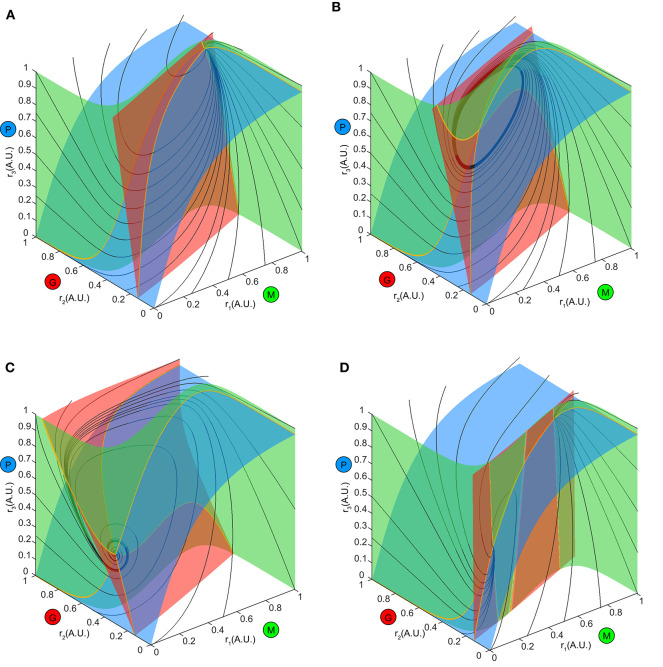
Growing evidence shows that top-down projections from excitatory neurons in piriform cortex selectively synapse onto local inhibitory granule cells in the main olfactory bulb, effectively gating their own inputs by controlling inhibition. An open question in olfaction is the role this feedback plays in shaping the dynamics of local circuits, and the resultant computational benefits it provides. Using rate models of neuronal firing in a network consisting of excitatory mitral and tufted cells, inhibitory granule cells and top-down piriform cortical neurons, we found that changes in the weight of feedback to inhibitory neurons generated diverse network dynamics and complex transitions between these dynamics. Changes in the weight of top-down feedback supported a number of computations, including both pattern separation and oscillatory synchrony. Additionally, the network could generate gamma oscillations though a mechanism we termed op-down control of nhibitory euron amma (TING). Collectively, these functions arose from a codimension-2 bifurcation in the dynamical system. Our results highlight a key role for this top-down feedback, gating inhibition to facilitate often diametrically different computations.
越来越多的证据表明,梨状皮层兴奋性神经元的自上而下投射选择性地与主嗅球中的局部抑制性颗粒细胞形成突触,通过控制抑制作用有效地控制自身输入。嗅觉领域一个悬而未决的问题是,这种反馈在塑造局部回路动态以及由此产生的计算益处中所起的作用。通过使用由兴奋性的僧帽细胞和簇状细胞、抑制性颗粒细胞以及自上而下的梨状皮层神经元组成的网络中的神经元放电速率模型,我们发现对抑制性神经元的反馈权重变化会产生多样的网络动态以及这些动态之间的复杂转变。自上而下反馈权重的变化支持了多种计算,包括模式分离和振荡同步。此外,该网络可以通过一种我们称为“抑制性神经元γ振荡的自上而下控制”(TING)的机制产生γ振荡。总体而言,这些功能源于动态系统中的二维余维分岔。我们的结果突出了这种自上而下反馈的关键作用,即通过控制抑制作用来促进通常截然不同的计算。