Sandeep Bhushan, Huang Xin, Li Yuan, Mao Long, Gao Ke, Xiao Zongwei
Department of Surgery, Chengdu Second People's Hospital, Chengdu, Sichuan 610017, China.
Department of Anesthesiology, Chengdu Second People's Hospital, Chengdu Sichuan 610017, China.
Gastroenterol Res Pract. 2020 Jul 13;2020:7378215. doi: 10.1155/2020/7378215. eCollection 2020.
Gastric cancer is usually an age-related disease and mostly diagnosed after the sixth decade of life, though it may also be diagnosed earlier.
The aim of this study is to explore the clinicopathological characteristics and prognosis of gastric carcinoma in young patients.
A total of 1379 patients younger than 75 years histologically diagnosed with primary gastric carcinoma underwent gastrectomy. Patients were categorized into three groups based on their age which included young age group (≤40 years), middle-aged group (age 41-60 years), and elderly group (age 61-75 years). The young age group was further subdivided into two groups: Group A (age ≤35 years) and Group B (age 35-40 years). The analysis of the clinicopathological characteristics and prognosis followed thereafter.
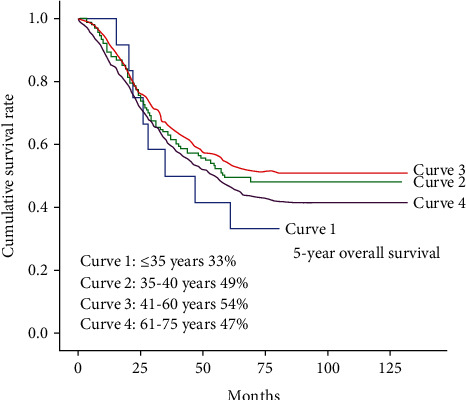
Females predominate in young group ( < 0.001). A significantly higher undifferentiated histological pattern was found in the young age group from the other two groups ( < 0.001). Tumor location in the lower third of the stomach was significantly higher in the young group than the other groups ( < 0.001). T4 stage was common in young patients similar to the middle and old age group ( = 0.049). Distal gastrectomy was performed more in the young age group rather than the middle and old age groups with the following percentage ratios: young group 74.5% (123/165), middle age group 59.9% (429/716), and old age group 52.2% (260/498) ( < 0.001). The 5-year overall survival rate of the young, middle, and old age groups were 46%, 48%, and 39%, respectively, whereas the 5-year overall survival rates of the subgroups of young patients, Group A and Group B, were 33% and 49%, respectively. Multivariate analysis revealed that independent negative prognostic factors were as follows: tumor location (L), = 0.016, OR = 0.795, 95%CI = [0.659; 0.959]; larger tumor size, = 0.026, OR = 1.727, 95%CI = [1.067; 2.797]; resection margin, < 0.001, OR = 2.167, 95%CI = [1.751; 2.682]; tumor stage (T4), < 0.001, OR = 2.572, 95%CI = [1.709; 3.870]; and nodal involvement N1, = 0.005, OR = 1.506, 95%CI = [1.123; 2.020]; N2, < 0.001, OR = 1.708, 95%CI = [1.289; 2.263]; and N3, < 0.001, OR = 2.986, 95%CI = [2.314; 3.854].
The young age groups of patients were predominantly female and had a higher proportion of poorly differentiated and undifferentiated type of tumor; moreover, patients aged <35 years had a poor prognosis. In addition, gastric cancer can occur in patients less than 30 years old, and symptoms suggestive of gastric cancer should be investigated aggressively; therefore, a close scrutiny and monitoring should be done in younger patients especially those associated with high-risk factors which could indicate the presence of the disease at an early stage.
胃癌通常是一种与年龄相关的疾病,大多在60岁以后被诊断出来,不过也可能更早被诊断。
本研究旨在探讨年轻患者胃癌的临床病理特征及预后。
对1379例年龄小于75岁、经组织学诊断为原发性胃癌的患者进行了胃切除术。根据年龄将患者分为三组,包括青年组(≤40岁)、中年组(41 - 60岁)和老年组(61 - 75岁)。青年组进一步细分为两组:A组(年龄≤35岁)和B组(年龄35 - 40岁)。随后对临床病理特征及预后进行分析。
青年组女性居多(<0.001)。青年组未分化组织学类型显著高于其他两组(<0.001)。青年组胃下1/3的肿瘤位置显著高于其他组(<0.001)。青年患者T4期与中老年组相似常见(=0.049)。青年组远端胃切除术的比例高于中老年组,具体百分比为:青年组74.5%(123/165),中年组59.9%(429/716),老年组52.2%(260/498)(<0.001)。青年、中年和老年组的5年总生存率分别为46%、48%和39%,而青年患者亚组A组和B组的5年总生存率分别为33%和49%。多因素分析显示独立的负性预后因素如下:肿瘤位置(L),=0.016,OR = 0.795,95%CI = [0.659; 0.959];肿瘤较大,=0.026,OR = 1.727,95%CI = [1.067; 2.797];切缘,<0.001,OR = 2.167,95%CI = [1.751; 2.682];肿瘤分期(T4),<0.001,OR = 2.572,95%CI = [1.709; 3.870];以及淋巴结转移N1,=0.005,OR = 1.506,95%CI = [1.123; 2.020];N2,<0.001,OR = 1.708,95%CI = [1.289; 2.263];N3,<0.001,OR = 2.986,95%CI = [2.314; 3.854]。
青年组患者以女性为主,低分化和未分化肿瘤比例较高;此外,年龄<35岁的患者预后较差。另外,胃癌可发生于30岁以下患者,对于提示胃癌的症状应积极检查;因此,对于年轻患者尤其是那些有高危因素的患者应密切检查和监测,这可能有助于早期发现疾病。
