Alipour Meysam, Rostami Hosein, Parastouei Karim
Health Research Center, Life Style Institute, Baqiyatallah University of Medical Sciences, Tehran, Iran.
J Res Med Sci. 2020 May 22;25:46. doi: 10.4103/jrms.JRMS_429_19. eCollection 2020.
The role of inflammatory states in cardiometabolic risks among patients with type 2 diabetes mellitus (T2DM) with similar degrees of obesity is unknown. The study aimed to compare cardiometabolic risk factors in inflammatory obesity phenotypes with regard to the role of the rs9939609 gene polymorphism.
This study was performed on 155 patients with T2DM (77 men and 78 women) in Ahvaz, Iran. Participants were grouped into four groups based on the presence of obesity and inflammation (high-sensitivity C-reactive protein ≥3.9 mg/L): low inflammatory normal weight (LINW), high inflammatory normal weight (HINW), low inflammatory obese (LIO), and high inflammatory obese (HIO). The genotypes of rs9939609, including homozygous carriers of the risk allele (AA), heterozygous carriers (AT), and carrying no risk allele (TT), were studied. The cardiometabolic risk factors, including anthropometric status, hypertension, lipid and glycemic profile, and inflammatory markers, were evaluated. The waist-hip ratio (WHR), mean arterial pressure (MAP), and atherogenic index of plasma (AIP) were calculated.
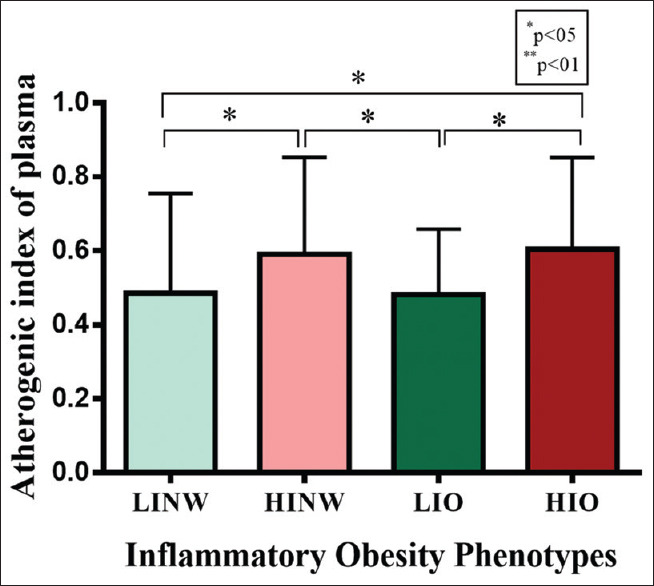
The patients in inflammatory groups (HINW and HIO) have significantly higher levels in AIP when compared to inflammatory healthy groups (LINW and LIO). No significant differences between any of the four group means were detected in WHR, blood pressure, MAP, glycemic status (fasting blood sugar and insulin), homeostatic model assessment, lipid profile (triglyceride, very low-density lipoprotein, high-density lipoprotein, low-density lipoprotein, and cholesterol), interleukin-6, and total antioxidant capacity. The most frequent of high-risk genotype (AA) of rs9939609 was in HIO, LIO, HINW, and LINW.
T2DM patients with inflammatory condition have similar degree of increased atherogenic risk irrespective of obesity. The obesity-risk genotype AA of gene was associated with an increased risk for inflammatory obesity in T2DM patients.
炎症状态在肥胖程度相似的2型糖尿病(T2DM)患者的心脏代谢风险中的作用尚不清楚。本研究旨在比较炎症性肥胖表型中的心脏代谢危险因素,探讨rs9939609基因多态性的作用。
本研究对伊朗阿瓦士的155例T2DM患者(77例男性和78例女性)进行。参与者根据肥胖和炎症的存在情况(高敏C反应蛋白≥3.9mg/L)分为四组:低炎症正常体重(LINW)、高炎症正常体重(HINW)、低炎症肥胖(LIO)和高炎症肥胖(HIO)。研究了rs9939609的基因型,包括风险等位基因纯合携带者(AA)、杂合携带者(AT)和无风险等位基因携带者(TT)。评估了心脏代谢危险因素,包括人体测量状况、高血压、血脂和血糖谱以及炎症标志物。计算了腰臀比(WHR)、平均动脉压(MAP)和血浆致动脉粥样硬化指数(AIP)。
与炎症健康组(LINW和LIO)相比,炎症组(HINW和HIO)患者的AIP水平显著更高。在WHR、血压、MAP、血糖状态(空腹血糖和胰岛素)、稳态模型评估、血脂谱(甘油三酯、极低密度脂蛋白、高密度脂蛋白、低密度脂蛋白和胆固醇)、白细胞介素-6和总抗氧化能力方面,四组均值之间未检测到显著差异。rs9939609的高危基因型(AA)在HIO、LIO、HINW和LINW中最为常见。
无论肥胖与否,患有炎症的T2DM患者发生动脉粥样硬化风险增加的程度相似。该基因的肥胖风险基因型AA与T2DM患者炎症性肥胖风险增加有关。