Department of Zoology, University of Oxford, Oxford, United Kingdom.
Avian Influenza Group, The Pirbright Institute, Woking, United Kingdom.
Front Public Health. 2020 Jul 10;8:344. doi: 10.3389/fpubh.2020.00344. eCollection 2020.
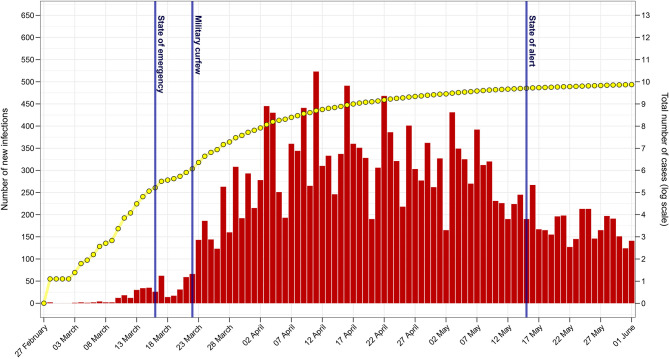
In the context of the COVID-19 pandemic, countries around the world varied in the strength and timeliness of their responses. In Romania, specific challenges were faced with regards to managing the spread and limiting the impact of the disease, ranging from healthcare infrastructure to demographic and sociocultural aspects. As the country has a sizeable diaspora, major difficulties were faced when large numbers of individuals from highly affected areas returned to Romania. However, the fast implementation of control measures successfully averted a surge in the number of COVID-19 cases. This delayed the overburdening of an already challenged healthcare system during the initial phases of the epidemic. Furthermore, early control was facilitated by the exploitation of communication channels that penetrated all layers of society, from ordinary citizens to governmental authorities and high-ranking religious figures. The management of the COVID-19 crisis in Romania illustrates the importance of a fast initial response which takes into account the role played by sociocultural aspects in the context of an epidemic. As the challenges faced by Romania are not unique, these results could inform future public health strategies worldwide.
在 COVID-19 大流行的背景下,世界各国的应对力度和及时性存在差异。在罗马尼亚,在管理疾病的传播和限制其影响方面,存在着从医疗保健基础设施到人口和社会文化方面的具体挑战。由于该国拥有庞大的侨民群体,因此当大量来自受影响严重地区的人返回罗马尼亚时,面临着重大困难。然而,控制措施的快速实施成功地避免了 COVID-19 病例数的激增,从而在疫情的初始阶段避免了医疗系统的超负荷运转。此外,通过利用从普通公民到政府当局和高级宗教人物等各个层面的社会沟通渠道,早期控制得到了促进。罗马尼亚 COVID-19 危机的管理说明了快速初始反应的重要性,该反应考虑了在疫情背景下社会文化因素所发挥的作用。由于罗马尼亚面临的挑战并非独一无二,因此这些结果可以为全球未来的公共卫生战略提供信息。